





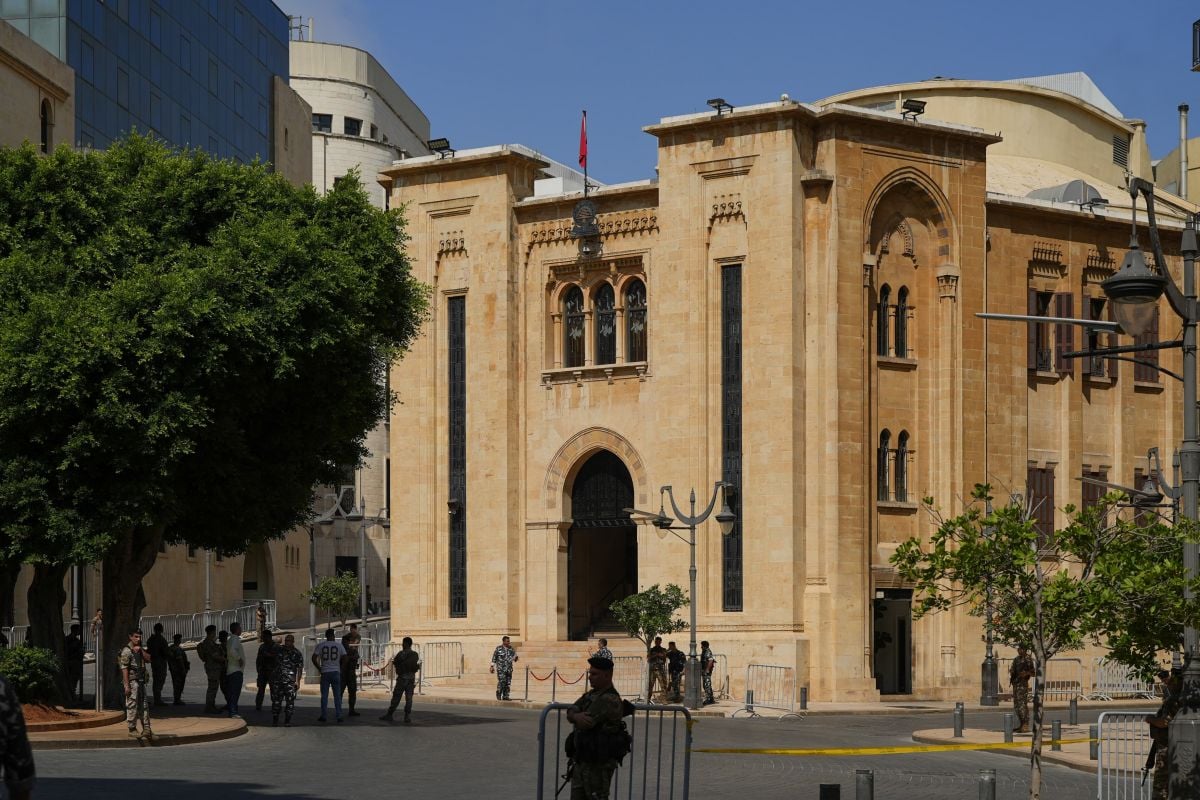
Lebanese soldiers in front of the Parliament building, on June 30, 2025, at Place de l'Étoile in Beirut. (Credit: Mohammad Yassin/L'Orient Today)






BEIRUT — One year before legislative elections, MPs are pushing for the 2017 expatriate voting bill, which as of yet has not been applied, to be amended, sparking heated debate among parties and a walk-out by several blocs during the Parliament meeting on Monday. The meeting was adjourned at around 2:30 p.m. and was supposed to resume at 6 p.m., but was finally postponed until Tuesday due to a lack of quorum.
Lebanese Forces (LF) and Kataeb MPs and several independents left the chamber in protest of Parliament Speaker Nabih Berri refusal to add their proposal to the agenda under an accelerated procedure. Despite their departures, quorum was not lost and the meeting continued.
Carrying on with the agenda, MPs adopted an amendment — approved by the government in early March — to the state budget, lowering tariffs in a move encouraged in particular by the president of the parliamentary Finance Committee, Ibrahim Kanaan, who denounced "problematic gaps and increases for citizens" in the budget.
MPs also endorsed the signing of two loan agreements with the International Bank for Reconstruction and Development (IBRD, affiliated with the World Bank). The first is intended to support the reform of the electricity sector in Lebanon by financing rehabilitation projects for the network, partially destroyed by Israel during its war against Hezbollah, and the second to finance the green transition in the agro-industry sector, which includes adhering to the Madrid Protocol on the international registration of trademarks.
Parliament had convened on Monday morning as part of the extraordinary session agreed upon by President Joseph Aoun and Prime Minister Nawaf Salam from June 5 to Oct. 20, outside of the usual two sessions held annually.
The expatriates' vote
The contentious bill, put forward by a coalition of MPs, aimed to amend the electoral law so as to have Lebanese abroad vote in the same manner as residents: for the 128 deputies of the Parliament instead of just the six seats reserved to represent the diaspora in different continents.
Upon leaving the chamber, Kataeb leader Samy Gemayel said the move was meant to "show our insistence" that expatriates have their votes cast within the constituencies of their families' village or city of origin in Lebanon. "It is the first time in 30 years that a bill designated as double urgent is presented without being on the agenda," LF MP Georges Adwan pointed out.
Shortly before the legislative session began, MP Michel Moawad warned that he "will leave the session if the point relating to expatriate voting is not included on the agenda," denouncing "a double crime, both against the Lebanese diaspora and against the Parliament."
LF MP Georges Okais added his voice to the warning, saying that "if the Speaker does not include the electoral law proposal on the agenda, he will go against the will of the majority of MPs, since a petition was signed by over 65 parliamentarians."
To this, Berri replied: "We have not received this petition. When it arrives, we will handle it according to the rules. Do not threaten me; the meeting will be held, with or without threat."
LF MP Melhem Riachi acknowledged "divergences and disagreements" around the proposed amendment for the 2026 elections, but said his party was "trying to reconcile as much as possible, and may the best win."
Progressive Socialist Party MP Hadi Abou el-Hosn expressed being "in favor of adding the amendment to the agenda" but specified that his party would not leave the chamber, declaring, "We have always refused to hinder legislative work."
In an interview on MTV, Progressive Socialist Party MP Hadi Abou el-Hosn said that he is "in favor of adding the electoral law amendment to the agenda," while specifying that his group would not leave Parliament if this request were not accepted. "We have always refused to hinder legislative work," he emphasized.
Vice President of Parliament Elias Bou Saab had warned ahead of time that the meeting could be marked by intense debate. "The request to include the proposal with a double urgency nature to the electoral law is a political act, and this point is not currently on the agenda of the session," he said.
However, a walk-out from parliamentary groups would constitute a "legitimate political choice," he added. "If the quorum is broken, the session will be adjourned."
The 2017 electoral law provides for six parliamentary seats reserved for the diaspora (one per continent), in addition to the existing 128. However, this measure has never been applied: in 2018 and 2022, expatriates voted according to their original constituencies in Lebanon.
For the 2026 election, Parliament Speaker Nabih Berri is seeking to apply the provision of the six dedicated seats (one Sunni, one Shia, one Druze, one Maronite, one Greek Catholic, and one Greek Orthodox). Lebanese Forces leader Samir Geagea, on the other hand, rejects this idea, arguing that emigrants should vote in their home regions to fully participate in national life.
Monday's meeting also includes addressing a law granting a monthly subsidy to active military personnel (14 million Lebanese pounds, or $156 at the market rate) and veterans (12 million, or $134), as well as draft laws on the professions of radiological sciences, pharmacy, commercial leases, and empowering municipalities.
Teachers' and tenants' sit-in
Outside the Parliament buildings, public political engagement was full swing since morning, with contractual teachers with the Ministry of Education (primary, secondary, technical) holding a sit-in, demanding they be included in the draft law providing a monthly allowance of 12 million pounds, similar to retired military personnel, pending comprehensive and equitable pension reform.
Teachers have been advocating since 2019 for an increase in their pensions, which have been significantly reduced by the collapse of the Lebanese pound.
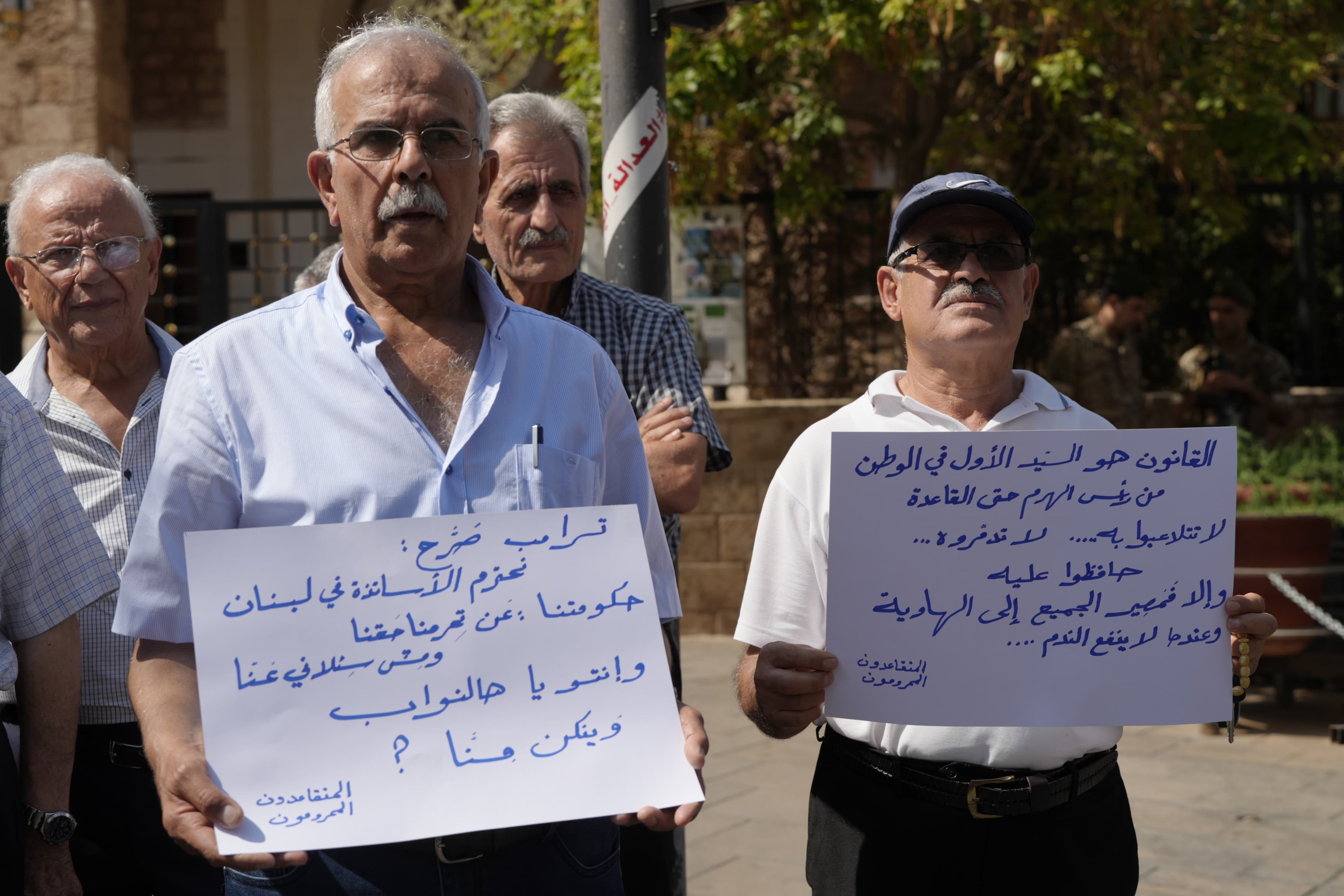
At 11 a.m., another gathering began at the call of the Committee for the Defense of Tenants' Rights in Lebanon, to denounce the commercial leases law, which affects old leases of shops, offices, or factories signed before 1992.
A similar demonstration took place in Saida simultaneously, according to the state-run National News Agency. The text foresees a gradual liberalization of these leases over four years. While property owners view it as a measure of economic justice after decades of freezing, tenants decry it as a decision threatening their right to home and work space.
Adopted in December 2023 while the country was without a president, the law was published in April 2025, before being annulled in May by the Constitutional Council following an appeal by President Joseph Aoun for procedural flaws.

 Evening recap: Netanyahu announces West Bank offensive; 7 killed in Jordan church shooting; tents burned in south Lebanon
 US strike on Iran this weekend? ‘Absolutely,’ says Barrack; ‘I have no idea,’ says Trump