






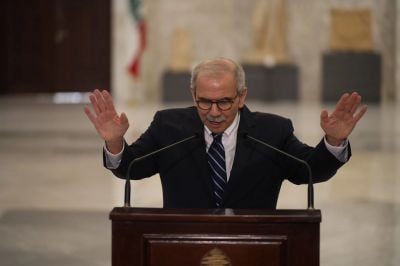
Prime Minister Nawaf Salam in Baabda on January 14, 2024. (Credit: Mohammad Yassine/L'Orient-Le Jour.)






BEIRUT — On the occasion of the 100th day since his government received parliamentary confidence, Lebanese Prime Minister Nawaf Salam gave a preliminary assessment of his actions, emphasizing his team's determination to implement necessary reforms despite numerous obstacles.
"I assure you of our determination to implement our program, despite the obstacles and difficulties in our path," declared Salam in a televised speech delivered on the eve of the Adha festival.
Recalling the severity of the situation upon his assuming power in a country ravaged by "five years of crises worsened by Israeli aggression," the head of government stressed that "the salvation" of Lebanon "is not possible without a true reform process to establish a modern state, regain the trust of Lebanese people, Arab countries, and the international community, and achieve sustainable economic and social recovery."
Dismantling of more than 500 military positions
In terms of security, Salam assured that "the state continues its mission, as provided for by the Taif Agreement, to extend its authority over the entire Lebanese territory and reserve weapons for legal institutions." "The Lebanese army has so far dismantled more than 500 military sites south of the Litani," he said.
However, the head of government warned: "We will not achieve stability as long as Israeli violations persist, the occupation of certain lands continues, and our prisoners are not released." "We will continue to press for a total Israeli withdrawal, in accordance with U.N. resolution 1701, to rebuild what has been destroyed, and to allow the dignified return of our displaced inhabitants," he assured.
He also indicated that the state's authority has been strengthened at the Beirut airport. "We have implemented administrative, technical, and security changes, removed partisan images, and arrested those who attacked UNIFIL forces," the United Nations Interim Force in Lebanon, highlighted Salam.
Regarding the Lebanese-Syrian border, he indicated the establishment of joint committees with Damascus to "control the borders, combat smuggling, and prepare delimitation" of the borders. The head of government also stated he is working with Syrian authorities and international bodies to ensure a "dignified and secure return of Syrian refugees."
'Against the very idea of deposit cancellation'
On the economic front, Nawaf Salam defended an approach based on transparency and restoring confidence. "We have lifted banking secrecy [...] and approved the draft law on banking sector restructuring," he recalled. "Our economic vision is not based on illusions, but on correcting past mistakes and reforming our financial and banking system.
He added that the government is finalizing a law concerning the distribution of losses, which is "essential to render justice and recover citizens' deposits."
In this regard, Salam emphatically said, "I repeat clearly: I am against the very idea of deposit cancellation. This is an ethical, constant, and unambiguous position." "Our goal is not to destroy the banks but to rehabilitate a healthy sector that serves the economy and the people," he added.
Negotiations with the International Monetary Fund (IMF) "are progressing seriously," he affirmed. "The IMF is neither an enemy nor a savior, but a tool we must use with discernment."
Institutional reforms: "Let justice do its work"
Salam reminded that several institutional reforms are underway, with his priorities being to "restore the administration's credibility and strengthen judicial independence." In this context, he recalled that the government had adopted a draft law on the independence of the judiciary and launched an initiative to expedite trials of detainees in Lebanese prisons, notably in Roumieh. He took the opportunity to reaffirm the need to resume the investigation into the Beirut port explosion. "Let justice do its work," he said.
He also mentioned the establishment of a new recruitment mechanism in the public sector, based on "transparency and merit," as well as the appointment of new members to head the Council for Development and Reconstruction (CDR).
The Prime Minister also touched on the fight against corruption in public properties, notably with "the suspension of illegal quarry extensions."
Reconstruction and the future
In terms of reconstruction, Nawaf Salam announced obtaining a $250 million loan from the World Bank and launching projects with U.N. agencies worth over $350 million for the South.
He concluded by announcing two major events: "In the coming months, we will organize an international conference for reconstruction and another to attract investments."
The Prime Minister emphasized the need to strengthen Lebanon's regional anchoring, recalling that "the president has made several visits abroad to put Lebanon back on the regional and international map. For my part, I have visited Saudi Arabia, Syria, the United Arab Emirates, and represented Lebanon at the Arab summit in Baghdad. These initiatives aim to rekindle our role in our Arab environment and to open a new page of constructive cooperation."
He also notably mentioned "a tourism strategy to encourage the return of visitors, particularly those from the Gulf countries."
Public services: 'What we are doing is not an achievement'
In the field of public services, the head of government cited several goals, including "reforming the electricity sector with a plan for production, distribution, and renewable energies," as well as an effort to "improve the quality of telecommunications." He also announced "additional funding for the Aman program, which currently benefits nearly 800,000 vulnerable people." The government, he added, is also working on "a sustainable solution for civil servants' salaries, pensions, and retirements."
On the political side, Salam welcomed the organization, "for the first time in nine years, of neutral municipal and local elections," as well as the launch of preparations for the next legislative elections.
Additionally, the Prime Minister highlighted growth projects "based on support for agriculture, industry, digital technology, culture, and education." He recalled the ongoing rehabilitation of the Camille Chamoun Sports City, emphasizing the development of "all regions of the country in a balanced manner." "I have personally visited the South, the Bekaa, the North, and revived the Rene Moawad Airport project in Qlayaat," he said, noting that a master plan is being developed, followed by a feasibility study.
"What we are doing is not an achievement, but the minimum to regain the confidence of the Lebanese people and give them back a dignified life," assured Salam. "It is our duty, and we will fulfill it to the last minute. As during these first 100 days, nothing will drive us back from our mission of reform, and we will continue to work to save Lebanon."

