






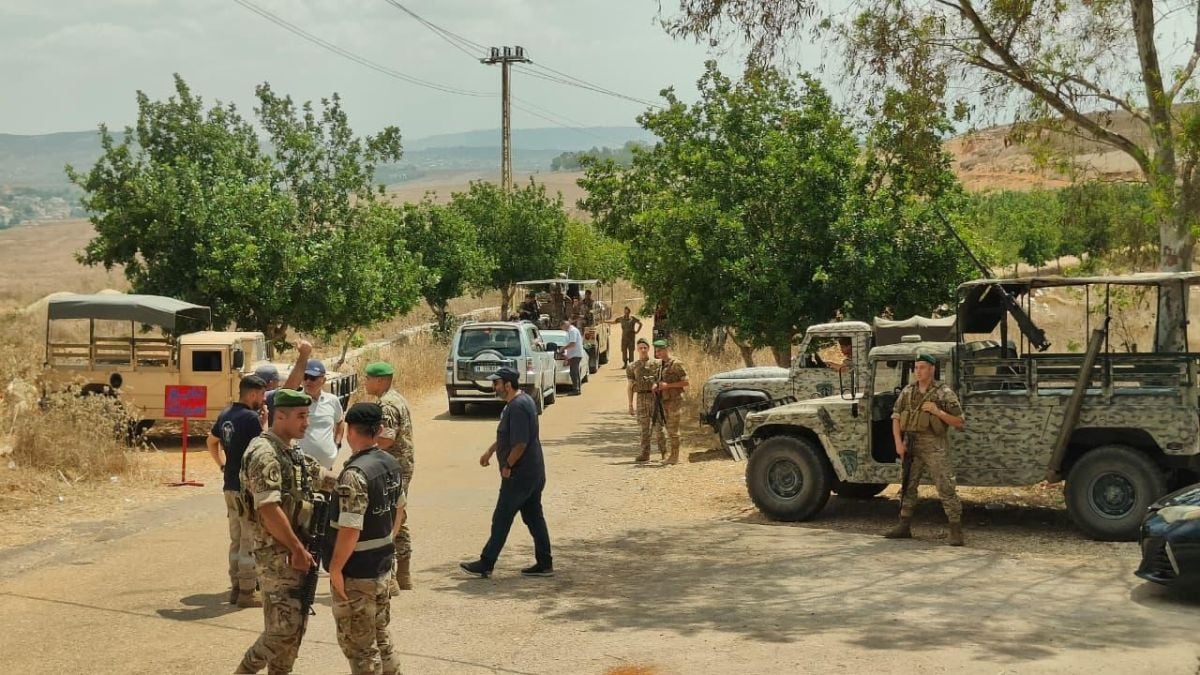
Lebanese Army soldiers deployed in the locality of Zawtar Gharbieh, in south Lebanon, on July 24, 2026. (Credit: Mohammad Yassine/L'Orient-Le Jour)






BEIRUT — The cease-fire between Lebanon and Israel continues to divide Lebanon's political class. While Lebanese Forces (LF) leader Samir Geagea has called for addressing Hezbollah's weapons before anything else, Hezbollah remains firmly opposed, denouncing the "failure" of the framework agreement between Lebanon and Israel signed at the end of June in Washington.
Geagea warned against "reducing the Lebanese crisis to mere cease-fire demands and Israeli withdrawal, however important they may be." He argued that "the roots of the crisis lie in the existence of a parallel state within the state, which makes strategic decisions and drags Lebanon into wars." He stressed that "a real solution begins with the dismantling of all illegal weapons and handing them over to the Lebanese Army."
"We can conclude as many cease-fire agreements as we want and obtain the withdrawal of the Israelis from Lebanon, but if the root cause remains unchanged, we will find ourselves facing the same problem in a month, six months, a year, or two years. And that is precisely what has happened," he said during Radio Liban Libre's annual dinner on Tuesday evening.
He added that the previous cease-fire agreement, reached on Nov. 27, 2024, had led to an Israeli withdrawal "except for five positions." However, he argued that "failing to address the root of the problem" led to renewed escalation, with those five positions "now becoming 50."
Referring to "the suffering of the people in the South and the displaced who lost their homes and livelihoods," Geagea said they were "the most affected by the war." However, he stressed "the need not to forget the millions of Lebanese living in other regions who are also paying the price for decisions and wars they did not choose."
A framework agreement was reached on June 26 between Lebanon and Israel under U.S. auspices, with the aim of ending the war between the two countries. Its implementation provides, among other measures, for the establishment of "pilot zones" in southern Lebanon, where Hezbollah's disarmament would serve as a test before the gradual withdrawal of Israeli forces from other areas.
Hezbollah, which opened a front against Israel on March 2 in support of Iran, rejects the agreement and refuses to surrender its weapons.
'Failure' of the framework agreement
Hezbollah MP Ali Mokdad said Wednesday, in an interview with Russian radio Sputnik, that "the first phase of the framework agreement has failed."
"Hezbollah demands a complete withdrawal from Lebanese territory, without any redeployment [of the Israeli army]," he sid, adding that "Hezbollah still counts on the Islamabad agreement to force Israel to withdraw from southern Lebanon."
Mokdad criticized "the propaganda surrounding the withdrawal from areas that were never occupied, as well as the Israel's failure to comply with the cease-fire and the continued displacement of inhabitants of southern villages." He added that Hezbollah "counts on the wisdom of the commander of the Lebanese Army," stressing that "the army's command will remain a national command and that the army will not engage in any confrontation with the people of the South or with [Hezbollah]."
Hezbollah MP Hassan Ezzeddine, meanwhile, said the framework agreement, "resulting from direct negotiations with the Israeli enemy," had "created a deep division among the Lebanese population, threatening civil peace, security and stability." He made the remarks during a memorial ceremony for victims in Bafliyeh, southern Lebanon.
The Free Patriotic Movement (FPM), a former Hezbollah ally, adopted a more nuanced position. MP Assaad Dergham said that "any framework agreement should include a clear timetable for Israeli withdrawal, precise implementation and funding mechanisms, and respond to the aspirations of the Lebanese people."
"The FPM's position is neither for nor against any agreement, but in favor of Lebanon's sovereignty," he said, adding that "people are judged by their actions, not their words."
Dergham also insisted that "state sovereignty is fundamental and the presence of weapons outside the authority of the Lebanese state is unacceptable." He maintained that "building a strong state begins with entrusting decisions on war, peace and armament to its legitimate institutions."
The Free Patriotic Movement (FPM), a long time Hezbollah ally, said through MP Assaad Dergham that "any framework agreement should include a clear timetable for Israeli withdrawal, precise mechanisms for implementation and funding, and respond to the aspirations of the Lebanese people." "The [FPM]'s position is neither for nor against any agreement, but rather in favor of Lebanon's sovereignty," the MP said, adding that "it is in deeds that one is judged, not in words."
Dergham insisted that "the sovereignty of the state is fundamental, and the presence of weapons outside the framework of the Lebanese state is unacceptable," and added that "the establishment of a strong state begins with entrusting the decision of war, peace, and armament to its legitimate institutions."

 Midday recap: Hebron attack sparks Israeli crackdown, international meeting in Istanbul for regional 'de-escalation'