






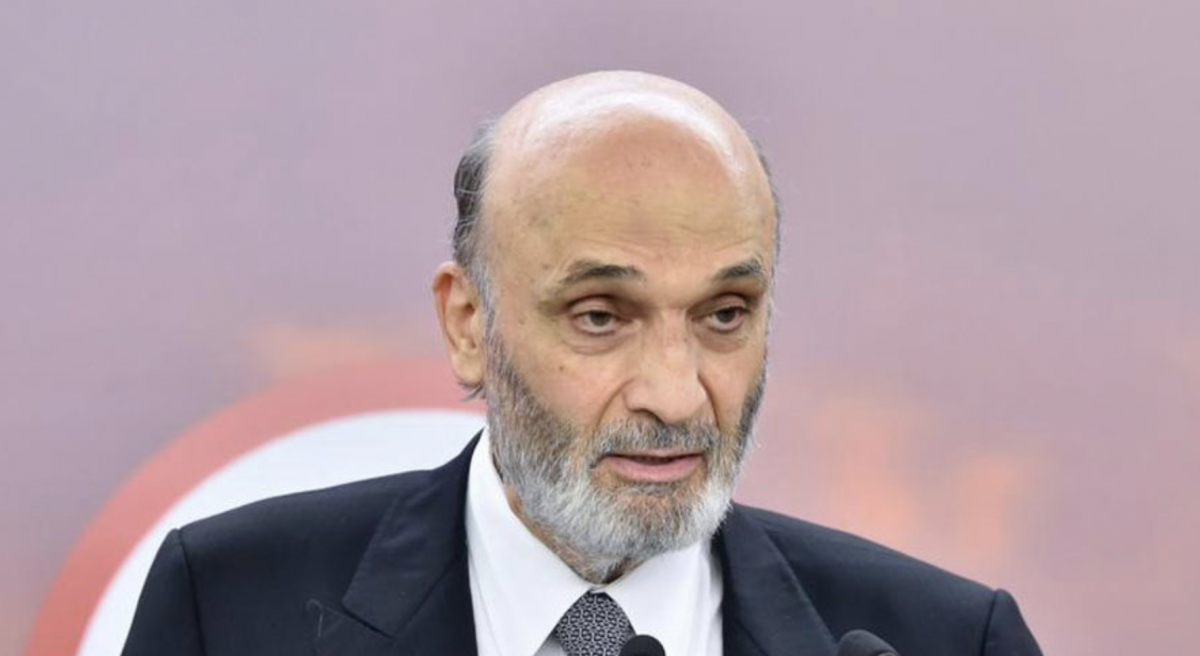
The head of the Lebanese Forces (LF), Samir Geagea. (Credit: NNA.)






BEIRUT — A year before the legislative elections, Parliament Speaker Nabih Berri and the leader of the Lebanese Forces (LF), Samir Geagea, are opposed over the future of the current electoral law.
Berri denounces "a caricature law" whose "results have ruined the country" and proposes a reform based on a single constituency and the creation of a Senate. In response, Geagea defends the current law, which he considers "excellent" while calling for "the required amendments," particularly to ensure the participation of Lebanese abroad.
The head of the legislature, following the legislative proposals presented by his right-hand man, MP Ali Hassan Khalil, last March, wishes to amend the 2017 electoral law, on which the 2018 and 2022 elections were based. "The experience with the current electoral law has shown that it is a caricature law, and its results have ruined the country," said Berri, in an interview published Thursday by the daily al-Joumhouriya, recalling "the comprehensive proposal" made by his parliamentary bloc.
Berri's group's proposal plans to replace the current 15 constituencies with a single one, based on proportionality, as well as creating a Senate composed of 46 members elected based on confessional quotas and parity between Christians and Muslims. The deputies would no longer be elected on a confessional basis. "The debates around these proposals will determine the direction the electoral law will take, which cannot remain in its current framework," said Nabih Berri.
While this proposal had already sparked a backlash among the LF, who believe that the single constituency does not ensure the representation of the country's various communities, their leader, Geagea, implicitly responded to Berri on Thursday by estimating that "the experience with the current law is excellent," while specifying that "it is necessary to make the required amendments to fully highlight its benefits."
"The experience with the current law is excellent, as it is the first since the beginning of the implementation of the Taif Agreement (1989), which guarantees, to a large extent, the accuracy of representation in accordance with the spirit of the agreement," said Samir Geagea, as quoted by the state-run National Information Agency (NNA).
The law "has helped correct representation both nationally and in terms of the [national] pact, has freed the Lebanese from electoral steamrollers and the influence of big capital, and ensured the best possible representation of Lebanese in Parliament," estimated the Christian leader.
The participation of Lebanese abroad in debate
"The current electoral law was only applied in two elections [in 2018 and 2022] and incompletely; that is why it is necessary to make the required amendments to highlight all its assets. The most important of these amendments are the magnetic card, the megacenter, and above all, the participation of Lebanese abroad - who now form a large part of the electorate - in these elections, each in their constituency," the LF leader further declared.
While the 2017 electoral law, the first text to enshrine the vote of emigrants from their country of adoption, contains a clause allocating six deputies to the diaspora (one per continent), in addition to the 128 in Parliament, this clause, however, was not fully applied in the 2022 legislative elections, in a rerun of the (described as "temporary") May 2018 scenario. Although emigrants were indeed able to vote, they did so based on their original constituency in Lebanon, without the six diaspora deputies being added to the total number of parliamentarians.
Nabih Berri refuses to see this scenario repeat in 2026, stating that "the provision on expatriate voting for internal constituencies no longer exists."
In contrast to Geagea. "Our goal is to try to bring the Lebanese family together [...] This gathering will not happen by isolating the Lebanese diaspora through the six seats abroad, but by allowing them to fully participate in the national life in its noblest form: the election of national deputies, each in their constituency," he insisted, calling not to "manipulate the current electoral law because it guarantees, to a large extent, fair representation."
It is worth noting that megacenters are offices where voters could vote outside their regions of origin. In Lebanon, it is necessary to travel to one's city or village of origin to vote in offices distributed by confessional affiliation.
