






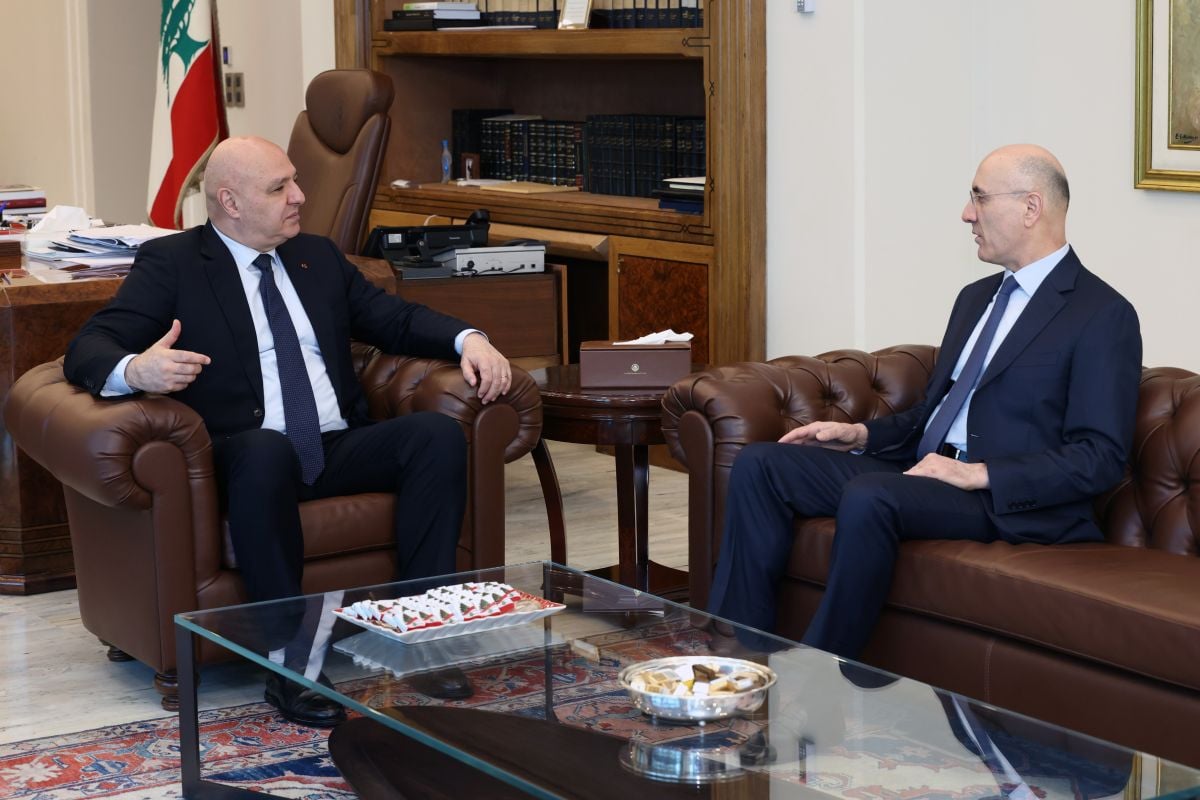
President Joseph Aoun and Interior Minister Ahmad Hajjar at the Baabda Presidential Palace on July 24, 2026. (Credit: Lebanese Presidency/X)






President Joseph Aoun met Friday with Prime Minister Nawaf Salam and several members of his government, two days after returning from the United States and his meeting with U.S. President Donald Trump. Interior Minister Ahmad Hajjar said the trip reflected "the strengthening of the international community's confidence in Lebanon and its legitimate institutions."
"We expressed our satisfaction with the positive atmosphere surrounding President Aoun's visit to Washington, the warm welcome, and the praise he received," the minister said.
While several high-ranking officials and elected representatives welcomed the president's initiative and its potential benefits, Hezbollah described the visit as a "failure," accusing the authorities of leading Lebanon "down a dead-end path marked by successive concessions" that undermine "the sovereignty of the state" and demonstrate "its dependence on and submission to foreign control."
For Hajjar, the "historic summit" that brought together Aoun and Donald Trump at the White House constitutes "a pivotal moment in Lebanese-American relations" and "a clear message of support for Lebanon." He also affirmed his "support for the national efforts led by President Aoun to protect Lebanon, preserve its sovereignty, and extricate it from the war imposed upon it, with the aim of achieving Israeli withdrawal and extending state authority to its entire territory."
In the morning, Aoun also received Salam, whom he briefed on the outcome of his visit to Washington. He emphasized that American officials want to "support the army and assist Lebanon in all areas," and that the United States is committed to implementing the framework agreement, which stipulates the Israeli withdrawal from southern Lebanon.
For his part, Salam informed the president of his visit to Zawtar Gharbieh in the South, one of the two "pilot zones." "I reaffirmed that we stand with our southern residents and that the state is determined to meet their needs, in order to consolidate their presence on their land and preserve their livelihoods," Salam said during the meeting, according to the state-run National News Agency.
The two officials also discussed Salam's planned visit to Iraq on Sunday, where he will meet with his Iraqi counterpart, Ali al-Zaidi.
Aoun also met with Defense Minister Michel Menassa, who briefed the president on the measures taken to continue the deployment of the Lebanese Army in several towns and villages in southern Lebanon, as well as the military's needs.
The framework agreement reached June 26 between Lebanon and Israel, following the first direct negotiations between the two countries in decades, stipulates a gradual withdrawal of Israeli forces, contingent upon the deployment of the Lebanese Army and the dismantling of Hezbollah infrastructure in designated "pilot zones."
The agreement began to be implemented Monday, with the deployment of army units to two of these zones in the central southern sector: the villages of Srifa and Froun, where the occupying forces were not present, and Zawtar Gharbieh, north of the Litani River, a locality that had been under Israeli control. Israeli forces were stationed along the riverbanks and had carried out several incursions to demolish homes.
