






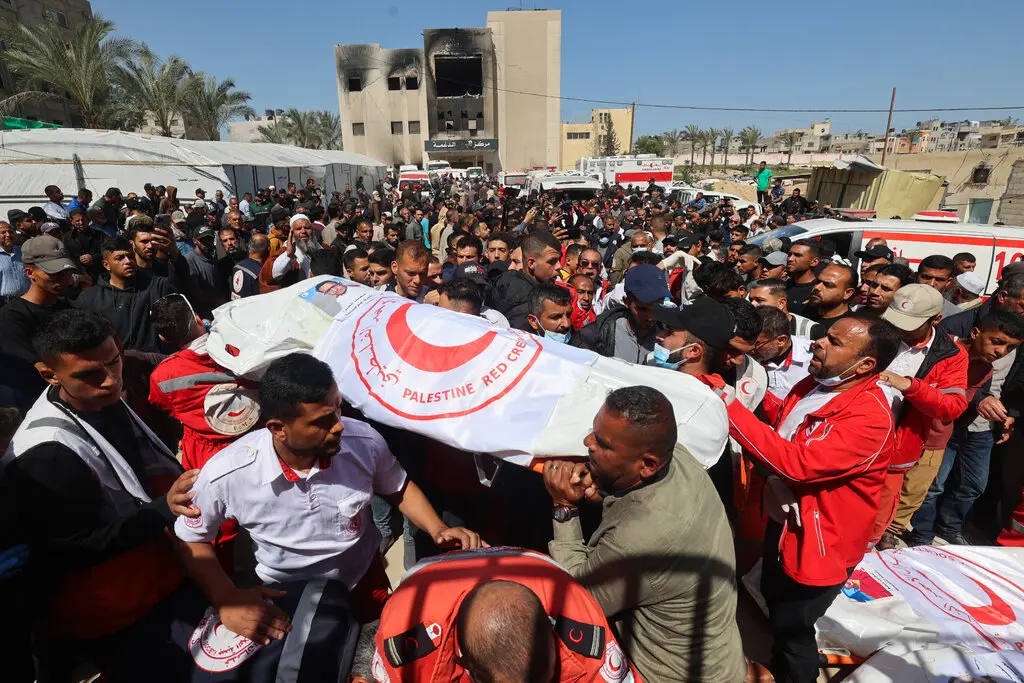
Members of the Palestinian Red Crescent and other rescue services pay tribute to their colleagues killed by Israeli forces near Rafah, in the southern Gaza Strip. (Credit: Eyad Baba/AFP)






Most of the 15 rescuers killed last month by Israeli forces in Rafah, southern Gaza, died from gunshots to the head or chest, a recent autopsy report obtained by the New York Times showed. Of the 11 victims with gunshot wounds, at least six were shot in the chest or back and four in the head. Most were hit multiple times, while others died from injuries such as shrapnel wounds.
The autopsies were performed and documented between April 1 and 5 by Dr. Ahmad Dhair, head of the forensic medicine unit of the Gaza Health Ministry, and obtained by the New York Times for 14 of the 15 victims, excluding the U.N. employee.
The Israeli attack on March 23 near Rafah targeted several Palestinian Red Crescent and Civil Defense vehicles, as well as one from the U.N. The Israeli army blocked access to the area where the rescuers went missing for nearly a week.
While Israel acknowledged targeting the convoy, it defended the strike by claiming it hit suspicious vehicles that were not identifiable. However, a video released by the Palestinian Red Crescent — retrieved from a victim’s phone — showed ambulance and fire truck lights switched on before several minutes of gunfire erupted.
According to the autopsy reports, the 14 examined victims were partly or fully wearing uniforms with reflective strips that make them visible at night.
The slain rescuers were later buried with their vehicles by bulldozers in what the U.N. described as a “mass grave.” In response to international uproar and accusations of war crimes, the Israeli army said it would conduct a thorough investigation, after initially claiming nine of the dead were Hamas and Islamic Jihad fighters, then lowering the number to six.
Several bodies were missing limbs, according to the autopsies, and one was severed at the waist. The partially or severely decomposed state of the remains complicated forensic analysis. At the end of March, after the bodies were recovered, Dhair told the New York Times that one victim had bruises and marks on the wrists, suggesting they may have been bound, though he said more investigation was needed. The autopsy reports reviewed by the Times did not mention such evidence.

