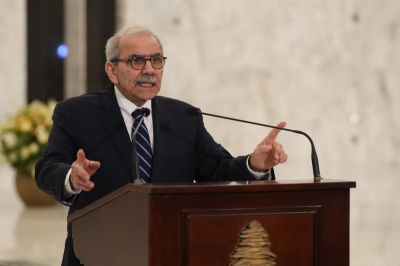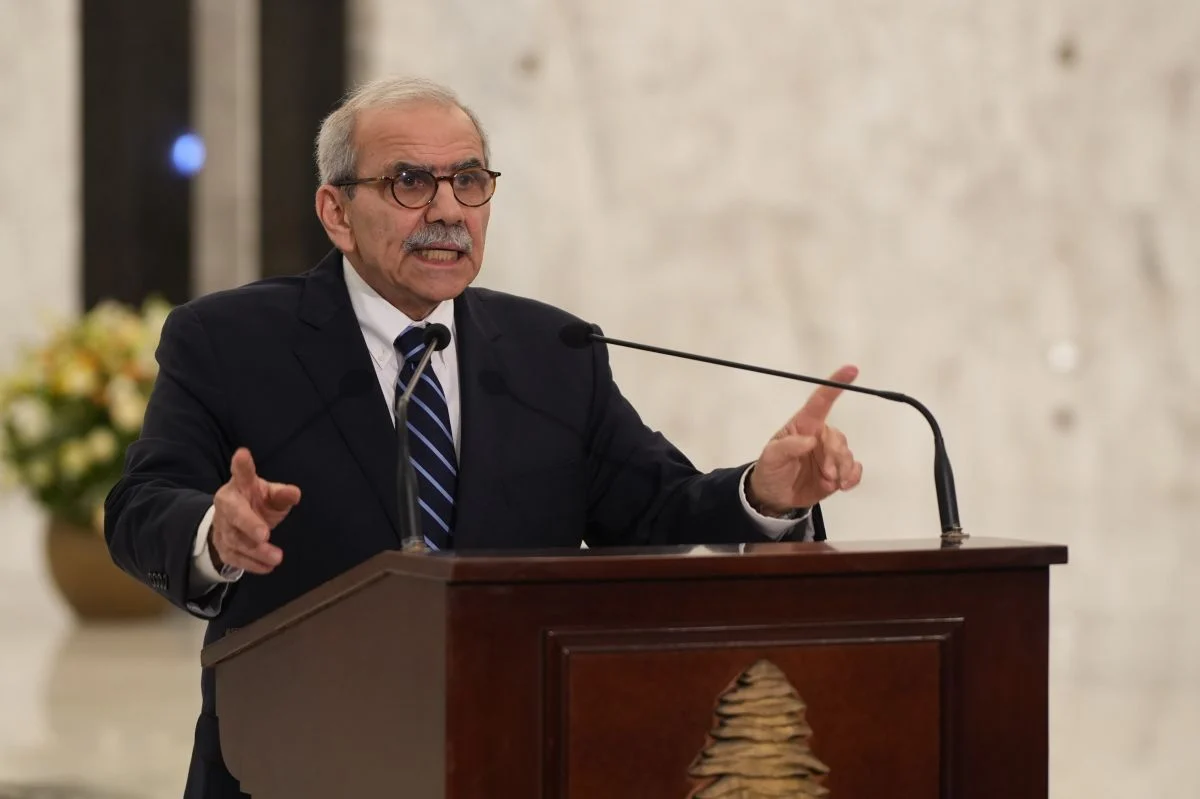
Prime Minister Nawaf Salam at the Baabda Palace on Jan. 14, 2025. (Credit: Mohammad Yassine / L'Orient-Le Jour)






Prime Minister Nawaf Salam laid a wreath Sunday at the Martyrs’ Monument in downtown Beirut to commemorate the 50th anniversary of the start of the Lebanese Civil War, calling on the Lebanese people not to "relive the sufferings of the past," according to the National News Agency (NNA, official) and several media outlets. A minute of silence was also observed at noon, as he had requested on Friday.
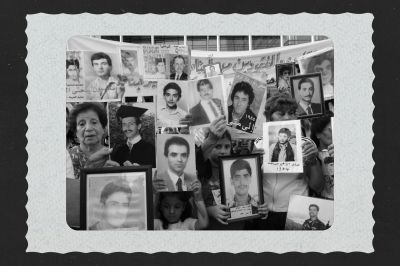
Salam also delivered a brief speech, which he shared on his account on the social media platform X, confirming that he would travel to Syria on Monday to discuss, among other issues, the fate of Lebanese citizens who disappeared in the prisons of the former Assad regime.
"This commemoration has taught us — and we continue to draw lessons from it — that we must not repeat the sufferings our people have endured," he said, "which has always brought the Lebanese together."
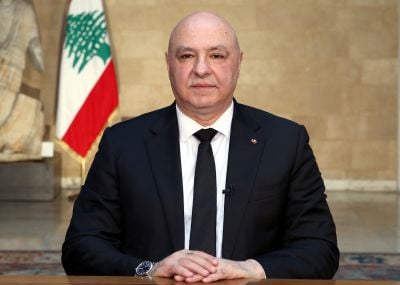
"All the victories were false, and all parties came out as losers. No matter the differing opinions on the causes of the war, they all converge on one point: the absence or failure of the state," declared the Prime Minister. "A true state exists only when the legitimate armed forces hold the monopoly on weapons. Let us fully implement the provisions of the Taif Agreement [signed on Oct. 22, 1989, which ended the Civil War], correct what has been implemented contrary to its spirit, and address its shortcomings."
"Let us remember together, so we can build together. Let us make this 50th anniversary a turning point. Let us look together toward a new Lebanon, worthy of the sacrifices of its children."
These remarks echo statements he made on Friday during the opening of a civil war exhibition at the National Library in Beirut. On Saturday evening, President Joseph Aoun delivered a similar speech broadcast by the media.
'Returning with good news'
Regarding his upcoming visit to Syria, Salam affirmed that "it is the responsibility of the state to seriously and transparently address the cases of the missing and abducted." This issue has resurfaced strongly since the fall of Bashar al-Assad, who was overthrown on Dec. 8 by a coalition of Islamist rebels.
"I hope to return with good news about the disappeared in Syria, and I will share more on this matter tomorrow," Salam added.
He also stated that it is time for the Lebanese to "build a state in which they can have confidence," and reiterated his government's commitment to reforming the country, starting with banking secrecy laws.
"Some have taken advantage of banking secrecy to launder money, and the importance of reform in this area lies in its contribution to recovering depositors' funds," he said.
Kabalan not convinced
While the cease-fire between Israel and Hezbollah has held for more than four months — despite near-daily Israeli strikes and violations — Salam argued that Israel has no legitimate reason to remain stationed at five strategic points in southern Lebanon under the pretext of monitoring and countering Hezbollah’s movements.
"There is no need for Israel to remain in these positions, because we are in the era of satellites, and everyone can see what is happening on the ground without setting up posts and occupying territories," he noted.
Calls to reestablish the state’s monopoly on weapons, repeated by both heads of the executive branch on the 50th anniversary of the Civil War, did not convince Jaafari Mufti Ahmad Kabalan, a cleric close to Hezbollah.
"The country’s problem must not be reduced to the issue of weapons. That is a strategic mistake, and the Lebanese state cannot protect Lebanon with its internal capacities alone. This means the army and the resistance must serve as the national foundations for security pacts and the defensive strategy Lebanon needs," said the mufti, according to the NNA.
"Because the Civil War, with all its calamities and horrors, was and remains a game played by nations, I say to the Lebanese people and to all political and religious forces: the time has come to ‘Lebanonize’ national issues, away from external pressures and Americanization programs that have peaked at all levels and sharply contradict all aspects of national sovereignty," he added.
However, the Sheikh did not contradict the Prime Minister’s position regarding the Taif Agreement:
"As Muslims and Christians, we want to live together in peace, safety, and security... There must be a comprehensive system of citizenship to address public issues in this country, and development certainly doesn’t happen with the push of a button. But it must begin now, and the Taif Agreement is suited for such development."