






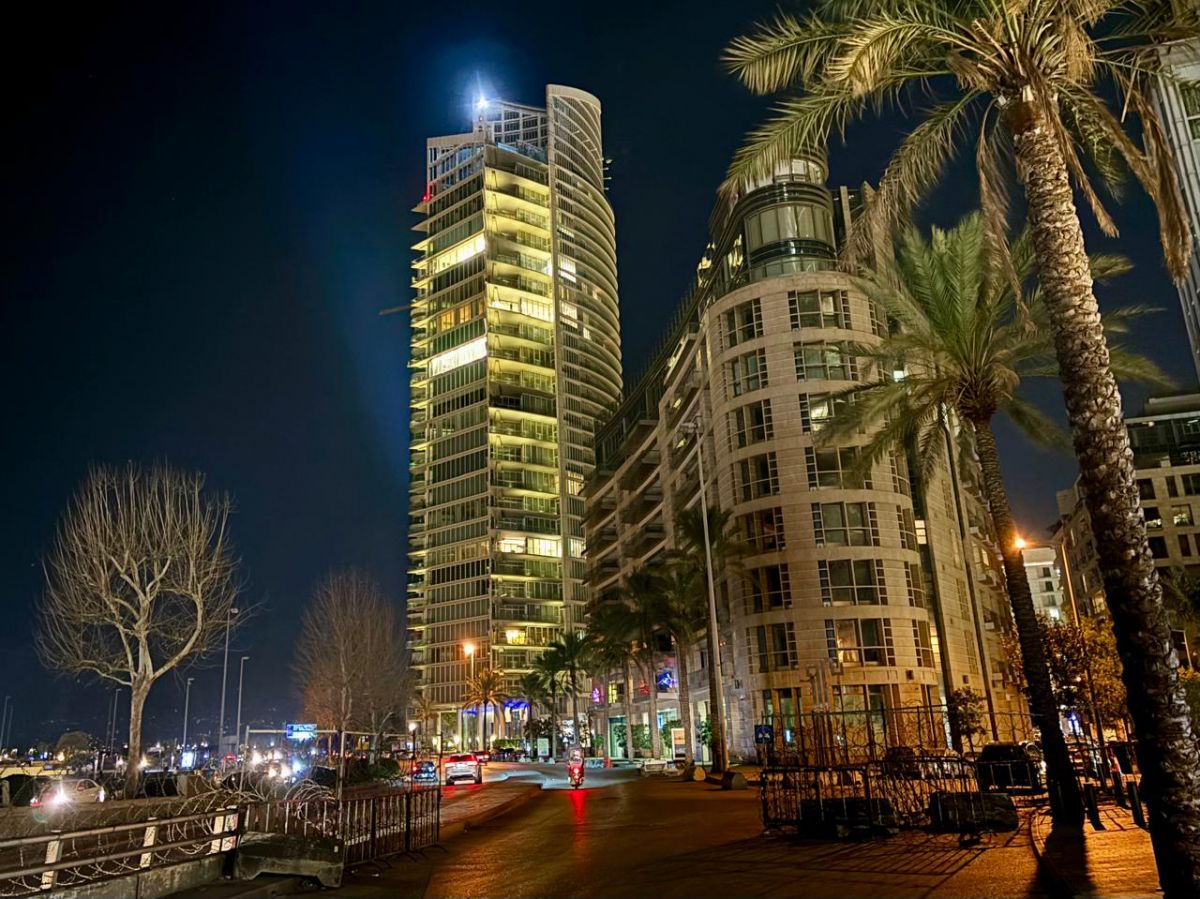
The avenue that runs along the coast in Ain el-Mreisseh, in Beirut. (Credit: Philippe Hage Boutros/OLJ)






The positive sentiment in the private sector sparked by the election of Joseph Aoun and the appointment of Nawaf Salam as prime minister remained steady in February.
This is the main takeaway from the update of the Lebanese Purchasing Managers' Index (PMI), developed by BlomInvest, which remained above the pivotal level of 50 points, despite a very slight decrease by one-tenth, setting it at 50.5 points.
The PMI assesses the economic climate based on surveys conducted with purchasing managers from 400 Lebanese companies, using a model and methodology consistent with what is done elsewhere in the world. A PMI below 50 points reflects a slowdown in economic activity and unfavorable prospects, and vice versa.
If the PMI's value declines from one month to the next, it means that stakeholders believe their perception of the economic climate has deteriorated over that period compared to the previous one. In this case, the deterioration is minimal.

Many challenges
This is only the fifth time in its history, after August 2022, then June, July 2023, and last January, that the PMI has shown a score above 50 points. Mira Said, an analyst at BlomInvest, noted that "all the sub-indices that make up the PMI" showed values above 50 points, which is also quite rare and worth highlighting.
She attributes this "optimism of Lebanese businesses" to the formation of a reformist government on Feb. 8, which moreover obtained the confidence of Parliament in the weeks that followed. However, she fears that the PMI might eventually drop if Israel maintains its presence in southern Lebanon, while its army was supposed to withdraw by Feb. 18, in accordance with the cease-fire terms that ended more than 15 months of war between Hezbollah and Israel on Nov. 27. She also cites "political and sectarian divisions, as well as widespread corruption" among the challenges that could counter the current trend.
"Despite this, the new government is committed to negotiating with the International Monetary Fund and implementing a set of reforms. In a context of uncertainty regarding Lebanon's ability to recover, some believe that the country has hit rock bottom and can only improve from there," continues Said.
She highlights that the rise in eurobond prices – dollar-denominated debt securities on which Lebanon defaulted in March 2020 and has yet to restructure – since Aoun's election on Jan. 9 is another sign of the prevailing optimism.
The eurobond prices, which long fluctuated between 6 and 7 cents on the dollar during the more than five years of crisis the country has undergone, has surpassed for the first time in several years the 18-cent mark at the beginning of the week.
