






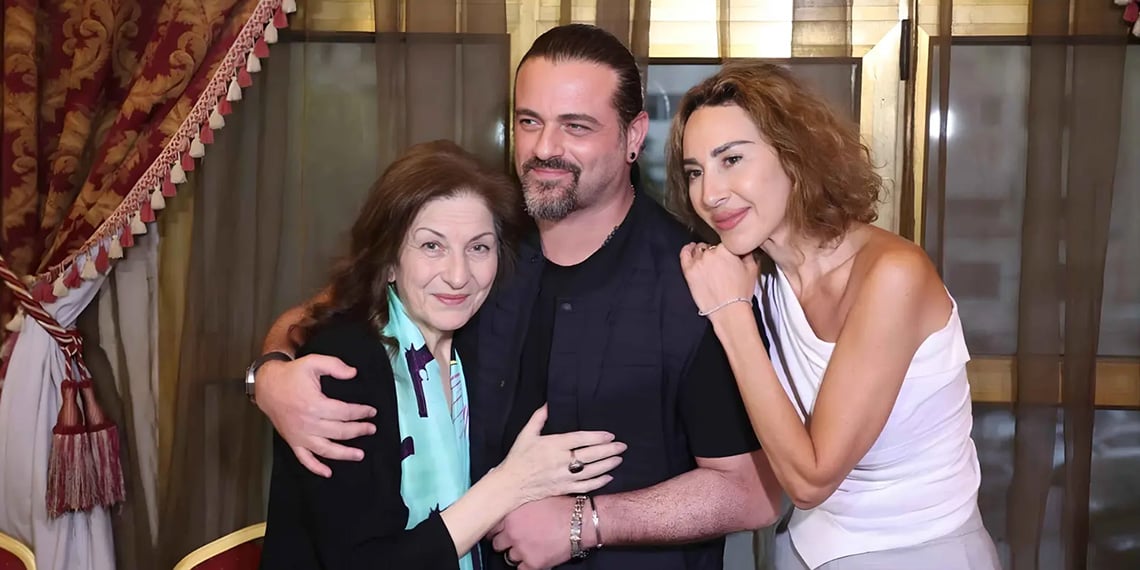
Maha Bayrakdar with her children Youssef and Ward al-Khal. (Credit: Instagram)






She was beautiful, of course. A beauty both grave and light, a silhouette that seemed to float between eras. Maha Bayrakdar al-Khal, poet, painter, and screenwriter, passed away on Feb. 22, 2025, and with her fades poetry made of lines and pigments, of suspended phrases and elusive memories.
Born on Feb. 26, 1947, in Damascus, she drew before she could even write, she wrote before she even understood the world. An unyielding logic led her to the School of Fine Arts in Damascus, from which she graduated in 1967. Art was fine, but life was more unpredictable: She flew to Munich, studied business administration — another form of painting, perhaps — and returned with a degree in 1969. But it was the words, the images and a gaze cast upon her that caught up with her.
For there was that gaze. That of Youssef al-Khal, poet, art critic and man of spirit, whom she met amid the excitement of the an-Nahar publishing house in Beirut. A meeting, a marriage, years of complicity and creation. From 1970 to 1975, they co-directed Gallery One, that incandescent space where art and life intertwined. They had two children, Youssef and Ward, heirs of a sensitivity that seemed to flow through their veins.
But Bayrakdar was never content to be just a silhouette in an artist's setting. She painted, she wrote, she exhibited, here and elsewhere. 15 personal exhibitions, 37 collective ones from Lebanon to Iraq, passing through the Gulf countries. Her canvases did not tell reality; they reinvented it. Unreal landscapes, worlds that are guessed at but never grasped, a oneirism that brushes without jostling.
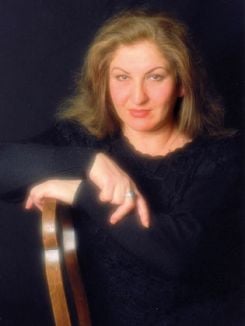
And then, there were the words. For children first, with illustrated books that kept intact a sense of wonder. Then for television, where her stories came to life through the features of her own children. In 2008, she wrote Al-Ta'er al-Maksour (The Broken Bird), then Noktet Hobb (A Drop of Love) in 2010 and Kharej al-Zaman (Beyond Time) in 2013. Always this link between her and her loved ones, between her dreams and those of others.
In 2004, she was awarded the silver medal of the Lebanese Order of Merit. An official recognition, but what are medals worth against the gazes lingering before a canvas, to the melody of a verse recited in a low voice? Bayrakdar leaves behind more than a work: An imprint, a lineage.
Her daughter Ward wrote on X: “Mother of roses, she has left, taking with her the fragrance and the color, leaving behind the dew that lay on her cheek … Mama, my beloved sleeping princess, see you soon … Lord, take her soul into mercy …” Under a portrait of his mother holding a collection of poems, her son Youssef said: “Love ... She has gone.”
So yes, she has left. The colors and the words remain, unforgettable.
This article was originally published in French in L'Orient-Le Jour.