






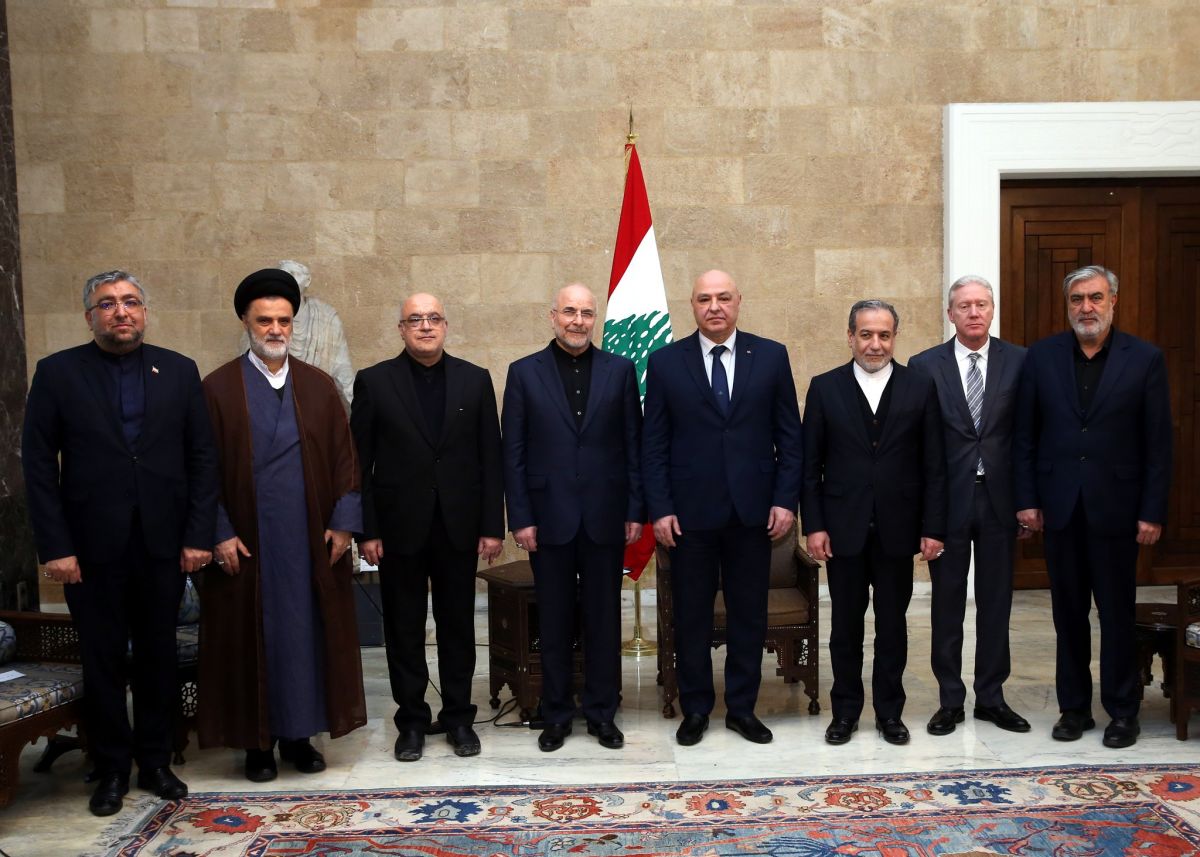
Lebanese president Joseph Aoun (5th from the left) receiving the Iranian Parliament Speaker Mohammad Ghalibaf (4th from the left) and the Iranian Foreign Minister (3rd from the right), in the presence of the Lebanese Foreign Minister, Joe Rajji in Baabda, on Feb. 23, 2025. (Credit: X/ @LebanesePresidency)






"Lebanon is exhausted by the wars of others on its territory," said Lebanese President Joseph Aoun to a delegation of Iranian officials present in Beirut for the funeral of the former Hezbollah leader, Hassan Nasrallah.
The Speaker of the Iranian Parliament Mohammad-Bagher Ghalibaf, Foreign Minister Abbas Araghshi, and the Iranian ambassador to Beirut, Mojtaba Amani, were part of the delegation.
During the meeting, the Speaker of the Iranian Parliament expressed "Iran's support for Lebanon's territorial unity, its integrity, and sovereignty," emphasizing that his country wishes to "see a stable, safe, and prosperous Lebanon," as reported by the National News Agency (NNA). In response to his statement that Iran respects "Lebanon's sovereign decisions, without any foreign interference," President Aoun said he shared this "view," adding that "the best response to losses and aggressions remains the unity of the Lebanese."
He further clarified: "Lebanon is exhausted by the wars of others on its territory. No country should interfere in the internal affairs of another," citing Article 9 of the Iranian Constitution, which states that "the freedom, independence, unity, and territorial integrity of a country are indivisible."
‘A heavy toll’ for the Palestinian cause
President Aoun also praised the conclusions of the Arab summit in Riyadh on Friday, which Iran had attended, particularly "the two-state solution for the Palestinian issue," as well as "the recognition of the Palestinian Authority as the legitimate representative of the Palestinian people," as reported by the NNA.
He added that "Lebanon has paid a heavy toll in defending the Palestinian cause," and reaffirmed "Lebanon's commitment to establishing the best relations with Iran, in the interest of both countries and their peoples."
The Speaker of the Iranian Parliament also expressed Iran's "readiness to cooperate with Arab and Muslim countries to participate in the reconstruction of infrastructure destroyed by the Israeli aggression against Lebanon."
Ghalibaf and the delegation he leads were received at 7 p.m. at the Grand Serail by Prime Minister Nawaf Salam, and later by Nabih Berri at Ain el-Tineh. After his meeting with Berri, Ghalibaf stated that Iran "supports any decision made by the Lebanese government, people, and resistance in Lebanon."
This visit by the Iranian delegation comes as the Salam government announced last Monday the indefinite suspension of flights between Beirut and Tehran. This decision followed the refusal of Lebanese authorities to allow two planes from the Iranian airline Mahan Air to land after several American warnings suggesting that Israel might bomb Beirut International Airport if these flights continued.
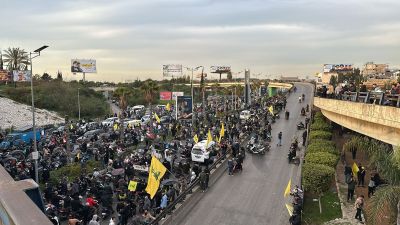
These prohibitions sparked anger among Hezbollah supporters, who blocked the road leading to the airport, located on the outskirts of the southern suburbs of the Lebanese capital, a stronghold of the party.
In mid-October 2024, remarks by Mohammad-Bagher Ghalibaf to Le Figaro, during negotiations for a ceasefire between Hezbollah and Israel, had been a source of tension between Beirut and Tehran, as the party, an ally of the Iranian regime, was losing ground on the local scene. The Speaker of the Iranian Parliament had suggested that Tehran would be willing to negotiate with Paris on the implementation of U.N. Security Council Resolution 1701 concerning South Lebanon.
This remark was widely criticized by Lebanese officials, who denounced it as blatant interference, even as an "attempt at tutorship," as then-Prime Minister Nagib Mikati had accused. Iranian officials later attempted to clarify Mr. Ghalibaf's comments. The cease-fire was ultimately concluded and implemented on the night of Nov. 26-27, under the auspices of France and the United States.
