Families of Palestinian prisoners after the announcement of Israel's suspension of releases, in Ramallah, Feb. 23, 2025. (Credit: Zain Jaafar/AFP)






Israel announced on Sunday that it is delaying the release of Palestinian prisoners — planned as part of the fragile cease-fire in Gaza — until Hamas guarantees an end to the “humiliating ceremonies” for released hostages.
One week before the first phase of the truce is set to end in the war-ravaged Palestinian territory, the Israeli government and the Islamist movement have accused each other of violating the agreement. This comes as what was supposed to be the seventh scheduled exchange of Israeli hostages for Palestinian prisoners. Hamas did release six hostages, but the exchange was overshadowed by the uncertainty surrounding the fate of hostage Shiri Bibas, who was ultimately confirmed dead on Saturday morning. As in previous exchanges, Hamas staged the event by displaying five hostages on podiums before handing them over to the International Committee of the Red Cross (ICRC).
Israel announced on Sunday that it is postponing the release of 620 Palestinian prisoners — initially planned under the fragile cease-fire in Gaza — until Hamas guarantees an end to the “humiliating ceremonies” for released hostages.
Following a security meeting, Prime Minister Benjamin Netanyahu confirmed that the releases would not take place. "It has been decided to delay the release of the terrorists [Palestinian prisoners, ed.] that was planned for Saturday until the next hostage release is assured without humiliating ceremonies," Netanyahu stated in a press release from his office overnight.
Hamas accuses Israel of a “blatant violation”
In both Gaza and the Israeli-occupied West Bank, families who had been eagerly awaiting the release of their loved ones were left empty-handed.
"Our Lord will give us patience, and we will simply wait until our sons are freed," said Umm Alaa, who had been waiting in vain for her son’s release in Ramallah, West Bank.
"You got your prisoners of war, so why delay the release of our Palestinian prisoners of war?" protested Bassam Al-Khatib in Khan Younis, southern Gaza. "It is heartbreaking; the lack of commitment, the disregard for all international norms and laws and the contempt for the countries that support this agreement."
'Disturbing' video
During Saturday’s initial releases in Rafah, where armed fighters were present, Tal Shoham, a 40-year-old Israeli-Italian-Austrian abducted on Oct. 7, 2023, was forced to speak in front of cameras.
Standing beside him was Avera Mengistu, 38, who had been held hostage in Gaza for over a decade after crossing the border fence in 2014.
The same scene played out in Nuseirat, central Gaza, where Eliya Cohen, Omer Shem Tov and Omer Wenkert — aged 22 to 27 and abducted from the Nova music festival — were presented smiling after 505 days in captivity.
These staged presentations have been repeatedly condemned by Israel, the UN and the Red Cross.
On Saturday evening, Hamas’s military wing also released a video, apparently filmed earlier in Nuseirat, showing two hostages watching the release of three Israelis while pleading with Benjamin Netanyahu to free them. The Hostage Families Forum called it “disturbing,” describing it as a “particularly sickening display of cruelty.”
Delayed negotiations
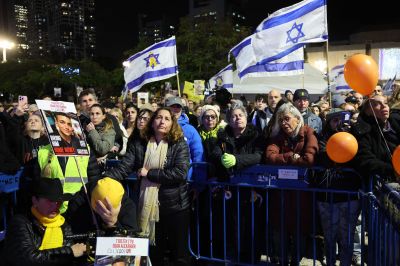
Despite these scenes, hundreds of Israelis watched the live broadcast of the hostage releases in Tel Aviv’s “Hostage Square,” reacting with both tears and bursts of joy.
"After 505 days, I saw him for the first time, and thank God, I saw him on his own two feet, smiling — it’s Omer! It’s my Omer!" exclaimed Sara Ashkenazi, the grandmother of Omer Shem Tov, who was waiting in an apartment in Tel Aviv.
Of the 251 hostages abducted on Oct. 7, 2023, 62 remain in Gaza, with 35 confirmed dead, according to the Israeli military. Since the truce began on Jan. 19, 29 Israeli hostages — including four deceased — have been returned to Israel in exchange for over 1,100 Palestinian detainees.
Hamas claims that only four deceased hostages remain to be returned before the first phase of the agreement concludes. The group has expressed willingness to release all remaining hostages at once in the second phase, which is intended to bring a definitive end to the war. However, indirect negotiations on this next phase have stalled amid mutual accusations of cease-fire violations.
'Cruel' violation
Hamas’s attack resulted in 1,215 deaths on the Israeli side, mostly civilians, according to an AFP tally based on official Israeli figures, including hostages who were killed or died in captivity. In response, Israel’s military offensive in Gaza has killed at least 48,319 people, mostly civilians, according to Gaza Health Ministry, figures deemed reliable by the UN.
U.S. Secretary of State Marco Rubio warned on Saturday that Hamas would be "destroyed" if it did not "immediately" release all hostages.
Meanwhile, Benjamin Netanyahu vowed on Friday that Hamas would “pay a heavy price” for its “cruel” violation of the cease-fire, after confirming that a body returned the previous day was not that of Israeli hostage Shiri Bibas, as initially announced.
Bibas, a symbol of the hostage crisis, was abducted on Oct. 7, 2023, along with her two sons, Kfir (eight months) and Ariel (four years old). Her body was finally handed over on Friday night. An autopsy of her and her children revealed no evidence of injuries caused by bombings, said Chen Kugel, head of Israel’s National Institute of Forensic Medicine.