






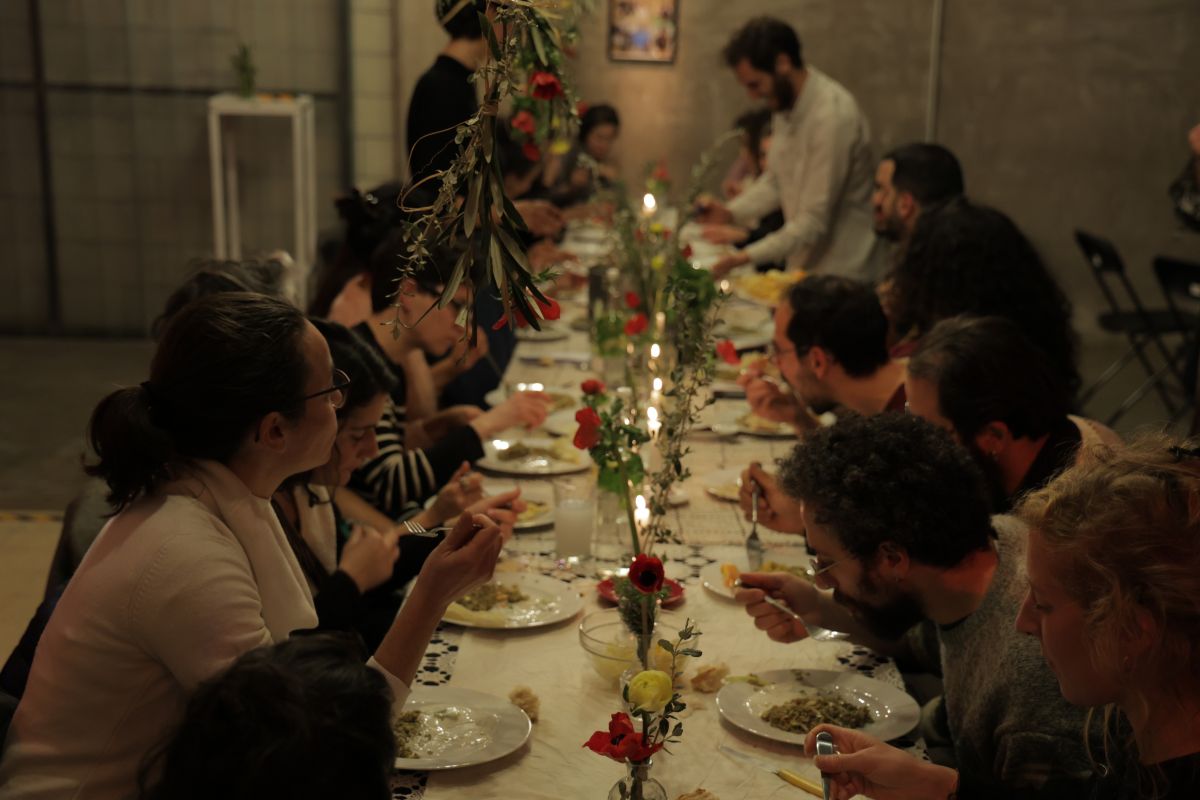
Friendly meal featuring Hiba Najem's frikeh at the Zoukak theater. (Credit: Celine Lahoud)






Hiba Najem merges cooking and the stage, partly to rehabilitate traditional rural dishes. Since 2015, she has been researching the relationship between theatrical performance and daily life, where cooking is a key element, with the aim to preserve its heritage and rituals.
Her interest in cooking and those who engage in it for occasions — dedicating their time to the task, especially women — emerged early. Her interest in theater and people followed.
She studied dramatic arts at the Institute of Fine Arts at the Lebanese University, then completed her first master's degree in theatrical research at Saint Joseph University in Beirut, writing her thesis on the theatricality of food and its presence on the contemporary art scene.
In 2022, she completed another master's degree at the University of Avignon in theater and writing and enrolled in a doctorate in the same university, continuing her research on the relationship between food and theater.

Those dishes we hardly prepare anymore
As part of a series dedicated to culinary performances that began with adas bi shoumar (lentils with fennel) and then fatayer bi banadoura (tomato turnovers), Najem dedicated her latest performance — from Jan. 9 to 12 at Zoukak Theater in Beirut — to frikeh (green wheat).
Frikeh, it's been 40 days since my aunt died, draws inspiration, as its name suggests, from the ceremony surrounding the 40th day of someone's passing. For her aunt's ceremony, to whom she was very close, she wanted to prepare this beloved dish, but faced opposition from the family.
"That day, my mother decided to order sandwiches and ready-made dishes because they were more elegant than frikeh. I realized that our relationship with food had become more distant with our current consumption habits and lack of time, and it saddened me. When my father passed away, the neighbors cooked us many dishes to help us overcome our sadness," explains Najem.
Indeed, frikeh was her aunt's favorite dish, so she decided to build her third performance around this theme, a form of transmission that was dear to her. Starting from this dish, she conducted research on wheat which led her to Greek mythology and the goddess of wheat, Demeter, daughter of the divinities Cronus and Rhea, sister and wife of Zeus (the father of the gods) and goddess of agriculture.
When writing, she discovered Dagan, an important Mesopotamian and Semitic-Eastern deity. Dagan is the deity of fertility and harvest in the Canaanite pantheon, who according to myth was the father of Baal. "I was happy to find a god from our region," says Najem, who notes that she examined death rituals and drew inspiration from the one in Mexico where it is festive, which she believes suits her aunt.

A multicultural performance
With the jovial accordion of Samah Boulmona, Najem nods to the Dinka culture in Sudan, whose lifestyle opposed the Islamization campaign of the native populations of the South.
She also makes an incursion into Italian culture by translating a text from the book Rituels de deuil, travail de deuil by French psychologist Tobie Nathan, in memory of her aunt who had a particular fondness for Italian and for Boulmona who speaks it.
Between theater and singing, Lebanese folklore is also present in this show carried out in interaction with the audience. Once the frikeh is cooked, the evening concludes with a collective dinner partially prepared by those present who share their impressions of the performance and who are asked to wash their plate before leaving. An experience that ventures off the beaten path and invokes another form of art.
The show is co-produced by the La Garance theater in the commune of Cavaillon in France and supported by Zoukak Sidewalks, an artistic residency program, as well as the Odyssée program, the Chateau de Goutelas, a French center for meetings and cultures, which is set to travel.

 8 p.m. recap: Israel again threatens Beirut’s south suburbs; 2 ships hit near Hormuz; Riyadh football matches canceled