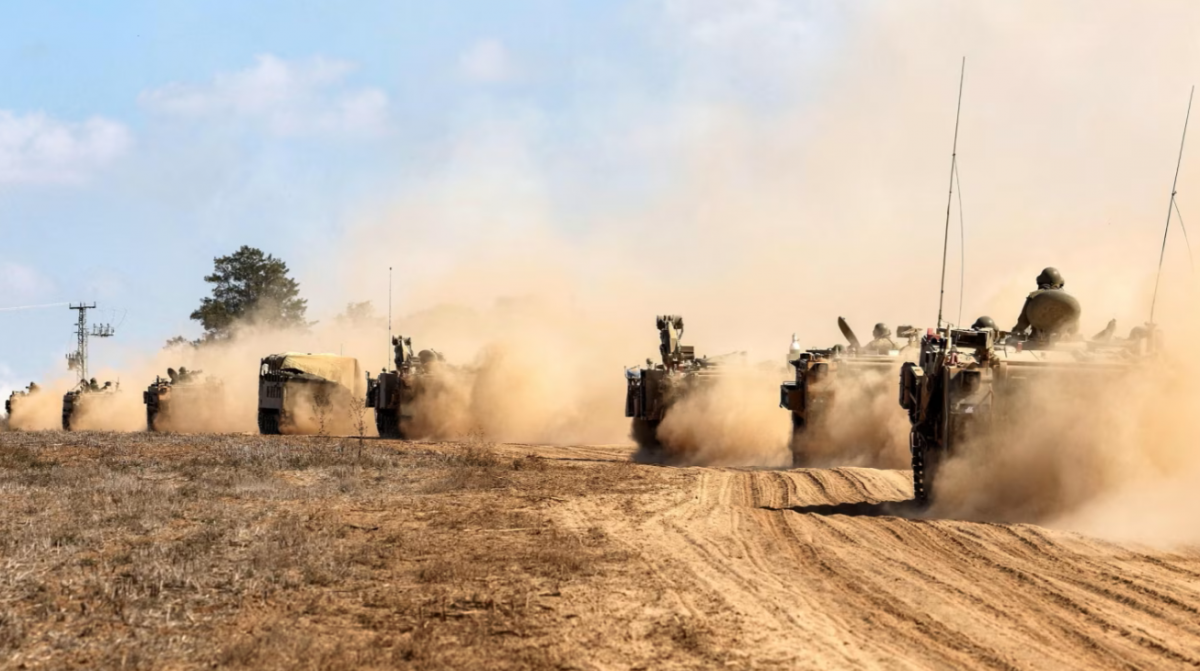
Israeli army tanks and vehicles deployed along the border with the Gaza Strip in October 2024. (Credit: Jack Guez/AFP)






On Tuesday, the U.S. expressed its opposition to any permanent construction of Israeli military bases in Gaza. Referring to a recent investigation by The New York Times (NYT), Vedant Patel, spokesperson for State Department, said that the Biden administration had opposed long-term Israeli control in Gaza since the start of the war in the enclave over a year ago.
The analysis was based on satellite images, video footage regularly published by Israeli soldiers themselves, and statements by Israeli military officials. According to NYT, the Israeli army has created a buffer zone around the Netzarim corridor — an area about 30 kilometers long in the center of Gaza, which divides the Strip in two.
They have one aim: To control the passage of Palestinians between the South and the North to prevent Hamas from reestablishing its forces in some parts of Gaza. Hamas had in fact reasserted some control over the Netzarim corridor after Israeli forces’ first withdrawal. Northern Gaza has been under siege since Oct. 6, following an offensive officially aimed at eliminating Hamas.

The situation is significantly similar to the “Israeli generals' plan” which intended to starve Hamas fighters until they surrendered or died while labeling all remaining civilians as military targets.
Some have accused the Israeli army of ethnic cleansing, which suggests that it may be preparing to exert long-term control over the area. A security source contacted by Haaretz said in November that “political leaders are pushing for the gradual annexation of large areas.” The establishment of a buffer zone in the Netzarim corridor is described by some as “ethnic cleansing.” Others consider it a prelude to the reoccupation of Gaza.
620 buildings razed
The U.S. objects to the ongoing presence of Israeli forces in Gaza, and Prime Minister Benjamin Netanyahu ostensibly rejects the idea of recolonizing the enclave. However, Israeli officials have promised in recent months to maintain security control in Gaza even after the war.
“Hamas will not rule in Gaza” said Netanyahu during a tour in the Netzarim corridor in November. Amir Avivi, a retired brigadier general who is regularly briefed by Israel’s security establishment, said many of the country’s military leaders now believed “withdrawing and separation are no longer options.”
In fact, the area cleared by Israel around the Netzarim corridor, about seven kilometers North-South, now represents more than 45 square kilometers according to NYT. Israeli forces leveled at least 620 residential buildings, from September to November, according to the NYT analysis.
Israeli officials have justified the demolition of residential buildings, claiming that this would prevent Hamas from using urban areas to gain military advantage against Israeli outposts. The pace of the construction of Israeli bases has accelerated in recent months. Twelve bases were either built or expanded since early September.
No withdrawal before 2026?
This is an apparent change in strategy from the basic plan, which was to withdraw from areas where the presence of Hamas seemed to have been eliminated. In total, the Israeli military now has at least 19 major bases in the Netzarim corridor, as well as dozens of smaller bases. According to the NYT analysis, these bases have extensive defensive infrastructure, paved roads, and parking lots for armored vehicles.
The New Arab previously published a report in October on the Philadelphia corridor, which delimits the border between Gaza and Egypt. It had already revealed a vast military infrastructure in this area in the south of the enclave, while this border corridor was the subject of a dispute in negotiations for a cease-fire.
Recently, Haaretz revealed that the Israeli army was building asphalt roads, cellular antennas, and water and sanitation infrastructure throughout the Gaza Strip. A high-ranking Israeli officer told NYT that “Israeli forces will not withdraw from Gaza until 2026.”