





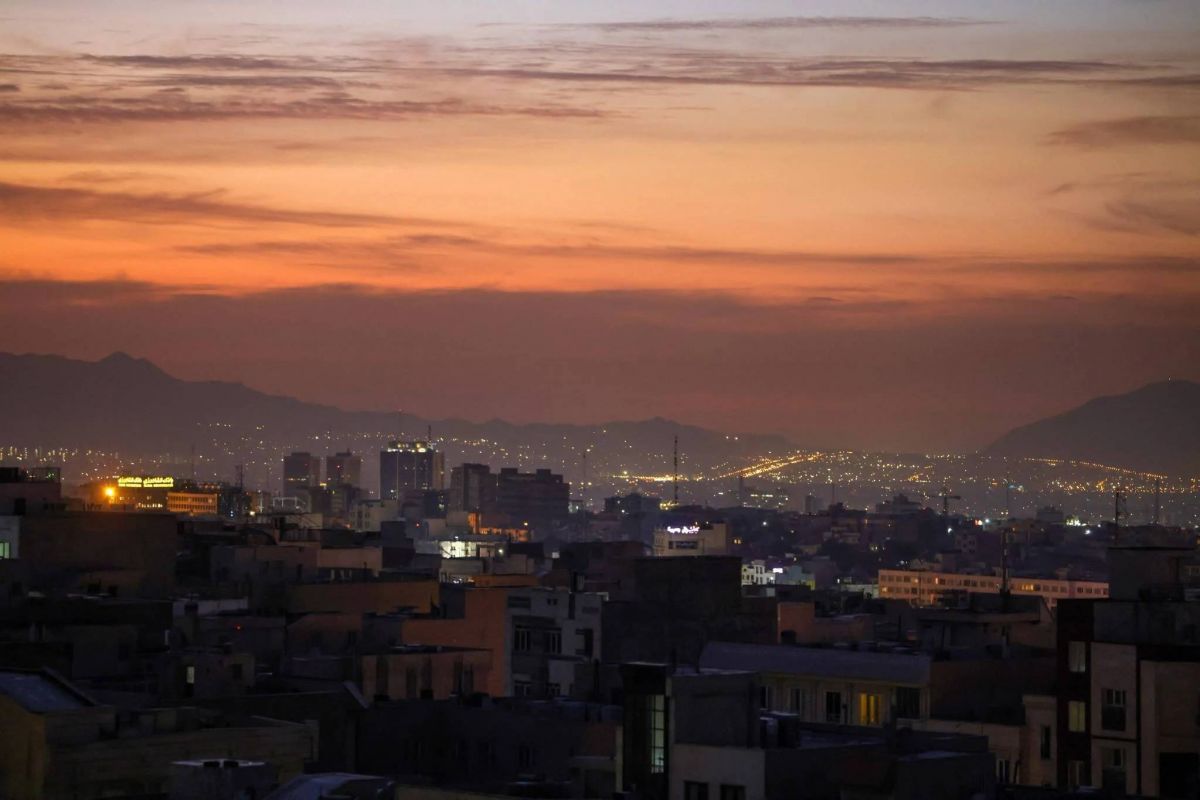
Tehran at dawn on Oct. 26, several hours after the launch of the Israeli attack which notably hit infrastructure in the capital, several explosions having woken up residents. (Credit: Atta Kenare/AFP)






Iran asserted its right to defend itself Saturday after Israeli strikes on military sites on its soil, the latest in a series of hostilities between the two rival countries that have fueled fears of a military escalation in the Middle East. Dubbed the "Days of Repentance," the attack was the first publicly announced by Israel against its arch-foe, which saw three waves of airstrikes launched before dawn Saturday against air defense systems and missile manufacturing facilities in the country. Iran reported "limited damage" and four military personnel and one civilian killed.
According to the Iranian army, "military sites in the provinces of Tehran, Khuzestan and Ilam" were targeted by Israel. "Thanks to our air defense, the attacks caused limited damage and only some radar systems were damaged," the armed forces' general staff announced. "A significant number of missiles were intercepted and enemy aircraft were prevented from entering our airspace."
Self-defense
At Tehran's request, the U.N. Security Council will meet urgently on Monday to discuss the situation in the Middle East, the Swiss council head announced to the press on Sunday. This meeting will take place at 3 p.m. (New York time) with Iran's request supported by Algeria, China and Russia, it specified. Iran's foreign minister called on Sunday for the Security Council to meet urgently to condemn the Israeli strikes.
Also using the notion of self-defense, the Israeli army said that it had "struck missile manufacturing sites ... that Iran has been firing at the State of Israel for a year," as well as "surface-to-air missile batteries and other aerial systems."
"The Iranian regime and its proxies in the region have relentlessly attacked Israel since Oct. 7 [2023] on several fronts," it added, in reference to Hamas, Hezbollah and the Houthi rebels in Yemen. With these strikes, the Israeli army said it had "completed the response to Iran's attacks," in reference to the firing on Oct. 1 of some 200 missiles at Israel to avenge in particular the assassinations of Hassan Nasrallah and Hamas leader Ismail Haniyeh in Tehran.
Prime Minister Benjamin Netanyahu said Sunday that Israel's "precise and powerful" attack on Iran had "achieved all its objectives," in his first public response to the strikes in Iran. "The air force struck Iran's defense capabilities and missile manufacturing capabilities" targeting Israel, he said during a ceremony marking the first anniversary of Hamas' Oct. 7, 2023, attack on Israel that sparked the Gaza war. Israel also threatened Iran with "a heavy price" if it retaliated. "I hope this is the end" of the cycle of violence, said U.S. President Joe Biden, whose country is the main arms supplier to the Israeli ally.
'No need to answer'
The Israeli strikes should be "neither exaggerated nor minimized," said Iranian Supreme Leader Ali Khamenei, whose country has made support for the Palestinian cause one of the pillars of its foreign policy. For Joost Hiltermann, director of the Middle East program at the International Crisis Group, the United States wanted the Israeli retaliation to be "proportionate so that Iran would not need to respond."
According to experts, the aim of the attack was to demonstrate Israel's offensive capabilities while avoiding escalation. Hasni Abidi, director of the Center for Studies and Research on the Arab and Mediterranean World, also believes that under pressure from the United States, Israel carried out a "limited" operation to reduce the risks of an "explosion." Israel "carried out a media and political coup, not a military one."
Despite the risks of failure and lingering concerns, life continued as normal in Tehran and Tel Aviv.
“I don’t think there will be war in Iran,” said Sepideh, 30, as she walked to work in Tehran.
“We are worried but not overly so,” said Yaniv Chen, 42, on a Tel Aviv beach.
“Iran has the right and the duty to defend itself against foreign acts of aggression, based on the inherent right of self-defense,” Iran's Foreign Ministry stated.
Iran “will not hesitate to respond decisively and proportionately to any violation of its territorial integrity and security at the appropriate time,” warned its foreign minister Abbas Araghchi. Iran’s determination to defend itself “has no limits.” A way of raising the stakes while talks were being held Sunday in Doha around new proposals for a cease-fire in Gaza and the American envoy Amos Hochstein was expected in Israel to discuss a cessation of hostilities in Lebanon.
