





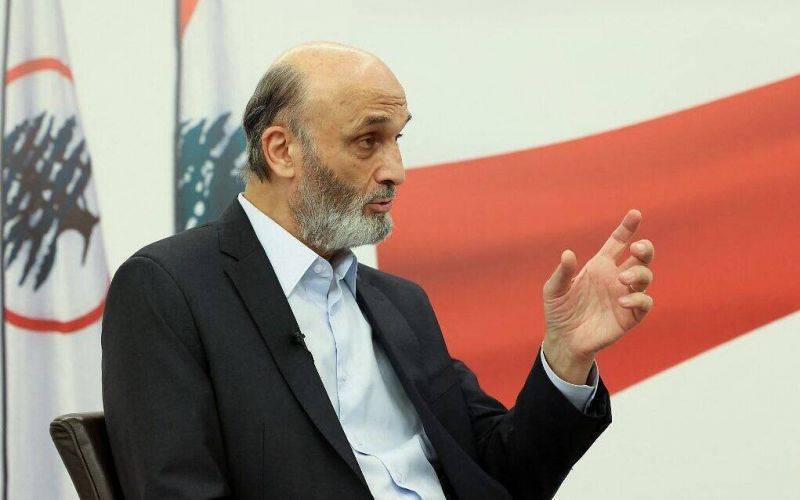
Lebanese Forces leader Samir Geagea. (Credit: AFP file photo)






Lebanese Forces (LF) leader Samir Geagea told Al-Arabiya TV on Wednesday that "if the army was present on the border, Israel would not have attacked Lebanon" and that Parliamentary Speaker Nabih Berri and caretaker Prime Minister Najib Mikati do not "want to ask Hezbollah to disarm."
"They do not want to implement resolutions 1559 and 1680 ... are playing smart in their management of resolution 1701, and do not want to demand that Hezbollah disarm," said Geagea. According to him, "the understanding of Messrs. Berri and Mikati of U.N. Resolution 1701 is partial" and there is neither room nor time to "play smart and maneuver" in the implementation of international resolutions.
"The Lebanese government must declare its commitment to international resolutions to avoid the worst, and must also respect resolution 1559 which concerns the disarmament of armed groups," he stressed.
Resolution 1559, adopted in 2004, calls for the disarmament of all militias, an end to all foreign intervention in Lebanon, and the preservation of the country's sovereignty and territorial integrity. Resolution 1701 (2006), adopted after a war between Hezbollah and Israel, aims to establish a lasting ceasefire, strengthen the Lebanese armed forces in the south of the country, and ensure the absence of any military force outside the Lebanese army. Resolution 1680 (2006) calls for the establishment of a dialogue between Lebanon and Syria to define bilateral relations, particularly with regard to borders and the disarmament of militias.
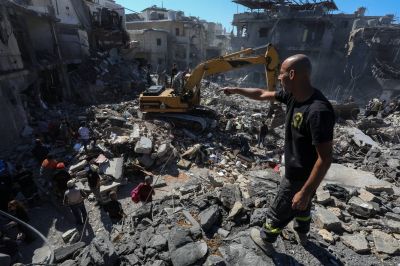
According to Geagea, "the ongoing war in Lebanon is between Israel and Iran" and the country "is heading towards more deaths, destruction and ruin."
"I warned of an imminent war several months ago, and asked Mikati to be frank with Hezbollah," he added. "We are not seeking to prolong the war to eliminate Hezbollah, as we are accused of doing."
Presidential election
Regarding the visit this week to Beirut of the American envoy Amos Hochstein, the LF leader also considered that some of his proposals undermined Lebanese sovereignty. Hochstein, who met with Mikati and Berri, stressed that a U.S.-sponsored agreement could complement Resolution 1701, a kind of addendum specifying the concrete details of its implementation.
Regarding the presidential election, Geagea said: "There is a group, headed by Berri, that does not want to elect a president before the cessation of hostilities."
"Berry must call a parliamentary session to elect a president, and then we will see who will be absent," he added.
Lebanon has been without a president since Oct. 31, 2022, when Michel Aoun's term ended, without Lebanese MPs having managed to elect a new head of state since then. "There is a strong tendency among political blocs to appoint the army commander [Joseph Aoun] as president," he also said, before specifying that he himself "needed to know the army commander's policy before voting for him."
On Tuesday, the leader of the Free Patriotic Movement (FPM), Gebran Bassil, had ruled out the possibility of a candidacy by the army chief who, according to him, "has no project for Lebanon and does not unite the Lebanese."

 7 p.m. recap: Iran warns Egypt, Israeli soldiers vote in south Lebanon, Haret Hreik responds to Kataeb