





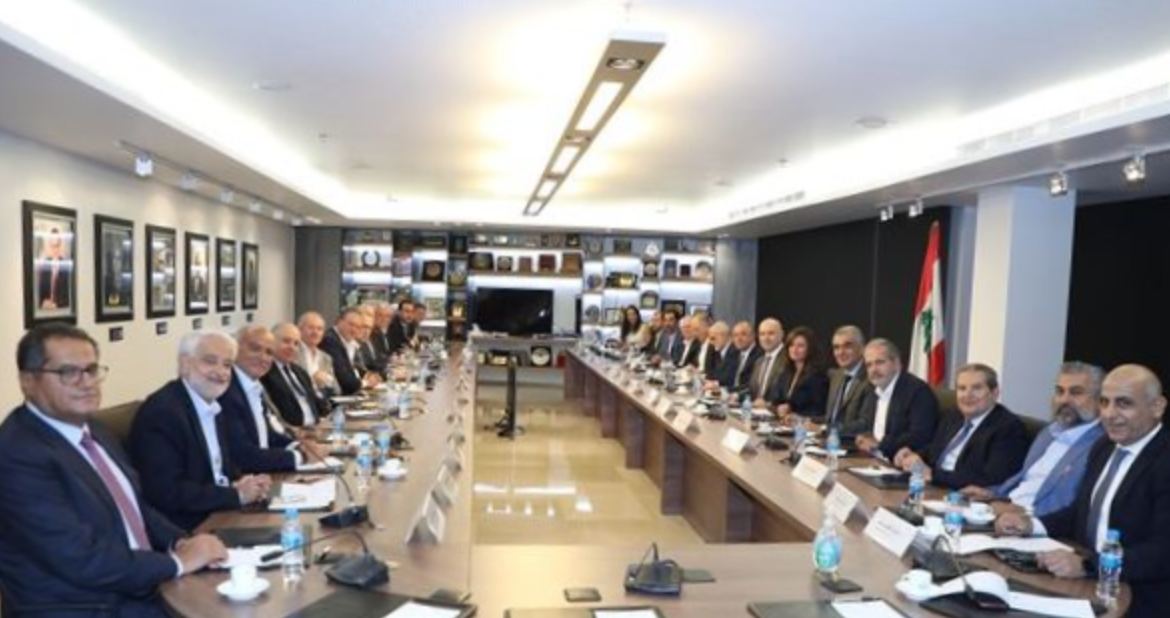
Economic bodies gathered with deputies from the various parliamentary blocs on Oct. 22 at the headquarters of the Beirut and Mount Lebanon Chamber of Commerce, Industry and Agriculture. (Credit: National News Agency)






According to former minister and president of economic organizations Mohammad Choucair, “economic activity [in the private sector] in Lebanon has fallen by 85-90 percent, with the exception of activity linked to foodstuffs and certain basic and essential products,” while the country has been at war with Israel for over a year.
This is a situation that “will lead to a significant drop in Treasury revenues,” while “the central bank's foreign exchange reserves fell by $343 million in the first half of October,” he pointed out, adding that “the most important question is what the situation will be in the months following the end of the war.”
Choucair made these remarks at the end of a meeting of economic bodies with MPs from the various parliamentary blocs on Oct. 22, under the theme “Saving Lebanon.” The aim of the meeting was “to inform the representatives of the Lebanese people of the true reality of the country's economic and social conditions,” according to a press release.
The meeting also aimed to “encourage a cease-fire and the implementation of Resolution 1701,” to “launch the constitutional process to elect a president,” as well as to “strengthen the solidity of institutions and enable them to continue working,” in order to preserve their employees and economic activity, according to the same text.
According to the former minister, the economic losses resulting from the Israeli aggression on Lebanon are estimated at “nearly 10 billion dollars.” He also warned that “if the war continues, a large number of companies will be unable to pay salaries, which will inevitably lead to a reduction in salaries ... and a reduction in the number of employees.”
According to the press release, the economic organizations and MPs agreed, among other things, to set up a commission made up of MPs and representatives of the economic organizations, after approval by the Parliament Speaker, to monitor the various economic and social developments during the current phase. They also agreed that the organizations would draw up an economic and social emergency plan, which the MPs would help to implement.
This article was translated from L'Orient-Le Jour.

 7 p.m. recap: Iran warns Egypt, Israeli soldiers vote in south Lebanon, Haret Hreik responds to Kataeb