






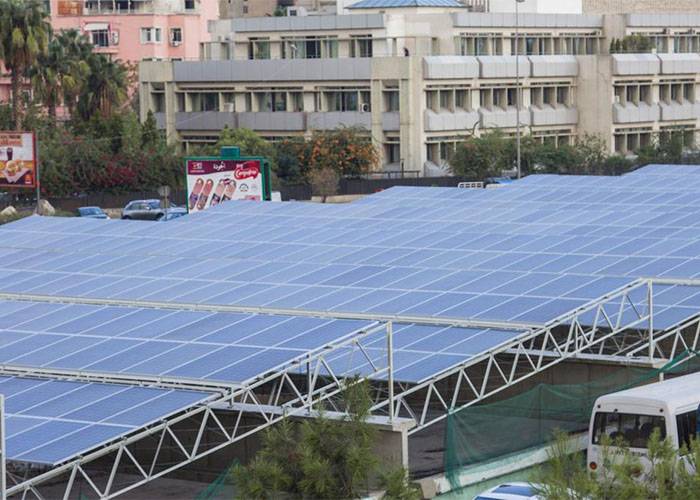
The Beirut River Solar Snake. (Credit: The Lebanese Center for Energy Conservation website).






BEIRUT — As Lebanon continues to experience electricity shortages, caretaker Energy and Water Minister Walid Fayad announced the launch of a call for tenders on Sep. 11 for the construction of a solar farm with a total capacity of eight megawatts along the Beirut River.
The project — set to be financed by the Energy Ministry — will serve as an extension of a power station previously built in 2015 (with a total capacity of one megawatt), dubbed the Beirut River Solar Snake (BRSS). Meant to reach a total capacity of 10 megawatts (by gradually extending its capacity by one megawatt per year), the BRSS never reached its target.
Marc Ayoub, energy policy researcher at AUB’s Issam Fares Institute, said to L’Orient Today that while this project is a positive step in the right direction, it does not represent a comprehensive solution to the country’s electricity problems. Ayoub questioned whether this would be the most efficient way to use the ministry’s money, given the country’s circumstances.
Only 0.1 percent of total national demand
Around 2,000 megawatts are needed to meet Lebanon’s total national electricity demand, said Ayoub, of which only 600 megawatts are provided by the EDL, in its most efficient days of production.
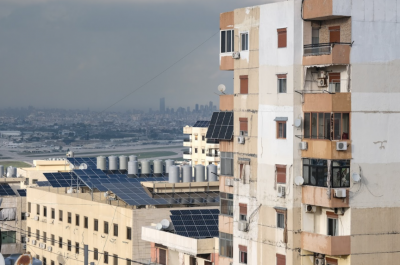
Pierre Khoury, President and Director General of the Lebanese Center for Energy Conservation (LCEC), told L’Orient Today that the country has around 1,500 megawatts of decentralized renewable energy installations, meaning those installed through private initiatives by Lebanese people.
”But these provide a total of around 200 megawatts because solar installations only produce between 15 and 20 percent of their total capacity,” or what Ayoub called “effective/actual energy.”
”This is due to multiple factors such as the availability of the sun, weather conditions as well as unused (lost) energy, amongst others,” explained Ayoub.
Combined with EDL provisions, this means that only 800 megawatts out of 2,000 megawatts are being provided, he added, or only 40 percent of the national electricity demand, according to our calculations.
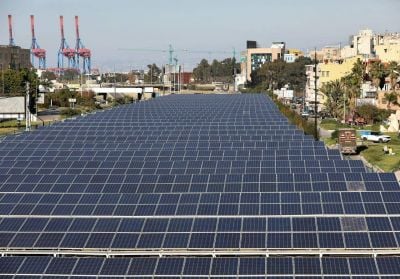
The expansion of the BRSS will likely also yield between 1 and 2 megawatts (equivalent to only 0.1 percent of total national demand according to our calculations) — and not its full capacity of 8 megawatts — particularly given its location in Beirut, where sun radiation is lower compared to other regions.
“The area where the highest yields could be produced is the Bekaa [where sun radiation is significantly higher than the capital],” said Ayoub, adding that the ministry could gain more by reconsidering the location of its latest initiative and using public lands.
The first phase of the BRSS project had cost $4 million in 2015, and while it’s unclear what the new cost will be, Ayoub estimated that the cost per megawatt (cost of electricity) will be lower due to technological improvements that have driven solar panel prices down, yet without considering the mounting structure cost, which might drive the cost higher.
A project of 6.2 megawatts as a first step
After the call for tenders concludes on Oct. 23, 2024, Khoury estimates it could take less than the 12-month deadline set in the tender contract to install the solar panels and connect them to Electricite du Liban (EDL)’s national grid. The winning bidder will be in charge of maintenance “for a year or two,” Khoury estimated, before transferring to EDL, who will become its owner and manager afterward, he added.
“The bidding companies will need to submit an initial offer to build a farm with a total capacity of 6.2 megawatts, after which the ministry will compare the offer it gets, and go for the bid that costs the least,“ said Khoury. “Depending on the available budget, the total capacity of the project may be increased to 8 megawatts, otherwise the solar farm will be expended on a pro-rata basis and any expansion beyond 6.2 megawatts will be contingent on the available ministry funds.”
This project is part of the ministry’s plan to expand the solar energy market in Lebanon, as it hopes to increase the country’s share of renewable energy from 20 percent to more than 30 percent.
Khoury says that the Energy Ministry has also launched a new bid to rehabilitate the Jeita-Hrash hydropower plant, built back in the 1930s. The power station, which used to generate around 1.2 megawatts, has been out of service for the last six years.
Fayad did not respond to L’Orient Today’s immediate request for comments.
