






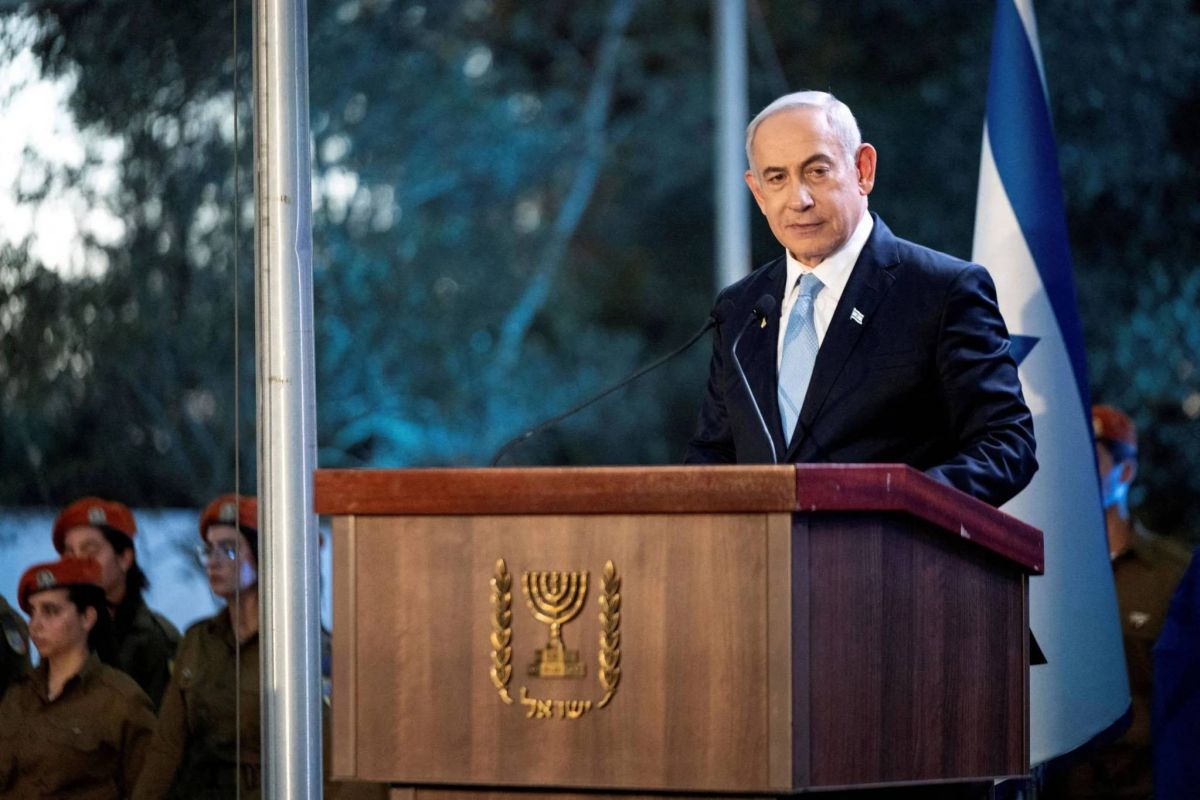
Israeli Prime Minister Benjamin Netanyahu speaks at a memorial ceremony in Jerusalem, on Aug. 4, 2024. (Credit: Naama Grynbaum/Reuters)






American magazine Time published an interview with Israeli Prime Minister Benjamin Netanyahu on Thursday, given to journalist Eric Cortellessa. Here are the key points from the interview regarding the possibility of a regional war, the future of Gaza and the American-Israeli relationship.
Hezbollah and the regional war
The Israeli prime minister first stated without hesitation that Israel could defend itself at the same time against Hamas, Hezbollah, the Houthis in Yemen and Iran.
"Hezbollah should think twice before considering opening a wider front by attacking Israel," he warned. Regarding the prospect of bringing back the 60,000 displaced people from the north of the country for the start of the school year in September, Netanyahu did not give a date for their return.
As the region holds its breath awaiting Iran’s response to the assassination of Hamas political leader Ismail Haniyeh on July 31 in Tehran, the Israeli prime minister stressed the importance of a broad defense against “Iran’s terrorist axis,” which also affects “all countries in the region, including our Arab partners.” “The stronger we are, the stronger our alliances, the less likely it is that we will have to take military action,” he said. Echoing elements of his well-received speech to the US Congress on July 24, the head of government called the ongoing war “existential.” “Not just for our defense, but for the defense of the West and civilization against barbarism,” he added.
Apologies for Oct. 7
In an unprecedented admission, Benjamin Netanyahu apologized for Oct. 7. “Apologize? Of course. I am deeply sorry that something like this happened.” A phrase quickly picked up by other media outlets, which the prime minister uttered after several refusals to discuss the criticism leveled at him for the security breach that allowed the Hamas attacks. “I never had any illusions about Hamas ... Oct. 7 demonstrated that those who said that Hamas had renounced war were wrong. I probably did not question enough this assumption that was then common among security agencies.” The head of government also postponed the examination of his responsibility until after the war, saying that it would be a “mistake” to open the subject now, when Israel is “in the midst of a war on seven fronts.”
Faced with 72 percent of Israelis who believe that Netanyahu should resign immediately or when the war is over, the prime minister affirmed that he would remain "in power as long as [he] believes he can help lead Israel towards a future of lasting prosperity and security," specifying that "it does not depend only on him" but on the people.
Justification of the policy prior to Oct. 7
The Israeli prime minister also defended his policy prior to Oct. 7, particularly with regard to Hamas in Gaza, clearing Qatar of any accusations that it may have been made of having financed the Islamist movement, while the gas emirate plays a key role in the truce negotiations. Doha's support was intended for a civilian administration to avoid a humanitarian disaster in the enclave, the prime minister explained, adding that this had "not prevented him from leading three military campaigns" against Hamas to "prevent it from having the capacity to attack Israel." Justifying the fact of not having completely eliminated the group at that time, he invoked the lack of internal and international legitimacy for a large-scale ground invasion, also complaining about the current criticism following the "worst terrorist attack against the Jewish people since the Holocaust."
Gaza truce agreement and hostages released
After the assassination of Fouad Shukur in the southern suburbs of Beirut, a few hours before that of Ismail Haniyeh in Tehran – which Israel refuses to comment on – a cease-fire agreement is not only still possible, but "its chances have increased," according to Netanyahu. For him, the "military pressure" exerted on Hamas in the Gaza Strip will allow the release of the hostages still held, but also the destruction of the group's military capabilities and the assurance that it will no longer govern the enclave.
Asked about the possibility of an agreement that would release all the captives but would not end Hamas's rule in the Palestinian enclave, the prime minister responded negatively, stressing that this was a consensus in Israel and would only lead to a repeat of Oct. 7. While the military hierarchy has recently multiplied its expressions of disagreement with his government, he said that "in a democracy, decision-making responsibility lies in the political echelons of the political leaders."
The future of Gaza
"I want to end the war. If I could, I would end it tomorrow. And if Hamas laid down its arms, surrendered, went into exile, the war would be over immediately," continued Netanyahu. Returning to his vision of the post-war period in the enclave, the head of the Israeli government explained the notion of demilitarization, affirming that the priority was to "prevent the trafficking of weapons and terrorists from the Sinai" in Egypt. "That is why I insist on the permanent control of the Philadelphi corridor between Egypt and Gaza," he said, while the issue is a point of contention with Cairo for progress in negotiations for a truce.
For the Israeli prime minister, preventing Hamas from controlling Gaza has two objectives: "Eliminating a front so close to the heart of our country" and "sending a message to all the other elements of Iran's axis of terror." After denying using famine as a weapon of war, blaming Hamas for the lack of humanitarian aid arriving in the enclave, he said he wanted to avoid mobilizing for this "a much larger military force, which would occupy and manage Gaza." "What we want is the elimination of Hamas, but a civil administration to manage Gaza. And we are working on how to do it," he stated, mentioning "potential support from regional partners."
Arab countries, the Palestinian state and normalization with Saudi Arabia
Refusing to name the countries in question, Netanyahu nevertheless stressed that "the defeat of Hamas serves not only the goals of Israel but also the peace and security interests of the entire region, whether they admit it openly or not." "In any case, they told us so in private conversations," he added. While the Israeli parliament recently rejected the idea of the creation of a Palestinian state, the prime minister summed up his "vision of a long-term arrangement with the Palestinians" thus: "They would have the powers necessary to govern themselves, but not those that could threaten us. First, security."
Rejecting the “conceptual trap” surrounding the notion of a Palestinian state, Netanyahu argued that normalization with Saudi Arabia would become more likely once Israel wins. “I have not given up on this deal,” he said, despite Riyadh’s condition of an irrevocable commitment to the path of creating a Palestinian state, which the prime minister’s two far-right partners, Itamar Ben Gvir and Bezalel Smotrich, firmly reject. “I can assure you of one thing: I lead, I make the decisions, I formulate the policy,” he insisted.
Civilian casualties in Gaza and colonization
Netanyahu subsequently defended the military's actions in Gaza, saying that the army had taken "unusual measures that no army has ever taken in history to avoid [civilian] casualties," putting the ratio of civilians to combatants killed at "one to one," or "around 15,000, or more," while the current toll from the local health ministry in Gaza is approaching 40,000 Palestinians killed since Oct. 7. He also implicitly criticized Egypt's refusal to open its borders to accept Gazan refugees, saying that the high number of civilian deaths was mainly due to the fact that "Gaza was blocked because the population cannot go to Sinai."
Reaffirming that Israel is a country governed by the rule of law and that the judiciary is independent and functional, the prime minister dismissed criticism of a permanent annexation of the occupied West Bank, pushed in particular by Finance Minister Smotrich. "This is completely exaggerated. ... Take a satellite photo and compare it, you will see that there is not this change that people are talking about," he maintained, while Israel approved in July the largest appropriation of land since the Oslo Accords in 1993. "I did not seek annexation. I explained that our objective was to reach a negotiated solution. (...) It will happen one day, but I do not see it without fundamental changes within the Palestinian Authority." Netanyahu nevertheless insisted on one fact: "We intend to stay here. We will not commit more ethnic cleansing against the Jews than against the Arabs."
This article originally appeared in French in L'Orient-Le Jour.
