


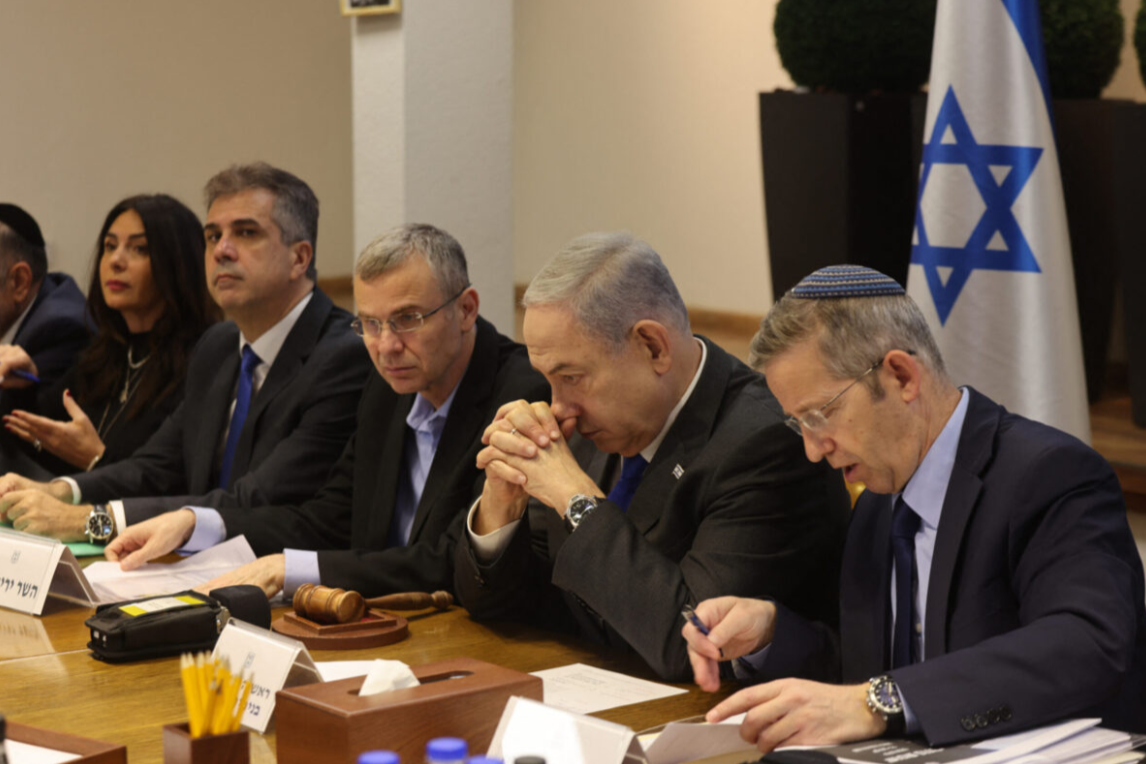
Israeli Prime Minister Benjamin Netanyahu chairs a Cabinet meeting at the Kirya, which houses the Israeli Ministry of Defence, in Tel Aviv on Dec. 17, 2023. (Credit: Menahem Kahana/AFP archives)






Following a four-hour Israeli Security Cabinet meeting on Sunday evening, ministers voted to give Prime Minister Netanyahu and Defense Minister Yoav Gallant the power to decide the “manner and timing” of the country's response to a deadly strike blamed on — and denied by — Hezbollah. Israeli media reported on various details of the meeting, which was held at the Defense Ministry headquarters in Tel Aviv, and its outcomes, as international diplomats and politicians work to minimize the fallout.
The meeting was called to discuss potential retaliation to a strike on Saturday evening in the Druze village of Majdal Shams, located in the Golan Heights — recognized internationally as being Syrian land illegally occupied by Israel, which captured the Golan in 1967 and formally annexed it in 1981.
Both Israel and the White House have attributed Saturday's attack — which hit a football field and killed 12 children — to Hezbollah, while the party has denied all responsibility. Majdel Shams is less well protected than nearby Jewish localities and was not evacuated following the opening of the front between Hezbollah and Israel in October.

Netanyahu cut short his week-long trip to Washington D.C., departing for Israel before the end of Shabbat "in an unusual manner that highlighted the emergency nature of the situation," the Jerusalem Post reported. The outlet wrote that the prime minister went directly to the ministry headquarters upon landing.
Netanyahu's office released a statement at the meeting's conclusion saying that the cabinet had mandated him and Gallant to decide on the timing and nature of the response to the Majdal Shams strike.
Cabinet ministers had objected to the hasty approval of Israeli strikes directly against Houthis on Yemen soil last weekend and so, in response, they were given each "ample time to speak," according to a report from Israeli Ynet News. The same report claims that Finance Minister Bezalel Smotrich and National Security Minister Itamar Ben Gvir abstained from the vote.
According to the Times of Israel, while hostage release negotiations were discussed during the meeting, a separate meeting will be hosted to focus on the next steps regarding that subject.
Haaretz reported that Israeli "defense establishments" are examining "optimal responses" to the Majdal Shams event and support a severe response to Hezbollah, but not one that will lead to a war along the Lebanese-Israeli border. According to Haaretz, the Israeli army is concerned that the response will escalate the situation and influence the chances of a hostage deal.
Haaretz also reported on claims from the Israeli army that months of combat in Gaza have rendered it "not in the position to promote a war in the north." Citing the army, the outlet reported that soldiers are worn out and the equipment required for a ground operation in the north "need tending to."
According to estimates in the defense establishment, Haaretz wrote, an attack on Beirut will provoke a response from Hezbollah and days of escalation but despite this, senior Israeli officials have not ruled this option out.
In an interview with Ynet News, Israeli minister and former war cabinet member Benny Gantz said, "Israel needs to respond, but what it needs more is a full strategic action plan." He attacked Netanyahu's policy, noting that he "cannot continue to play for time. Time only brings with it failures."
According to Gantz, "What is happening cannot continue. The [Israeli army] will attack Hezbollah strongly and with continuous force and also targets of the Lebanese state if necessary. We cannot let this event continue."
 7 p.m. recap: Iran defies Washington over Hormuz; Bab al-Mandeb ignites, Israel strikes the Bekaa