






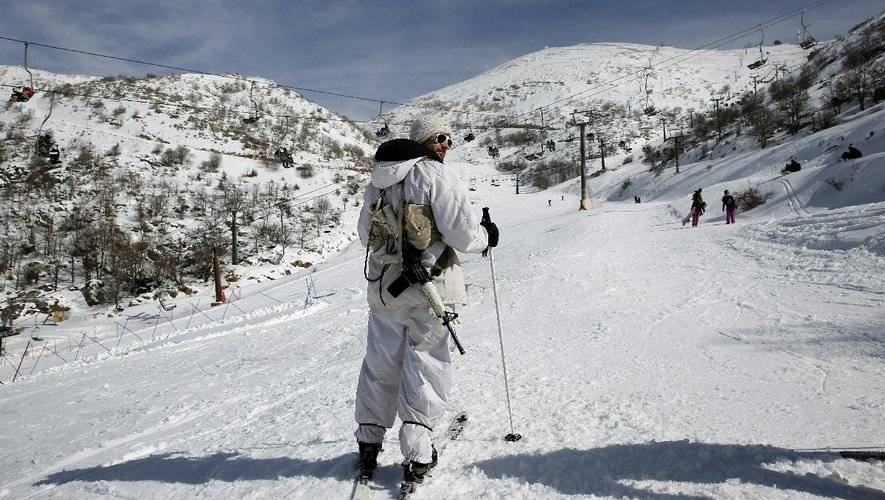
An Israeli soldier on a ski slope on Mount Hermon, in the Israeli-occupied Syrian Golan, in January 2016. (Credit: Thomas Coex/AFP Archives)






BEIRUT — Hezbollah carried out its “largest air force operation” against Israel since Oct. 8 on “a key surveillance center” in Mount Hermon in the Israeli-occupied Syrian Golan Heights on Sunday.
This site has only ever been attacked once before, during the Yom Kippur War between the Syrian and the Israeli armies. That attack happened on Oct. 8, 1973, exactly 50 years before Hezbollah opened its support front following Israel's declaration of war on Gaza, which was in turn a response to Hamas' al-Aqsa Flood operation on Oct. 7.
Known in Hebrew as “Mitzpe Shlagim,” or “Snow Lookout” in English, the observation center, at 2,224 meters above sea level, is the highest point in Syria and allows the Israeli army to monitor areas of Lebanon, Syria, Iraq, Jordan, and Saudi Arabia. The Golan Heights are recognized internationally as being Syrian land illegally occupied by Israel, which captured the Golan in 1967 and formally annexed it in 1981.
In a statement released on Sunday, Hezbollah had said that its fighters “launched an aerial attack with successive swarms of explosive drones on the long-range technical and electronic observation post on Mount Hermon in the occupied Syrian Golan Heights.”
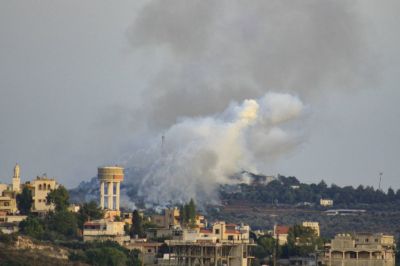
The party added that “the drones hit the center's domes, and its espionage and intelligence equipment, leading to the destruction of the targeted devices and a large fire breaking out.”
An Israeli military post with a view
The site on Mount Hermon is close to the disputed Kfar Shuba hills, along Lebanon's southern border, according to the map published by Hezbollah following the strike.
Not far from the Israeli army's observation post is a ski resort called Oriental Ski. According to a report from Times of Israel, the ski resort doubles as a military zone and “even in normal times has soldiers stationed at chairlifts.”
“This is a very important strategic site that provides Israel with advanced early warning and signal intelligence capabilities,” Military expert Riad Kahwaji told L'Orient Today. “Damaging it will affect Israel’s early warning capability but will not diminish it. Israel has airborne early warnings that can provide considerable capability.”
Israeli Defense Minister Yoav Gallant Gallant had visited the base earlier in the day on Sunday and declared that the Gaza cease-fire would not automatically apply to the fighting in Israel's north.
In February of this year, the Israeli army's Arabic-speaking spokesperson Avichay Adraee announced that a new brigade, the "HaHarim" (Hebrew for mountains) brigade, was being stationed to "defend the areas of" Mount Hermon and the Shebaa Farms.
In a 2022 report, soldiers stationed at Mitzpe Shlagim told the Israeli TV news channel i24NEWS that the majority of their time on the base is spent doing close-combat fitness training. Footage from the news report shows soldiers clad in military fatigues doing target practice in a field of fresh white snow.
“These are the eyes of the state of Israel,” Captain Yahli Aharon told the channel. “When you come up here, you can see the entire area. You absolutely feel how important it is to be here.”

Hezbollah wants to show it can deter Israel without crossing ‘red lines’
Hezbollah announced that the attack was in response to the assassination of one of its members on Saturday evening, when an Israeli drone fired a missile at a van passing through the village of Chaat, some 10 kilometers from Baalbeck. Mayssam Moustapha Attar, born in 1991, was killed in the strike.
Fabian Hinz, research fellow at the International Institute for Strategic Studies, told L'Orient Today that the strike against Mount Hermon is an “attempt by Hezbollah to establish deterrence after the killing of its member in Baalbeck yesterday and it's also about the killing of high ranking officials.”
But at the same time, Hinz argues, Hezbollah is still operating in such a way that it doesn't cross any “major Israeli red lines.”
“Although it is escalatory in that more drones than before were used to strike a new position, its not escalatory enough that Israel would overreact,” Hinz said.
Israel's military said in a statement early on Monday that it had launched multiple air and artillery strikes overnight on what it said were Hezbollah military targets in Lebanon, but no significant response to the Mount Hermon attack has been declared.

“New developments are being presented by Hezbollah in a dramatic fashion.” Hinz said. “It wants to be cautious because there are real escalatory things that Hezbollah can do, like striking Tel Aviv, striking oil and gas installations in Karish, and striking ships — but we haven’t seen any of that. Hezbollah is trying to introduce new elements but not necessarily a major escalation."
Kahwaji, on the other hand, warned, that such a strike by Hezbollah could trigger Israel into attacking Lebanon on a wider scale.
“Israeli strikes will continue so long as there are missiles fired from Lebanon. But successful targeting of high-value sites only strengthens arguments by the Israelis who believe Hezbollah’s capabilities have grown too much to be ignored and a large-scale war should be waged to remove or substantially weaken the threat,” Kahwaji noted.
On June 6, Hezbollah surprised observers with its first-ever firing of anti-aircraft missiles at Israeli jets. The party claimed the Israeli fighter jets, which represent the Israeli army's strongest asset, were forced to retreat. Military experts told L'Orient Today they believed Hezbollah revealed this capability as a matter of deterrence rather than destruction.
