






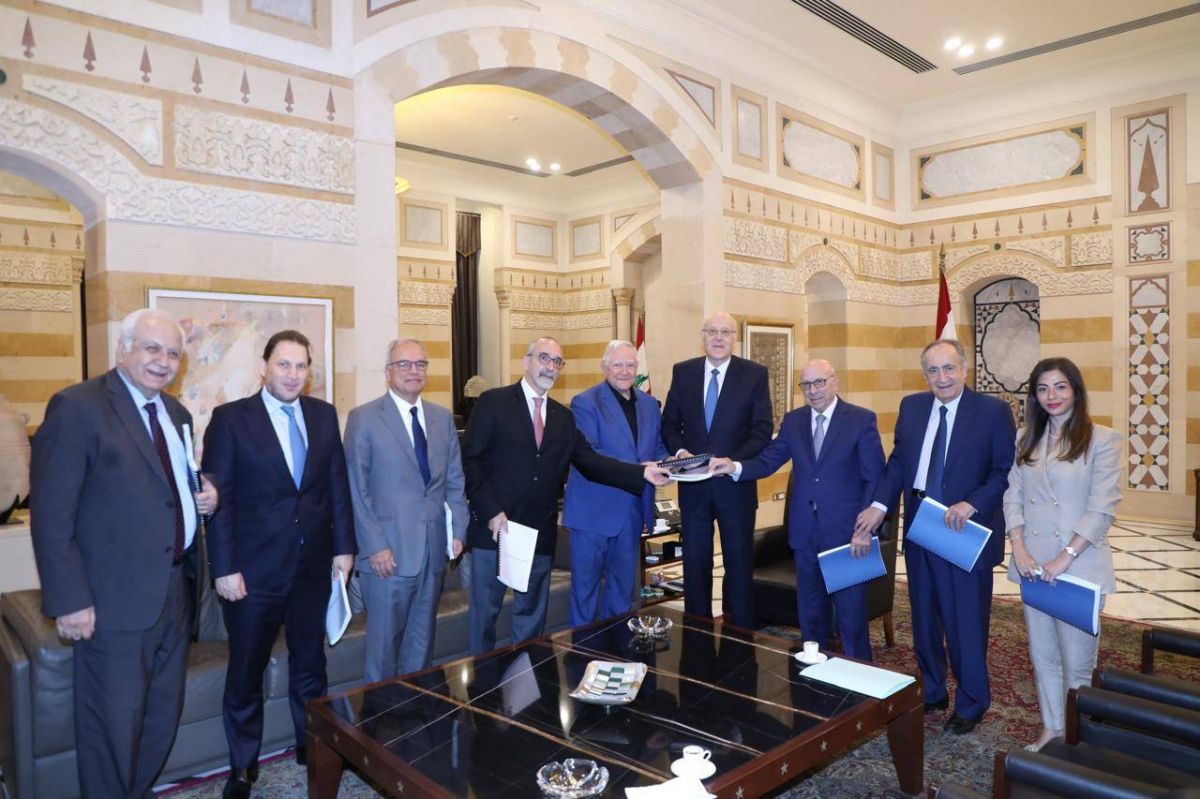
Members of the committee of experts mandated by caretaker Prime Minister Najib Mikati on Monday at the Grand Serail. Photo provided by the office of the prime minister.






Caretaker Prime Minister Najib Mikati is unlikely to be short of reading material this week. On Monday, the committee of experts he appointed last summer submitted to him at the Grand Serail a proposal for a partial overhaul of the Currency and Credit Code (CMC), the main regulatory framework for the Lebanese banking and financial system and the birth certificate of the Bank of Lebanon (BDL).
The committee includes two bankers – Hassan Saleh (Bank Audi) and Abdel Hafez Mansour (member of the Special Investigation Commission) – three former ministers – Shakib Cortbawi, Nicolas Nahas and Ibrahim Najjar – the former vice-governor of the BDL Ghassan Ayyash, Judge Rana Akoum (also the anti-corruption liaison officer of the Ministry of Justice to the United Nations Office on Drugs and Crime), and the jurist and doctor of law Nasri Diab.
The committee, which began its meetings in August 2023, amended a substantial part of the 230 provisions of the CMC, listed in a 113-page document of which L'Orient-Le Jour was able to obtain an undated or signed copy. At this stage, it is only a simple proposal that could, in time, be transmitted to Parliament by the caretaker government or proposed by an MP.
Restoring trust
According to Ibrahim Najjar, the new version of the CMC drawn up by the committee aims primarily to "restore confidence in the Lebanese financial and monetary system," which explains why its authors did not include any provision that "endangers the rights of depositors vis-à-vis the banks."
One of the main changes concerns the supervision of the mission of the BDL governorate. "The committee preserved the powers and functions of the governor, but it also created and improved the competent bodies to control his decisions so that the work of the entire institution can inspire confidence," explains the former minister. The committee thus introduced a completely new article (40 bis) which subjects the actions of the BDL to control by the government but also by internal and external auditors.
The committee also provided an article that requires the BDL to formally dissociate the banks' required reserves – the funds in Lebanese pounds and dollars that they are required to keep at the Central Bank - from the rest of the foreign exchange reserves (article 77). "A measure that makes it impossible for the BDL to use them in the context of its monetary policies," specified Najjar.
Another major change recommended is the amendment of Article 2 of the CMC, which now requires the BDL to respect the interplay of supply and demand to determine the exchange rate between the Lebanese pound and the dollar, as well as other currencies, and this, " via a mechanism" that it will have to put in place. The official rate will have to align with the market rate which will be determined at the end of this process. Articles 2 and 229 provide that, "pending" the establishment of said mechanism as well as the implementation of the regulations to restore the banking sector and clean up the financial system, it is the Ministry of Finance that has the authority to set the exchange rate on the proposal of the BDL.
Finally, Articles 90 et seq. of the Code considerably restricts the BDL's ability to finance the State or its institutions, by setting strict conditions, such as prior validation via a special law limited in time and relating to a specific amount.
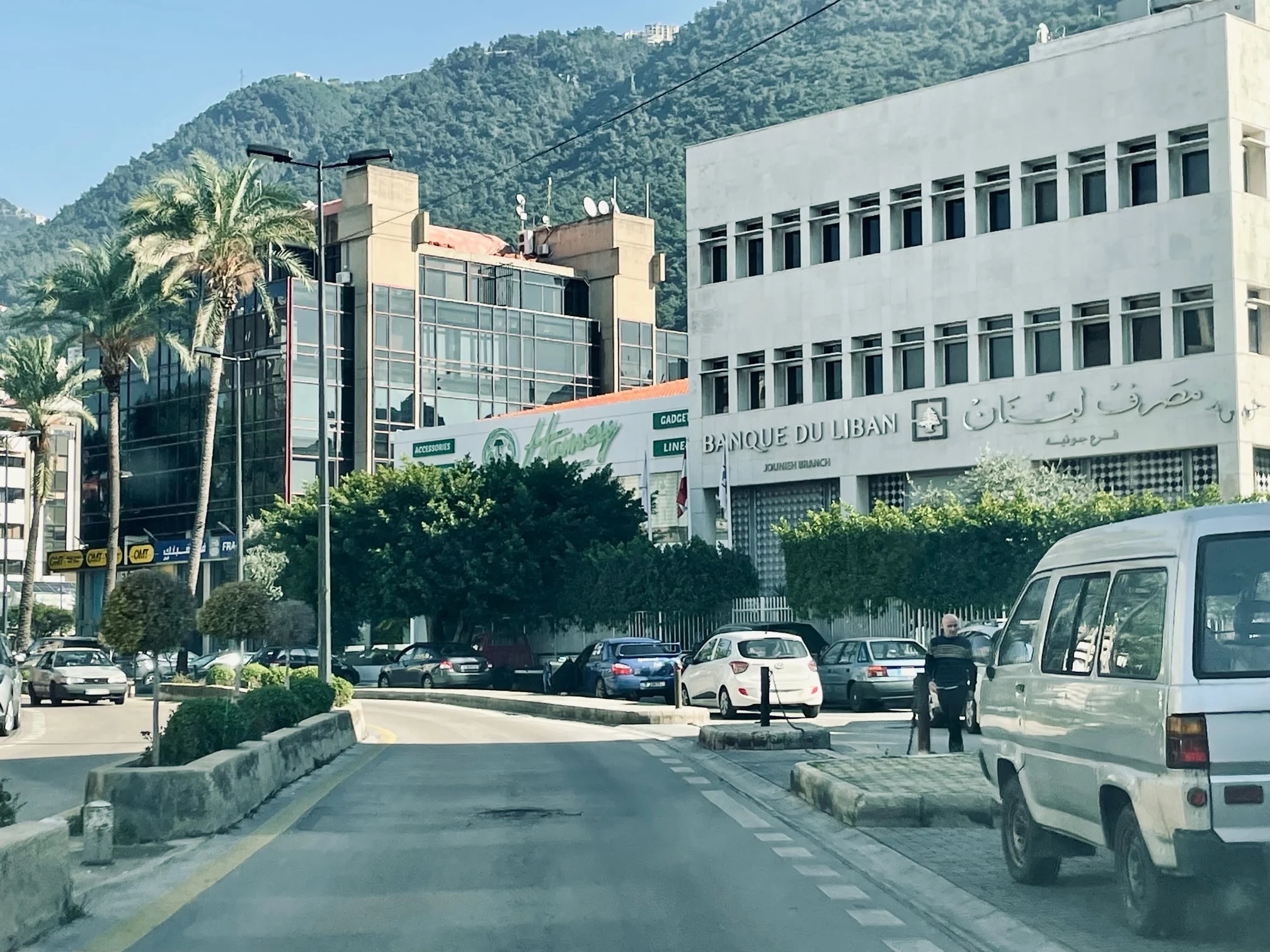 The branch of the Bank of Lebanon in Jounieh, in Kesrouan. (Credit: PHB)
An accumulation of disasters
Najjar specified that the prime minister mandated the commission just after the publication of the BDL audit reports carried out by the firms KPMG, Oliver Wyman and Alvarez & Marsal, commissioned by the government of Hassan Diab in 2020. "He specified that he wanted a tidying up of the law that does not affect the prerogatives of the governor – the governorate being the reserved domain of the president – nor the regulation of relations between banks and the central bank or banks among themselves," he added.
The committee, which worked pro bono, also drafted an explanatory statement explaining the need to rework a law that celebrates its 61st anniversary this year and was last amended in 1994.
In an op-ed published Wednesday in the daily Annahar, former deputy governor Ghassan Ayyash said the CMC was adopted at a time when "the excesses of liberalism threatened the banking sector." He also highlighted the fact that while the adoption of this law had helped "protect the banking system, the rights of depositors and Lebanon's financial reputation," the country had ultimately found itself in the same situation "six decades later."
This is a reference to the crisis that the country has been going through since 2019, during which billions of dollars of deposits were confiscated by banks that were virtually in default, while the BDL squandered other billions of its reserves to cushion the inevitable collapse of the national currency. The authorities, for their part, have remained in the background in the face of this accumulation of disasters.
This article originally appeared in French in L'Orient-Le Jour.