






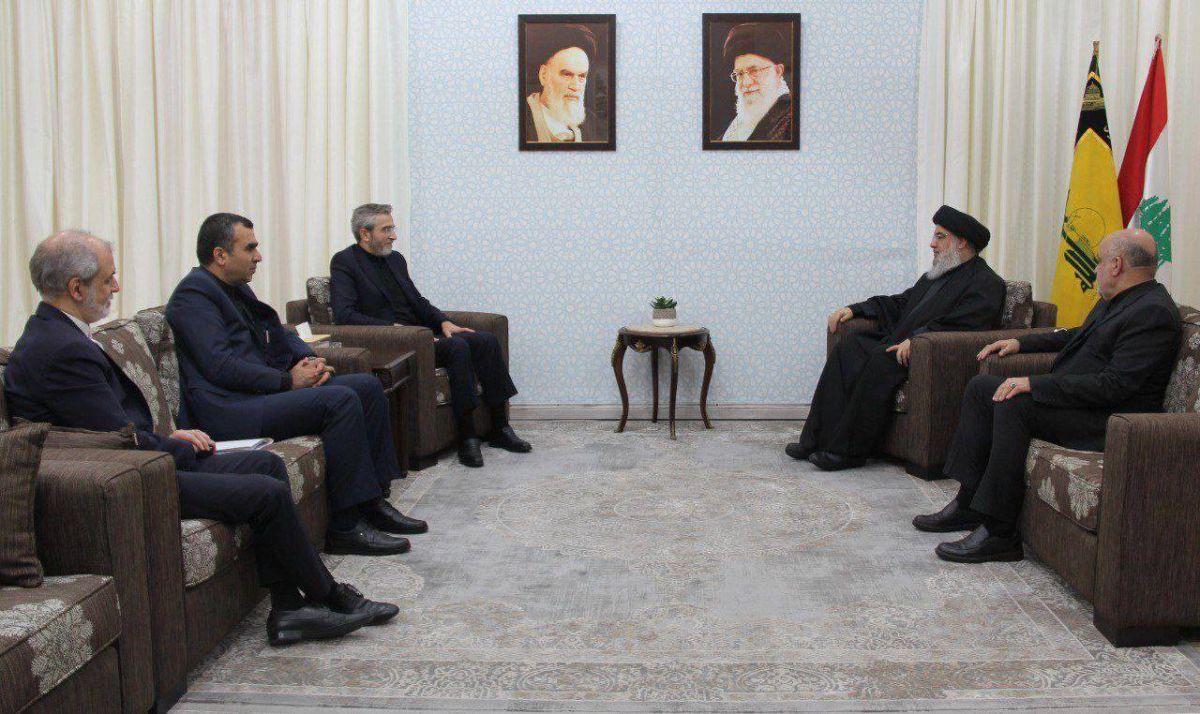
The Iranian foreign minister is received by the secretary general of Hezbollah, in the presence of the Iranian delegation and the Iranian ambassador. (Credit: Hezbollah Media Office)






In a terse statement published on Tuesday, Hezbollah reported a meeting between the Iranian acting foreign minister, Ali Bagheri, and the secretary general of Hezbollah, Hassan Nasrallah, without specifying the time or place. The text states that the two men discussed “the latest political and security developments in the region, particularly on the Gaza and Lebanon fronts, as well as proposed solutions and potential scenarios for the progression of events.”
On May 31, U.S. President Joe Biden presented a cease-fire agreement for the Gaza war, which provides for “a cease-fire, the withdrawal of Israeli forces from populated areas of Gaza, the release of hostages, an increase in humanitarian aid, the restoration of basic services and the return of Palestinian civilians to northern Gaza.” During the announcement, Joe Biden mentioned Lebanon for the first time since the start of the war, insisting on the need to achieve “a return to calm” along the Blue Line.
According to the Hezbollah press release, during the meeting Hassan Nasrallah reiterated his condolences for the death of the Iranian president, his foreign minister and their companions. At the same time, he “thanked Iran for its continued support for the peoples of the region and the resistance movements, as well as for its stable and firm stance against sanctions and threats.” American and European sanctions have frequently hit Hezbollah members and associates in recent years.
Bagheri was appointed acting foreign minister following the death of his predecessor Hossein Amir-Abdolahian in a helicopter accident on May 19, which also claimed the life of Iranian President Ebrahim Raissi. He was in Lebanon on Monday for his first foreign visit. He met with Parliamentary Speaker Nabih Berri, caretker Prime Minister Najib Mikati and Foreign Minister Abdallah Bou Habib.
The Iranian minister made a number of statements from Beirut, including that “the close relationship between the two countries is an essential indicator of stability in the region, as is the Resistance.” On Monday, he confirmed that his country was holding discreet negotiations with the United States in the Sultanate of Oman. Asked at another press briefing about the possibility of extending the war to the southern Lebanon front, Bagheri declared that “if the Zionist entity has an ounce of reason, it will not extend the front, because it does not have the means to go any further in Lebanon.”
After Lebanon, Bagheri went to Syria on Tuesday, where he met “the leaders of Palestinian resistance groups at the Iranian embassy in Damascus,” according to the Iranian agency Tasnim. He was due to be received by Syrian President Bashar al-Assad, whose regime Teheran supports.
This article originally appeared in French in L'Orient-Le Jour.