






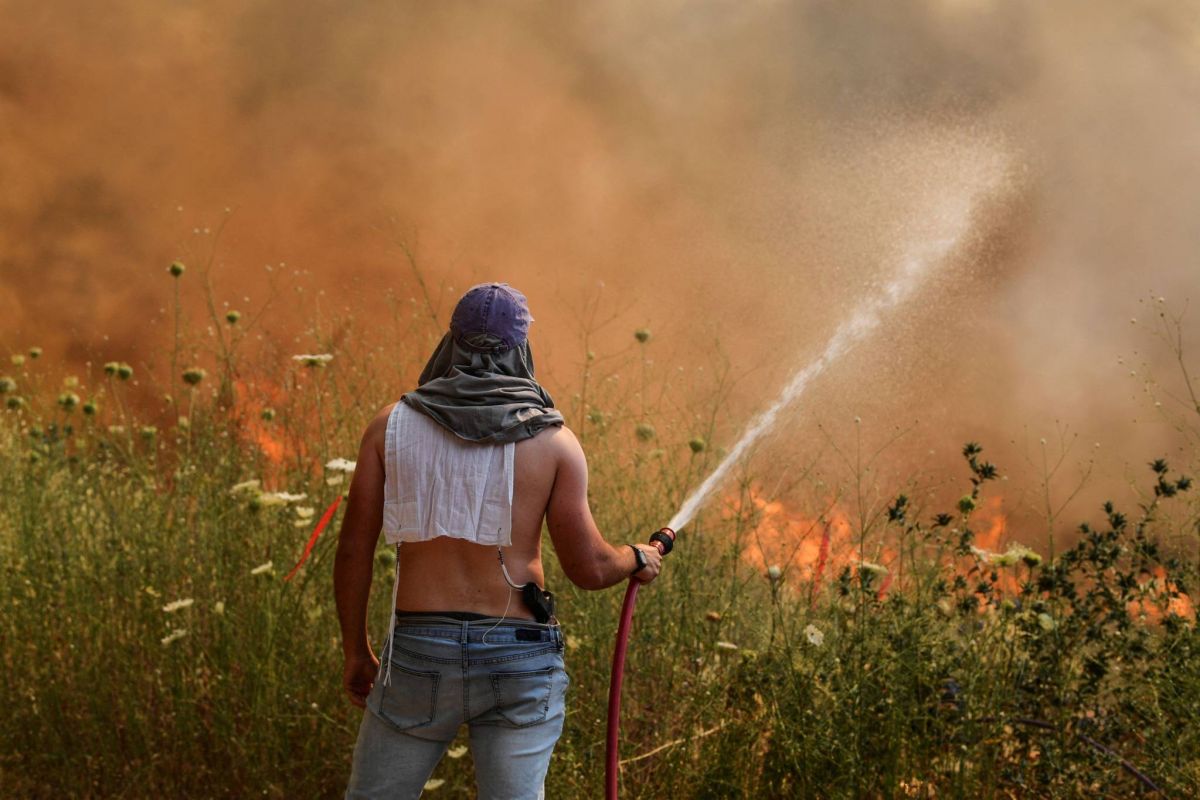
A man extinguishes a fire in Katzin, in the Israeli-occupied Golan Heights, following an attack from southern Lebanon, June 2, 2024. (Credit: Gil Eliyahu/Reuters)






On Sunday, an Israeli warplane targeted a motorcycle in Houla, southern Lebanon, killing two brothers, Ali Qassem, 31, and Mohammad Qassem, 43, in front of their home, according to L'Orient-Le Jour's correspondent, citing several local sources.
Local residents reported that the two brothers were walking their cattle before returning home by motorcycle. The missile that killed them also destroyed a large part of their house.
“They refused to leave the village and continued to work, producing milk and yogurt which they distributed to people in neighboring villages,” one resident told L'Orient-Le Jour. Another resident said that the two brothers “provided for their family, including their other brothers and their elderly father.”
“Who's going to look after them now?” he lamented.
In addition to this attack, Israel launched artillery strikes on Sunday on the outskirts of Naqoura, Tallet al-Hamames and Khiam, according to local residents.
These white phosphorus strikes caused fires on the Khiam plain and in the Mari and Helta forests. The Israeli air force also struck the villages of Tayr Harfa and Aita al-Shaab, in addition to repeatedly flying over several sectors of the border area, crossing the sound barrier at low altitude over the Western Bekaa, Nabatieh and Sour, causing panic among the inhabitants.
The Israeli army's Arabic-language spokesman Avichay Adraee claimed that a “Hezbollah weapons depot located in Mais al-Jabal, in an area used to launch shells towards the Margaliot region,” had been destroyed, “killing one terrorist.”
None of the factions fighting in southern Lebanon announced the death of one of their own.
Hermes 900 shot down
The previous day, the Israeli army had stepped up its attacks on Lebanese territory, particularly late at night. Artillery and machine-gun fire targeted the villages of Kfar Kila and Khiam, as well as the Mais al-Jabal government hospital, which sustained damage to one of its outer walls.
The Israeli air force targeted a house near the stadium and the public school in the village of Hnaouay, which was targeted for the first time since the clashes began on Oct. 8, as well as a house in the village of Baraasheet and another in the village of Siddiqin. An in-depth strike targeted the western part of the Baalbeck region in the Bekaa, targeting one of the villages in the Beit Msheik area, more than 80 kilometers from the southern border. Several people were injured in these attacks.
Tel Aviv claims to have carried out its operations after a Hermes 900 drone was shot down on Saturday while flying over eastern Sour.
“In response to the shooting down of a drone operating in Lebanese airspace by a surface-to-air missile belonging to Hezbollah, our fighter jets attacked a military complex used by Hezbollah in the Bekaa region,” wrote Adraee.
Israel usually responds to attacks on its drones by targeting the Bekaa, where Hezbollah is said to hide its most sophisticated weapons, and claimed responsibility for some twenty attacks between Saturday and Sunday. In a statement, it claimed to have launched a squadron of suicide drones against the headquarters of an Israeli battalion in the Yarden barracks in the occupied Syrian Golan, targeting “an Iron Dome radar and the areas where its officers and soldiers were stationed and positioned.”
These drones “hit their targets with precision, leading to the destruction and deactivation of the radar. Several officers and soldiers were killed and wounded," added the statement.
Since the start of the war, Hezbollah has generally responded to strikes in the Bekaa by attacking the Golan Heights. The party also claimed responsibility for an attack on Israeli military vehicles on Abad Hill, opposite the Lebanese village of Houla. “One of the vehicles was hit and destroyed, burning everyone inside,” the party said in a statement. It also claims to have launched dozens of Katyusha missiles in the direction of the Israeli town of Kiryat Shmona, a large city on the Lebanese border that has been emptied of its inhabitants since Oct. 8.
Hezbollah claimed responsibility for several attacks carried out “in retaliation for the Israeli aggression on the Bekaa” against “the headquarters of the 210th Golan division in Nafah” by dozens of Katyusha missiles, as well as artillery fire on the Israeli sites of Marj, Hanita and Hadeb Yarine.”
The “new headquarters of the Israeli army's 411 artillery battalion,” located in Ga'aton (a village some 10km from the border inside Israeli territory), was also targeted by rocket fire. On Sunday, several warning sirens sounded in northern Israel, reports Haaretz. It reports that an anti-tank missile hit a house in the town of Metulla and that fire-fighting teams were deployed in northern Israel to fight fires caused by the fighting, rescuing three people from the flames.
'Escalation and aggression'
Against this inflammatory backdrop, the Israeli army announced that it conducted new military exercises “to increase its preparation on the northern front,” according to a post by Adraee on social network X.
“This week, exercises in the headquarters of the General Staff were conducted, included in the defense forces' preparations for the battle on the northern front,” he wrote. On the other side of the border, Sheikh Nabil Qaouq, a member of Hezbollah's Central Council, asserted that “the escalation of Israeli aggression and assassinations will not change the reality of the enemy's failure on the battlefield.”
He added: “This will not put an end to the support front or bring the settlers back to their settlements.”
The sheikh was speaking at a ceremony to pay tribute to the mother of Hezbollah's leader, Hassan Nasrallah, who died a week ago. “After eight months of continuous confrontation with the enemy, the resistance is stronger today than it was on Oct. 8,” he promised.
This article originally appeared in French in L'Orient-Le Jour.

