






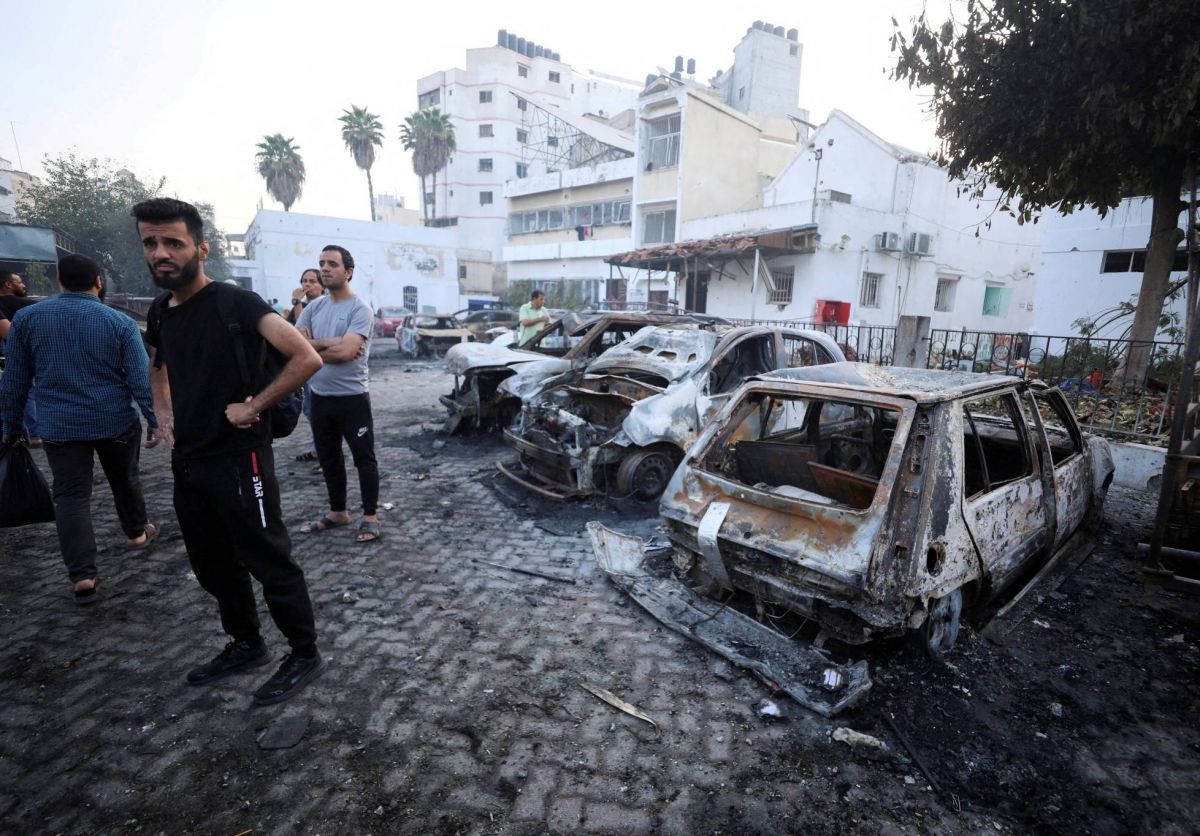
In Gaza City, people inspect the parking lot of the al-Ahli Arab Hospital where there is the site of the impact of a shot that hit the facility the day before, on the evening of Tuesday, Oct. 17. (Credit: Mohammed al-Masri/Reuters)






Click here to follow our live coverage.
Everyone has had their say. On Oct. 17 at around 7 p.m. local time, a strike hit the Anglican al-Ahli Arab Hospital in Gaza City , which was sheltering displaced people who had sought refuge there. The attack killed hundreds of them. The various investigations carried out by Western and regional researchers and media outlets are still giving different versions of the origin of the attack and the number of victims. While the information warfare is adding to the ongoing Israeli assault on the besieged Gaza Strip since the surprise Hamas attack on Israel on Oct. 7, no independent investigation has yet been conducted at the scene of the hospital tragedy.

Less than an hour after the strike, Hamas accused Israel of being the perpetrator, citing a death toll that ranged in the evening between 200 and 900, before settling the next day on a figure of 471 dead. For its part, Israel quickly denied they were behind the attack, and pointed the finger at an errant shot by the Islamic Jihad later in the evening, which refuted these accusations. While Tel Aviv denounced an “exaggeration” of the number of victims, the US intelligence services estimated the death toll a day after the tragedy at between 100 and 300, and told The New York Times that the real figure was more likely to be at the lower end of this range.
Faced with the popular anger that was spontaneously expressed across the Middle East on the evening of Oct. 17, Arab countries directly took up the theory of an Israeli strike, unanimously condemning it. In a strong gesture, Joe Biden, who continued his visit to Tel Aviv the day after the strike, stated alongside Israeli Prime Minister Benjamin Netanyahu that the strike was probably done by the “other team,” later specifying that his own Department of Defense provided this information.
Although it is still impossible to determine exactly the origin of the shot in the absence of an international investigation, L’Orient-Le Jour sheds light on what the various investigations conducted to date have said about the incident.
The warnings: Israel had carried out strikes on the hospital the weekend before Oct. 17, wounding four civilians, said Archbishop of Canterbury Justin Welby, whose Anglican church holds affiliation with the hospital, featured in a video on Channel 4. This assessment was also shared by Le Monde and ReliefWeb, a digital service of the United Nations Office for the Coordination of Humanitarian Affairs (OCHA), which cited Oct. 14 as the day of the strike. The next day, the Israelis called to tell everyone to evacuate, according to Welby.
The exchange of fire: SANAD, Al Jazeera’s investigation team, which attributed the strike to Israel, pointed to four Israeli strikes in the hospital’s zone in the 15 minutes preceding the tragedy. For its part, British daily The Guardian, which was in favor of the theory of a Palestinian error, reported that Hamas’ armed wing, the al-Qassam brigades, had reported on its Telegram channels “rocket bombardments” on the Israeli town of Ashdod at 7 p.m., followed by an attack on Tel Aviv three minutes later.
The images: From a distance, Al Jazeera took live footage of the explosion near the hospital at 6:59 p.m. local time, followed by a fire, and preceded two or three seconds earlier by another sound of an impact in an unspecified location.
A few seconds earlier, a salvo of rockets aimed at Israel is seen on the Qatari channel’s live stream, which seemed to be intercepted by Israel’s Iron Dome air defense system. Between the two, another rocket fired from a different location is seen flashing twice and then exploding in mid-air.
Yet, it was impossible to link this episode directly to the hospital blast explosion, which occurred seven or eight seconds later, as the trajectory of the debris of the rockets and where they fell could not be identified. According to a detailed analysis of SANAD’s videos, this last projectile was completely shattered and destroyed in mid-air during its interception. A week after the attack, based on a cross-check of six videos, The New York Times pointed out that the rocket in question, which Israel designated as the one whose debris exploded near the hospital, was in fact fired from Israel and not from Gaza, and seems to have exploded near the border with the Gaza Strip, more than three kilometers away from the hospital.
The “confession”: An audio recording released by the Israeli army shows two people identified as Hamas members discussing the alleged mistake made by Islamic Jihad in firing a rocket from the cemetery next to the hospital. The tape has been described by Hamas and some experts as an “obvious fabrication,” given the implausible accent, tone and syntax used.
In partnership with the Palestinian al-Haq organization and Earshot, an NGO, Forensic Architecture — which conducted a major investigation into the murder of Shireen Abu Akleh and the Beirut port explosion — concluded that the recording in question had been manipulated, stripping it of its credibility.
The trajectory: In the videos available of the Palestinian rockets fired towards Israel around the time of impact, the rocket questioned by the Israelis has a trajectory that is too high and horizontal to have been fired from the cemetery adjacent to the hospital, the investigation by Channel 4 suggested.
According to the channel, Israel also presented a map showing that the missile was fired from a location southwest of the hospital in the Gaza Strip. Forensic Architecture’s investigation showed that the shape of the crater indicated that the missile probably came from the northeast of the hospital, contrary to what the Israelis say, and this was confirmed by an analysis based on the Doppler effect (which calculates wave variations).
The crater: In photos and videos posted the day after the strike, a crater less one meter in diameter can be seen in the hospital’s parking lot near burnt-out cars. In view of the perimeter of the impact on the ground, military experts unanimously rejected the possibility of an air strike, with some suggesting a mortar strike, an artillery shell or even a defective weapon that had released its charge when falling to the ground.
The projectile and the damage: The aerial images broadcast by the Israeli army indicate that an air strike is to be ruled out, as it would have caused damage (particularly structural damage) to the surrounding buildings, which was not the case. Some of the windows of a church near the parking lot are still seen intact in Channel 4’s video.
According to an analyst interviewed by BBC Verify, Israel has the capacity to carry out airstrikes using drones, in particular Hellfire missiles, which generate a great deal of heat without leaving a large crater. Israel also uses Spike missiles, also dropped by drone, which have a limited impact despite their considerable destructive power, and which would coincide with the traces found on the ground, according to Forensic Architecture’s analysis.
Israeli army spokesman Daniel Hagari indicated that the damage had been caused not by an explosive warhead but by a propellant rocket fuel, which had not yet been consumed because it was fired from close proximity. Moreover, no traces of shrapnel appear to have been found at the scene. Hagari also claimed the day after the hit that nearly 450 rockets fired from Gaza had fallen on the Strip since the start of the onslaught Oct. 7.
In response to The New York Times’ request to see debris from the projectile, Hamas said that the munition in question had disintegrated beyond recognition, with a representative of the Islamist group claiming that “the missile has dissolved like salt in water.”

