






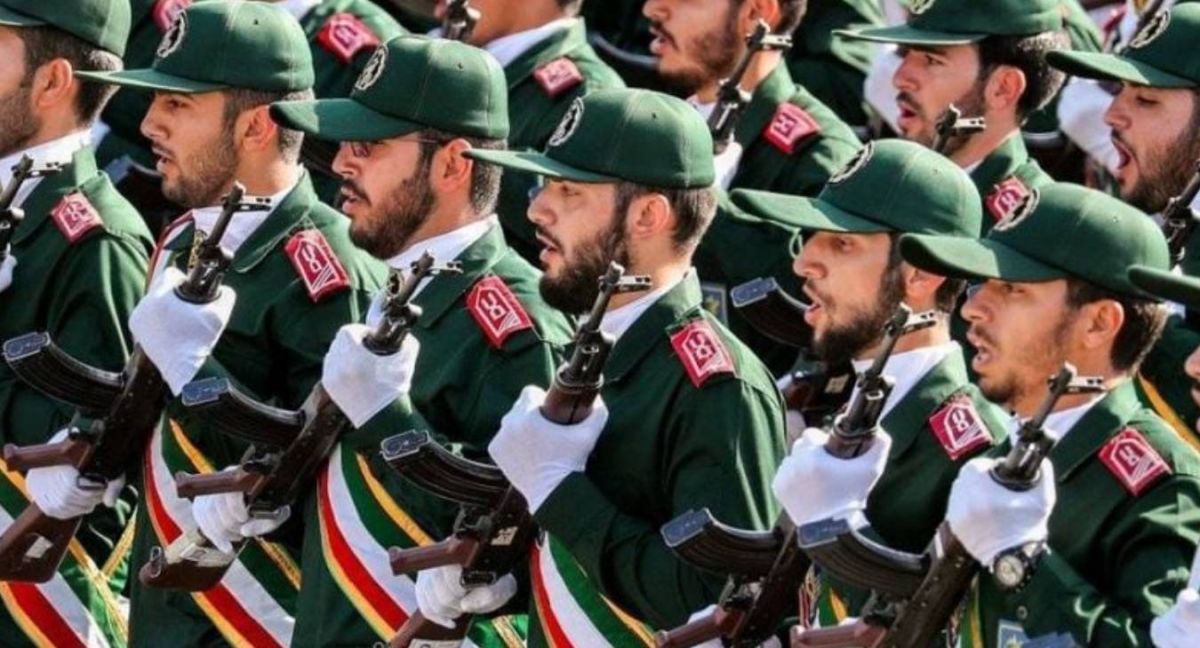
Iranian Revolutionary Guards during a parade, September 2018. (Credit: AFP archive photo)






If you started reading this article hoping for a definitive answer to the question of whether Hezbollah will plunge Lebanon into another war, you’re going to be disappointed.
No journalist, analyst or diplomat can predict with any certainty if Hezbollah will enter the conflict in the next few hours, days or weeks.
Everyone can speculate, but no one can tell for sure how things will unfold. Hamas’ surprise attack against Israel has shattered all certainties. We are now in a gray zone, where anything can happen.
The stakes are extremely high and go far beyond Lebanon. In fact the risk of an all-out war involving several countries in the region can no longer be ruled out.
Such a military venture might seem totally irrational for both Hezbollah and Iran, but Russia’s invasion of Ukraine was also considered irrational.
Every party has its own logic and misjudgments are plentiful in such situations.
The final decision does not lie with Hezbollah leader Hassan Nasrallah.
However, Nasrallah is much more than the mere obedient follower of Iran that he is so often portrayed to be. Nasrallah is a fully integrated member of the Iranian structure, especially when it pertains to matters concerning Lebanon.
His word has weight at decision making tables and it’s reasonable to assume that his influence has grown even stronger since the assassination of Iran’s Quds brigade leader Qassem Soleimani, in 2020. This is due to the considerable influence Hezbollah gained in Syria, Iraq, and Yemen.
Nasrallah is one of the best-known and most feared leaders in the Middle East.
In his 30 years of rule, Nasrallah transformed a militia created by Tehran in the context of “resistance” to Israel, into a regional and local political and military heavyweight, and international drug trafficking empire.
Now 63, Nasrallah faces the most challenging and pivotal decision of his life.
The initiation of an all-out conflict with Israel could potentially elevate his status to an entirely new level, locally, regionally, and internationally.. However, it also carries the risk of jeopardizing everything he has painstakingly built over the past three decades.
It was the 2006 war, the last confrontation between Hezbollah and Israel, that transformed Nasrallah into a “hero” of the Palestinian cause across the Arab world.
It was his voice, his gestures, his smile and his threats that, during a period when Israel was relentlessly bombing Lebanon, contributed to building him into a "legend."
While Nasrallah was the public face of the 2006 war, he was not its mastermind: that role is attributed to Imad Moghniyeh, who was assassinated in Syria in 2008.
At the end of the 33-day war, which left 1,200 Lebanese dead, Nasrallah admitted that he would not have ordered the capture of the two Israeli hostages “if he had known” that it would provoke a war of this magnitude.
Did he have the option of saying “no” at that time anyway? Almost 20 years later, the doubt persists.
‘Striking a blow’
Nasrallah sent his men to fight in every corner of the Middle East, but over the past 15 years he has distinguished himself above all as a political and religious leader.
The “resistance” remained at the heart of his rhetoric, but his priority was to consolidate his influence in Lebanon and the rest of the Arab world. The signing of an agreement on the demarcation of the maritime border between Israel and Lebanon just over a year ago, which Nasrallah endorsed, is further proof of his approach.
In a context that is much more delicate than 2006, is the Hezbollah leader ready to take on the mantle of warlord again?
The party is much stronger than it was then. It is alleged to have 150,000 rockets, 2,000 drones, “100,000” fighters (according to Nasrallah, a much disputed figure) and perhaps even ground-to-air missiles.
The party has honed its urban combat experience during its involvement in Syria’s war in 2013.
In other words, Hezbollah has what it takes to deal a painful blow to Israel, which has long regarded the movement as the greatest threat to its security.
But politically, Hezbollah is also much more isolated than it used to be.
Locally, the party has become increasingly isolated and no longer enjoys Christian support. Regionally, the Sunni heavyweights perceive the organization as an enemy.
This perception may of course change with the Israeli offensive on Gaza — the more brutal it is, the more justified Hezbollah will feel to act — but it’s hard to imagine Hezbollah enjoying the same support it did in 2006.
If Hezbollah chooses escalation, the Israeli response is likely to be far more violent than it was in 2006.
Can Hezbollah afford to push an already fragile Lebanon into a devastating conflict?
Can it risk its own existence in a direct confrontation with Israel, which the United States has unconditionally supported?The US recently deployed its USS Gerald Ford aircraft carrier in the Eastern Mediterranean to back its ally up. In the case of direct confrontation, Israel’s primary goal will likely be to destroy Hezbollah, or to cripple it at the least, to prevent it from taking armed action for decades.
For several days now, Hezbollah members have been privately asserting that the group will intervene if Israel invades Gaza. It would after all be difficult for Hezbollah to watch Israel venture into the Palestinian coastal enclave with the aim of eliminating Hamas without lifting a finger to prevent it.
For the party and for the “axis of resistance,” it’s a matter of credibility.
This axis has just scored a major victory with Hamas’ surprise attack, dealing a severe blow to the Saudi-Israeli normalization process, at least in the short term.
But will it stop here?
One plausible scenario is for Hezbollah to limit its reaction, to avoid escalation and keep face without risking major losses.
Yet, in the present circumstances, it appears extremely risky to distinguish between an action that is impactful enough to make a statement and one that could be considered a declaration of war.
Another, much more concerning scenario, would involve Hezbollah and particularly Tehran, believing that it is an opportune moment to deliver a blow aimed at altering the regional balance of power.
More so than the Israeli incursion on Gaza, this is the factor that appears to be the most critical for determining the course of events. Does Iran currently possess the confidence and strength to potentially initiate a regional war involving Israel and the US?
Time for revenge?
Nasrallah may give his opinion, but in the final stretch, Khamenei will decide. It is the Iranian Supreme Leader who will decide whether Lebanon will suffer the consequences of any decision he takes.
At the age of 84, Khamenei also faces the most difficult and crucial choice of his life.
During his over 30-year reign, Iran’s government lost much of its legitimacy, as witnessed by the protests that have regularly rocked the country in recent years.
If Khamenei planned to build a lasting model at all, he did not succeed, neither at home in Iran nor on the regional stage.
Iran is not an empire. It is a fragile player whose only strength lies in the fact that it poses a permanent threat of destabilization to the region.
Today, Iran is very close to becoming a nuclear power.
Above all, over four decades, Iran has built up a network of low-cost alliances, based on the export of its ballistic missiles and the training of local militias, with whom it maintains more or less organic relations, enabling it to have all its enemies in the Middle East within firing range.
Tehran can now strike from Lebanon, Syria, Iraq, Yemen and Gaza. For Iran, this is both a weapon of deterrence and an instrument of influence in the Arab world.
However, Khamenei has shown a certain aversion to risk in recent years.
In Syria, Israel has repeatedly struck both Iran and Hezbollah. Tel Aviv has carried out major operations on Iranian soil, including the assassination of scientist Mohsen Fakhrizadeh in November 2020.
The US went so far as to assassinate Quds brigade leader Kassem Soleimani in Iraq. Each time, there has been no large-scale retaliation.
Is it time for revenge? Is it time for Tehran to play all its cards? This is all speculation, of course, but as things stand now, nothing seems impossible.
If Iran decides to use its primary strategic asset, Hezbollah, it could likely secure substantial gains, if not an outright military victory, and at the very least valuable political concessions.
But Iran would be running a monumental risk by embarking on such a military venture because this would warrant a response not just from Israel but from the US as well.
In such a scenario, Iran would not only be risking the survival of Hamas, Hezbollah and their allies, but also the existence of its own regime.
The stakes of such a military venture are so high that a rational analysis would suggest that Iran might settle, in the worst-case scenario, for a minimal, small-scale conflict.
Nonetheless, it’s important to note that if such a war did occur, it would likely take place within Lebanese territory.
We can only hope that the stakeholders understand the seriousness of the situation and act with greater restraint as a result.
This article was originally published in French in L'Orient Le-Jour. Translation by Sahar Ghoussoub.
