







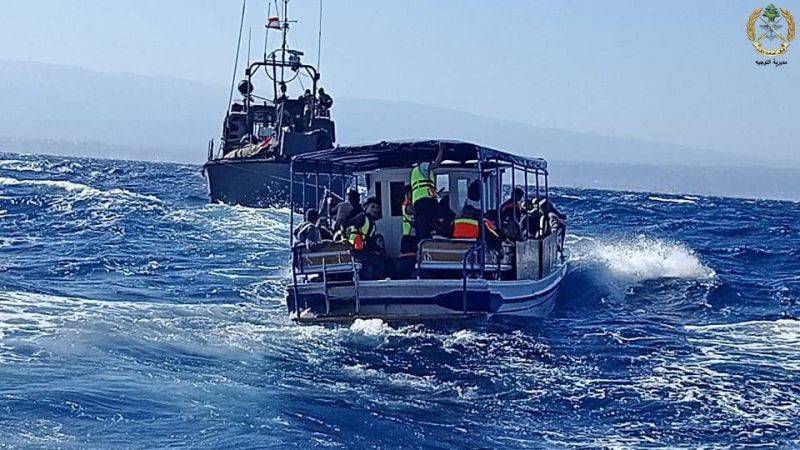
The Lebanese Army thwarts a migrant boat with 55 people on board that set out from Arida, in Akkar, North Lebanon, on Sept. 21, 2022. (Credit: Lebanese Army Twitter)






Want to get the Morning Brief by email? Click here to sign up.
Civil Defense volunteers from across Lebanon are in the “last stages” of extinguishing a fire that engulfed a textile warehouse in Beirut’s southern suburbs a week ago after “working 24 hours a day” to contain the blaze, the Civil Defense’s media office told L’Orient Today. Attempts to extinguish the fire led to the death of one Civil Defense member last week and the injury of 12 others since the start of firefighting attempts, a spokesperson for the Civil Defense said. The warehouse fire continued to burn yesterday amid “vital complications that are obstructing the operation of extinguishment.” The fire has damaged nearby buildings, the same source said, including adjacent warehouses that obstruct entry to the burning textile warehouse and force firefighters to use a more perilous entrance to prevent damaging private property. “The products were piled up at the [burning] warehouse without any measures that take into account general safety rules,” the Civil Defense media office added.
The Internal Security Forces (ISF) issued a public call for information on missing persons who were potentially aboard an irregular migrant boat that sank in Greek waters last month, drowning at least 82 people and leaving “hundreds” missing, the shipwreck survivors estimated. The ISF shared contact details for the Interpol Beirut Office urging residents who “lost someone since June 14” to contact them. The United Nations International Organization for Migration (IOM) recently reported that irregular migration attempts departing from Lebanon made up nearly half of the 378 deaths on the Eastern Mediterranean route in 2022. Irregular departures from Lebanon’s shores more than doubled for a second year in 2022 amid increasingly dire living circumstances.
The Lebanese Railways and Public Transport Authority (OCFTC) launched a call for tenders to manage and operate 95 public buses in Lebanon, caretaker Public Works Minister Ali Hamieh said. The tender specifications are now available on the Public Procurement Authority’s online platform. The OCFTC discontinued the operation of 10 buses donated by France in January due to difficulties financing their fuel, maintenance and drivers’ salaries. The new bus service used only one-fifth of the 50 France-donated buses because they did not have “sufficient funds to finance the fuel and maintenance costs of more buses,” OCFTC director Ziad Nasr then told L’Orient Today. In his press briefing yesterday, Hamieh said tenders to procure fuel and hire drivers for the buses at the time were not bid on, linking the lack of response to exchange rate fluctuations and the lira’s depreciation. A tender to operate Lebanon’s postal services also struggled to incentivize bidders before French shipping giant CMA CGM won the contract.
Saudi Ambassador to Lebanon Waleed Bukhari yesterday confirmed that the deadly clashes which broke out in the Ain al-Hilweh Palestinian refugee camp last week induced the travel advisories about Lebanon issued by the kingdom to its citizens on Friday. Saudi Arabia “was and will be one of the most important supporters of tourism in Lebanon,” Bukhari added. Tourism experts told L’Orient Today the advisories had not yet led to “a direct impact,” such as canceled flights or hotel reservations. The advisories were described as “a negative episode” that could potentially cause a “medium-term impact,” one expert said, while another noted a decline in Gulf tourists’ visits to “Lebanon's mountain areas.” All six Gulf Cooperation Council states issued travel advisories about Lebanon this weekend, nearly a week after armed clashes in Ain al-Hilweh led to the death of at least 13 people, left dozens injured and displaced hundreds of families. Last week, Michael Young, editor of Diwan, the blog of the Malcolm H. Kerr Carnegie Middle East Center, told L’Orient Today the travel advisories could be linked to a potential Israel-Saudi agreement, which prompts concern from the kingdom over “the reaction against its citizens in a country like Lebanon.” After a Central Security Council meeting yesterday, caretaker Interior Minister Bassam Mawlawi said that “endangering Lebanese and Arabs’ security is refused,” adding that “there is no indication that the situation in Ain al-Hilweh would get out of control and spread to other camps.”
Caretaker ministers received reports on the multiyear accounting audits of Banque du Liban (BDL) conducted by KPMG and Oliver Wyman ahead of yesterday’s cabinet meeting, Forces of Change MP Melhem Khalaf said. Khalaf’s statement, published on X, formerly known as Twitter, said the Finance Ministry delivered the reports to the caretaker prime minister after being compelled to do so by a ruling from Beirut interim relief judge, Mohammad Chehab. Oliver Wyman was hired to check whether BDL’s accounting practices were in line with those used by other central banks. Namely, the firm was tasked with identifying any excessive liberties taken by the central bank in its use of accounting rules in order to minimize the extent of losses on its balance sheet. Last month, the State Shura Council issued the second ruling compelling the caretaker finance minister to share a preliminary report by Alvarez and Marsal (A&M) on their forensic audit of the BDL.
In case you missed it, here’s our must-read story from yesterday: “Why are Gulf states tightening the noose on Lebanon?”
Compiled by Abbas Mahfouz