







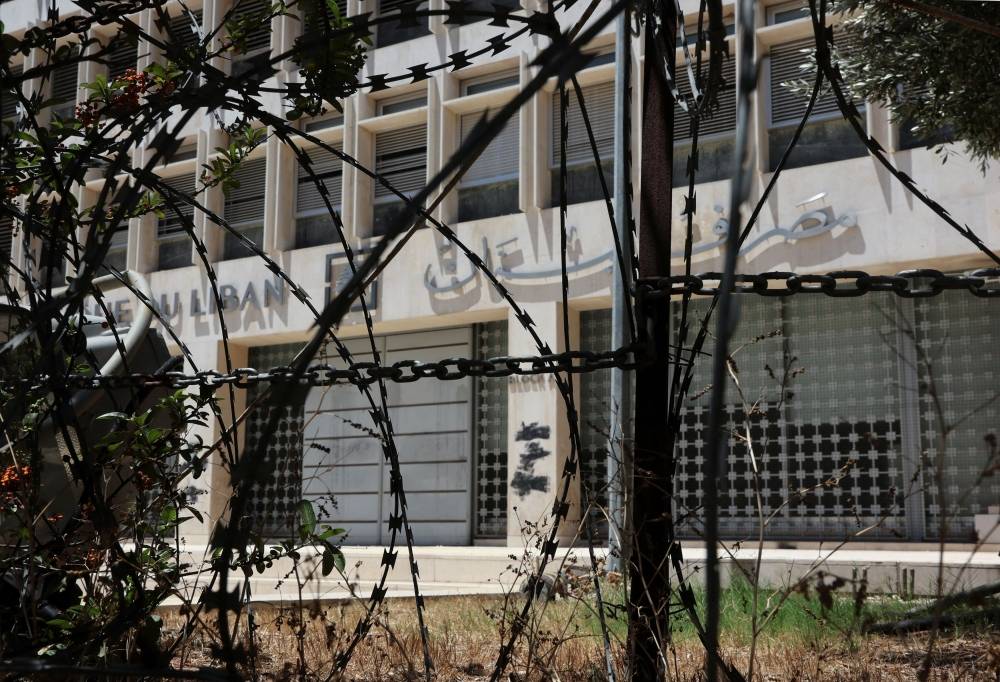
Lebanon's central bank building is pictured behind a razor wire fence on July 19, 2022. (Credit: Mohamed Azakir/Reuters)






Want to get the Morning Brief by email? Click here to sign up.
Prime Minister-designate Najib Mikati said yesterday a political agreement on a new central bank governor is required before going forward with a probe into current head Riad Salameh. Mikati’s comments came shortly after a judicial raid by Judge Ghada Aoun of Banque du Liban’s headquarters, a move Mikati denounced as inappropriate as the bank concerns itself with issues related to monetary stability and such a raid could lead to an “ominous shock.” A statement from Mikati's office said, “What is required is that this file be dealt with via prior political agreement on a new governor of the Banque du Liban, and that the case take its appropriate legal course after that.". Salameh, the central bank’s governor for about three decades, faces corruption charges in at least five European countries in addition to Lebanon, which has been reeling from a devastating financial crisis for which many hold him partly responsible. Salameh has denied any wrongdoing and claims he’s being scapegoated. Judge Aoun charged Salameh in March with illicit enrichment and ordered yesterday’s raid to implement a subpoena against him but was unable to locate him. Meanwhile, following the raid, the union of Banque du Liban employees announced a three-day strike starting today. “The dignity of the institution and its employees comes first. We refuse to be dealt with by militia methods and we announce a strike,” Abbas Awada, president of the union, told local media after Aoun left BDL’s premises. “We do not defend Riad Salameh but the institution, and we do not accept these methods,” he added. In late June, BDL’s employees observed a one-day “warning” strike to protest “the legal proceedings and accusations” that target the central bank and its staff.
Two laws to form an independent administrative judiciary were submitted to Parliament's Administration and Justice Committee yesterday. A subdivision of the committee discussed the laws proposed by MP Oussama Saad (Independent/Saida) and the head of the committee MP Georges Adwan (Lebanese Forces/Chouf). Both laws seek to create a higher administrative judicial council and grant it authorities that are the prerogative of the Justice Ministry, such as employments and promotions, delegations and the distribution of roles of judges. Additionally, they both give the higher administrative judicial council the authority to test judges before they are hired and a procedure to evaluate them. However, the two laws differ in how they believe judges should be tested before taking a seat on the bench; Adwan’s law prefers oral testing while Saad’s believes tests should be in written form. Saad’s law also reduces the role of the State Shura Council while Adwan’s law seeks to expand its power. Forces of Change MP Halimé El Kaakour, who attended the subcommittee session, told L’Orient Today that a separate law for an independent judiciary, which was sent back by Parliament in its last session before the May 2022 parliamentary elections, is still being studied by caretaker Justice Minister Henri Khoury. Following the meeting, Adwan discussed the matter with the head of tenders Jean Ellieh who had appeared before the Court of Cassation earlier in the day after being summoned by the general prosecutor’s office for criticizing the State Shura Council. After the State Shura Council had canceled the contract to award the management and operation of duty-free shops at the Beirut international airport, criticizing the Central Inspection Board for “lack of transparency and guarantees in terms of competition” and of having “violated the principles of public procurement” in the management of its call for tenders, Ellieh had accused the council of having taken a decision motivated by “political interference.”
Israeli Defense Minister Benny Gantz threatened Lebanon yesterday, warning that if its leaders “choose the path of fire, they will be hurt and badly burned.” In the tweet he added, “We are ready in all dimensions — by air, sea, land and cyber.” He continued, saying that if the Lebanese state and its leaders “choose the path of stability, they will help the Lebanese citizens.” Last week, Hezbollah’s Secretary-General Hassan Nasrallah threatened Israel with war amid heightened tensions over the delineation of the maritime border between the two countries, warning that the three unarmed drones sent towards the offshore Karish gas field in early July “are only a modest start.” Nasrallah added that his party is “militarily and financially capable of preventing [Israel] from extracting [gas] from the disputed Karish field and all [Israel’s] measures will not be capable of protecting its floating platform.” The Israeli army intercepted and shot down another drone on Monday that was launched from Lebanon across the southern border and is allegedly “linked to Hezbollah,” an Israeli army spokesperson said in a tweet. A Hezbollah spokesperson told L’Orient Today that the party has no information about the incident. Gantz’s renewed round of threatening rhetoric comes amid the anniversary of the devastating 2006 July war during which he served as the commander of the Israeli army’s ground forces. During the 34-day war, some 1,200 Lebanese were killed, most of them civilians, and over a million citizens were displaced. Some $2.8 billion was needed in reconstruction funds to redress the damage and destruction caused by Israel, according to the Lebanese government. Meanwhile, 160 Israelis were killed, most of whom were soldiers.
In case you missed it, here’s our must-read story from yesterday: “Online civil marriage ceremonies, a new pressure tactic for Lebanese couples.”