







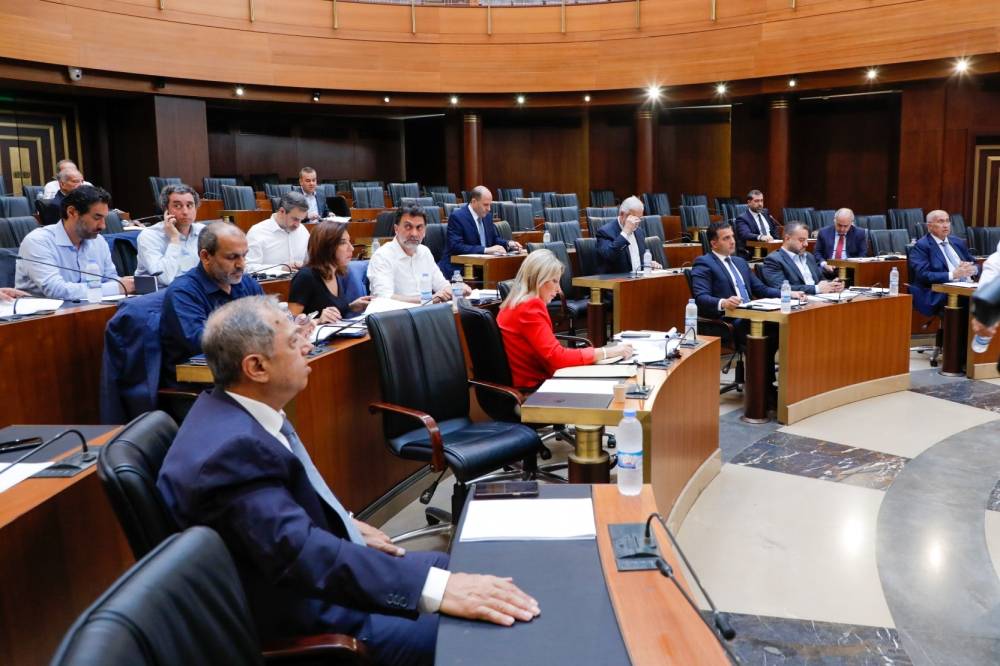
Parliament's Finance and Budget Committee meets on Monday, July 18. (Credit: Marc Fayad)






Parliament’s Finance and Budget Committee yesterday approved a draft law that would allow the lifting of banking secrecy from some accounts. The prerogative to do so would remain restricted to the judiciary, the National Commission for the Fight against Corruption, the Special Investigation Commission, the National Deposits Guarantee Institution and the tax authorities. The draft law will next be sent to Parliament, where it will be discussed and eventually voted on. Lifting banking secrecy is a key demand of the International Monetary Fund in its preliminary agreement with the Lebanese government. Asked if the IMF would approve the proposed banking secrecy law in its current form, caretaker Deputy Prime Minister Saade Chami, who previously held various high-level positions at the IMF, told L’Orient Today, “Yes, I think they would.” The passage of the banking secrecy proposal is just one of a list of actions demanded by the IMF. Another crucial one is passing a budget. On the issue of the 2022 budget, Finance and Budget Committee head Ibrahim Kanaan (FPM/Metn) said after yesterday's committee meeting that the Finance and Budget Committee has been waiting since April for the government to send a study around the use of multiple exchange rates in forecasting revenues and expenses. “How can the government use LL1,500 when calculating the public sector salaries and then use [BDL’s] Sayrafa [rate, currently set at LL25,600 to the US dollar] when calculating revenues?” Meanwhile, a delegation from the Financial Action Task Force, an intergovernmental anti-money laundering body, began a three-week visit to Beirut yesterday to assess Lebanon's actions to combat money laundering and terrorism on the ground.
The caretaker cabinet struck down a controversial pay increase for judges and issued a decree implementing a temporary social assistance payment for all public employees. The announcement halts a recent raise allowing judges to withdraw their salaries at an exchange rate of LL8,000 to the dollar rather than the official rate at LL1,500, which was not decreed officially but rather through a banking decision. The move, which was reportedly concocted by Banque du Liban — although a BDL spokesperson has denied it — was widely criticized, including by President Michel Aoun, yesterday at a meeting with judges and members of the Supreme Judicial Council in Baabda.The ministerial committee in charge of dealing with the repercussions of the financial crisis on the functioning of the public sector announced the reversal of the move after a meeting yesterday headed by Prime Minister Najib Mikati, also attended by Deputy Prime Minister Saade Chami and some caretaker ministers. The committee also announced a new social assistance payment, equivalent to a full salary, for all civil servants, who have been on an open-ended strike since mid-June. The employees, who are still paid in lira, have been protesting the heavy deterioration of their working conditions, demanding to have their salaries adjusted to the country’s rampant inflation. The ongoing strike has crippled everyday life in Lebanon. Caretaker Labor Minister Mustafa Bayram said that the ministers issued an exceptional decree to give the new social assistance payments beginning from July. Bayram did not specify for how long the assistance would be provided. The government also increased the daily transport allowances from LL65,000 to LL95,000. Bayram specified that these decisions are “conditional on the presence of civil servants in the premises, at least two days a week, in order to meet the needs of citizens and ensure revenue to the Treasury,” adding that “this solution is temporary until the draft budget of the current year is adopted.”
Teachers criticized the Education Ministry’s reversal of a decision to include school exam grades in the final average of the brevet exams yesterday. The ministry had reversed the decision after it “learned that some public and private schools handled the issue irresponsibly,” a spokesperson for Education Minister Abbas Halabi told L’Orient Today. Brevet students — those who take state exams to receive diplomas certifying their completion of middle school — were finally able to take their exams in late June after more than two years of COVID-19-related interruptions. To ease the examination procedure, some mitigating measures were put in place by the Education Ministry, one of which was to calculate school test results along with the results of official exams to potentially boost success rates. However, the decision was reversed after “some schools took advantage of this and forged their students’ grades … to improve [the school’s] success rates,” the ministry’s spokesperson told L’Orient Today. In a statement, teachers accused the Education Ministry of having lost its credibility because “the success rate exceeded 90 percent and the rate of those who earned distinctions was above 70 percent [before] the minister decided to cancel the calculation of school grades [which brought] the success rate down to 79 percent, and those who earned distinctions to 47 percent.”
Seventeen dogs remain loose of the 69 neglected and malnourished canines who were found unceremoniously dumped Saturday. The frightened dogs were left near a rescue organization’s dog shelter in a forest near Ras al-Metn on Saturday. The head of animal rescue group Give Me A Paw, Tamara Abi Khalil, told L’Orient Today yesterday that she was terrified when, as she was going to feed the shelter’s dogs on Saturday, she found tens of new seemingly neglected dogs outside her shelter. She immediately called for help on social media, asking for donations and volunteers to help her in rescuing the dogs. Abi Khalil stated that, in addition to helpful assistance by Animals Lebanon, activist for animal rights and lawyer Adnan Labban offered a piece of land he owns to accommodate the dogs. Abi Khalil noted that some of the dogs have “highly contagious and deadly diseases that [could] harm other animals and the wildlife, the vets who checked the dogs affirmed.” She has asked for trapping cages to help relocate the dogs still on the loose and called for food and monetary donations to ensure all the dogs are rescued and taken care of.
In case you missed it, here’s our must-read story from yesterday: “Two municipalities for Beirut?”