






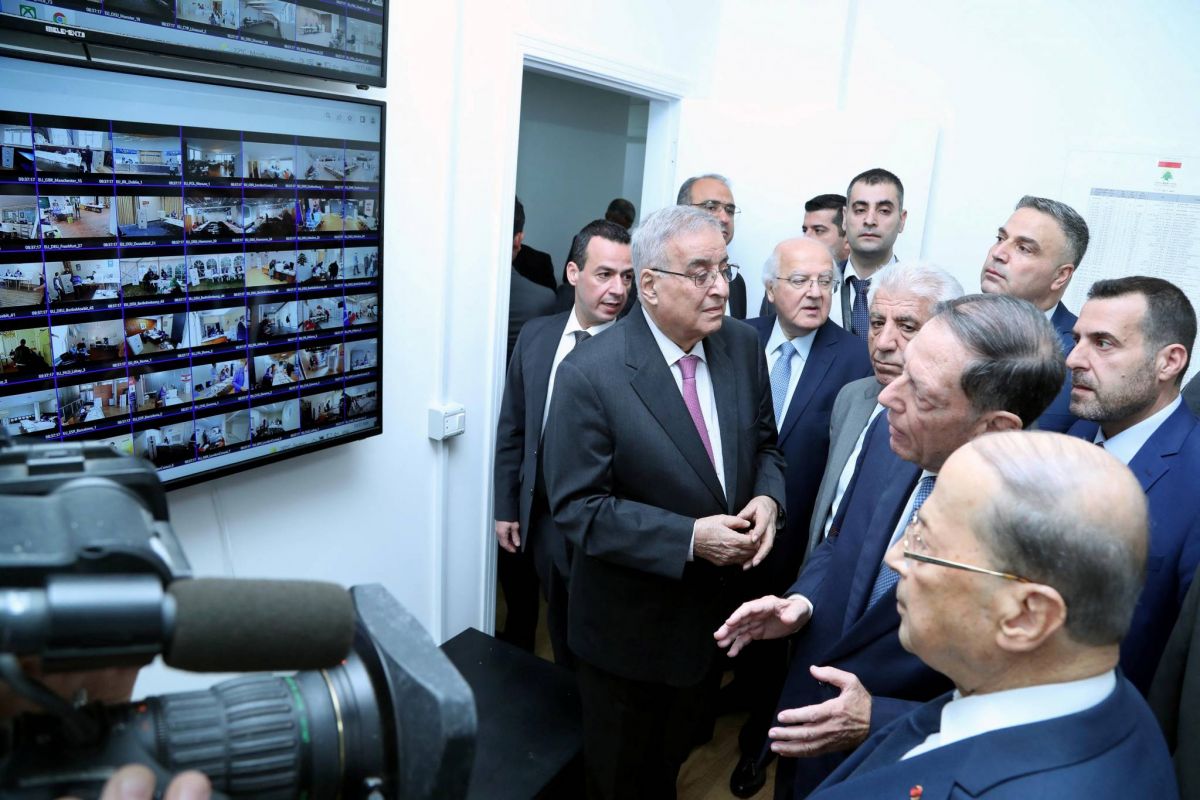
Lebanese President Michel Aoun visits Foreign Affairs Ministry as Lebanese expats vote in Lebanon's parliamentary elections, in Beirut, Lebanon May 8, 2022. (Credit: Dalati and Nohra)






Want to get the Morning Brief by email? Click here to sign up.
Lebanese expatriates voted in 59 countries over the weekend in parliamentary elections scheduled to take place in Lebanon on May 15. Voting kicked off on Friday in nine Arab countries and Iran, where turnout was higher than that of the 2018 cycle, rising from 56 percent to 59 percent. Yesterday, voting continued in the remaining countries around the world, with the EU Elections Observation Mission deploying 16 teams to monitor voting in 13 European countries. Yesterday’s polls in several countries saw long queues, especially in Dubai, with hundreds standing in a line stretching around the corner of the Lebanese consulate. To monitor the electoral process, live video surveillance was set up inside the Foreign Affairs Ministry, which was inspected by both Prime Minister Najib Mikati on Friday and President Michel Aoun yesterday. The overseas elections were not without some hiccups, with the live broadcast of voting on Friday abruptly stopping for more than 15 minutes. Additionally, social media posts yesterday showed altercations at polling stations in France and Germany. As of yesterday, ballots cast in Iran and Qatar arrived in Lebanon and will be counted next week. Many of the ballots will be delivered via shipping company DHL, while those of Syria, Russia and Iran will be brought to Lebanon by the countries’ respective ambassadors. Nearly 245,000 Lebanese living abroad are registered to vote. As of this morning, voter turnout stood at 52 percent in European countries. Turnout data for the rest of the world, reported at 9 p.m. last night, is available here.
Several political parties violated the electoral silence period over the weekend. The violations began on Friday when Lebanese Forces head Samir Geagea held a video call with voters in Saudi Arabia. Then, on Saturday, during a rally organized by the Progressive Socialist Party, party leader Walid Joumblatt was quoted as saying “We must repel the attack, together, at the polls, in order to prevent breakthroughs and followership,” the party’s news website, al-Anba, reported. Also Saturday, Labor Minister Mustafa Bayram, who is close to Hezbollah, encouraged voters to turn out in large numbers saying “parliamentary elections are crucial and decisive since they determine Lebanon’s policy for at least four years ahead.” The comments were made at a political forum hosted by Hezbollah. The electoral silence period commenced at midnight on Thursday ahead of overseas voting, and expired last night. It is set to recommence 24 hours before domestic voting starts on May 15. According to the Electoral Supervisory Committee, during this period candidates and party officials are forbidden from campaigning and media outlets are not allowed to broadcast any election stories, advertisements, or calls to vote.
President Michel Aoun on Friday claimed that the reason Syrian Refugees stay in Lebanon is because of international aid. His remarks came during a meeting with United Nations Special Coordinator for Lebanon Joanna Wronecka at the Presidential Palace in Baabda ahead of the Brussels VI conference held to raise funds for countries hosting Syrian refugees, which begins today. Aoun said “Lebanon is unable to continue fulfilling its duty to refugees, so they must return to their country and receive international assistance there.” Baabda Palace later denied any links between Aoun’s comments and the parliamentary elections. Wronecka, for her part, on Saturday called on the Lebanese government to “continue upholding the principles of refugee protection” while calling on the international community to provide more support to Lebanon to manage the refugees. She also added that UNIFIL would volunteer to help with the search for the 30 people missing after a boat carrying would-be migrants sank off the coast of Tripoli, North Lebanon. Lebanon hosts more than a million Syrian refugees. Many are unable to go back to Syria due to fear of reprisals against them. Moreover, aid they receive in Lebanon is impacted by Lebanon's ongoing financial crisis. In June of last year, it was reported that $250 million in UN humanitarian aid targeted to refugees and vulnerable communities was lost because Lebanese banks were exchanging it at unfavorable rates. It was estimated that between one-third and one-half of cash aid from the UN was lost due to this arbitrage.
Human Rights Watch and the Center for Lebanese Studies have called on international donors to hold Lebanese authorities accountable on the education front. The statement was made on Friday ahead of the sixth annual Brussels Conference, set to commence today. The conference will pledge funding in response to the crisis in Syria and neighboring refugee-hosting countries, including Lebanon. The statement read that donors “should press Lebanon to change policies that prevent aid from reaching schools and students.” It also called out Lebanon’s central bank practices, which impact the value of humanitarian aid “by manipulating currency exchange rates at the time of withdrawal.” An additional constraint on education outlined by the statement was the withdrawal limits set by banks which prevent educational institutions from providing the right amenities to students and staff, including salaries and electricity. The statement called on the Education Ministry to publish student enrollment data and end restrictions on refugee access to education, which include arbitrary rejections from public schools. The statement recommended that donors meet with representatives of Lebanese teachers “who have been on strike for most of the year over compensation grievances.”
In case you missed it, here’s our must-read story from over the weekend: “In Khaldeh, 'a gate to four places,' the Arab tribes stake out their turf”