






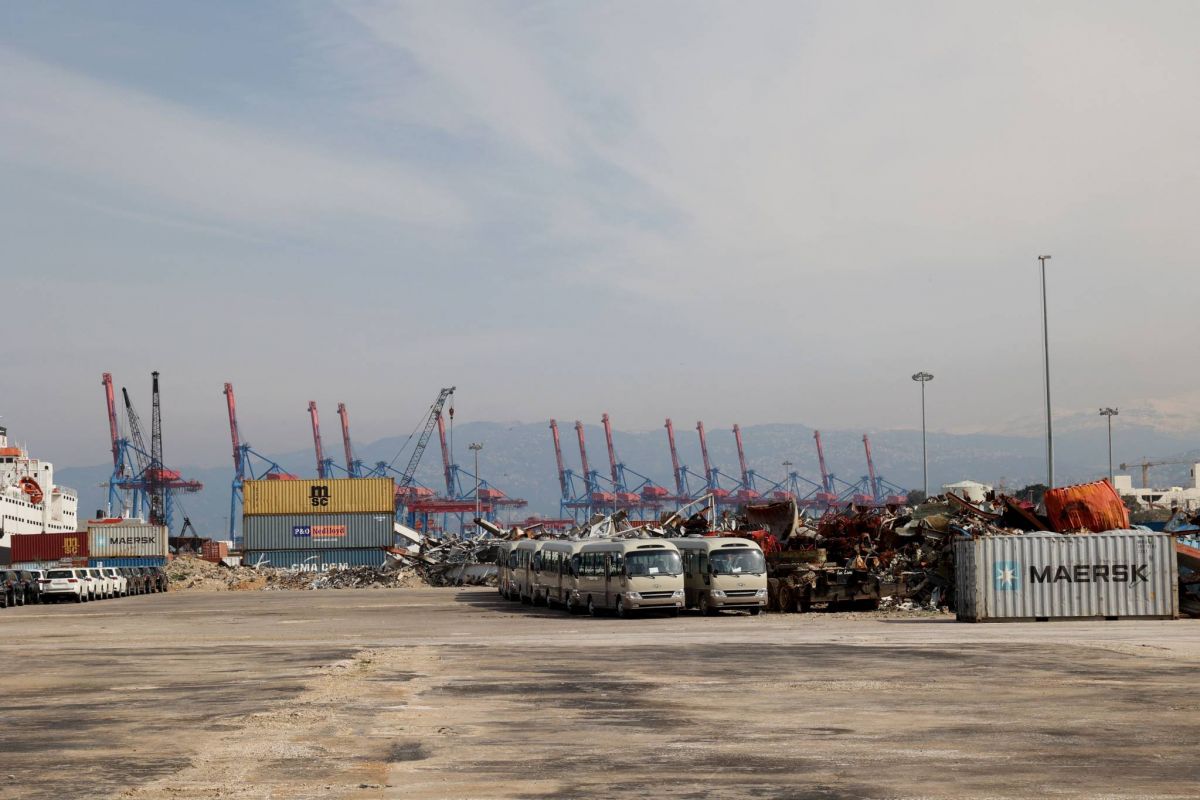
A photo taken on Feb. 17, 2022 shows the container terminal at the damaged Port of Beirut, a year and a half after a deadly explosion there killed more than 200 people and destroyed large parts of the Lebanese capital. (Credit: Anwar Amro/ AFP)






Want to get the Morning Brief by email? Click here to sign up.
CMA CGM announced yesterday that it had been awarded the rights to manage, operate and maintain the container terminal at the Beirut port. According to a press release by the French company, the contract is for 10 years and is set to commence next month. The statement added that the company plans to invest $33 million to renovate the container terminal, upgrade the port’s equipment, construct a new hangar and implement digital tools. During the tender process, CMA CGM outbid UAE-based Gulftainer for the rights. The news comes almost one year after CMA CGM bought out Gulftainer’s Lebanon subsidiary which operated the Port of Tripoli. The company said it plans to boost traffic to 1.4 million containers over the contract’s duration. Since the start of the financial crisis, the Beirut port has witnessed a contraction in operations on top of the damage sustained in the Aug. 4, 2020, explosion. Additionally, container traffic has halved, dipping from 1.3 million containers in 2017-18 to 614,994 last year.
Energy Minister Walid Fayad has asked Prime Minister Najib Mikati to call for a cabinet session next week to approve his electricity plan. During a meeting yesterday with Mikati, the topic of energy tariffs was discussed, specifically in relation to increasing supply and reducing waste. He added that the prime minister was keen on building new electricity stations soon, but Fayad noted that they would not be ready before 2024 because of the time needed to “prepare the books of conditions and secure funding.” Lebanon’s already ailing electricity sector has been unable to meet demand for years, but the recent economic crisis has compounded the challenges it faces, rendering it unable to produce more than a handful of hours of electricity a day across much of the country. This has forced the country to rely on private, heavily pollutant and unregulated generators for power. However, last month, Lebanon signed an agreement with Jordan and Syria that should bring Jordanian electricity via Syria in the Spring. The deal should be able to supply 100-250 megawatts of power, or about two hours depending on the time of the day.
MP Ibrahim Kanaan said yesterday that the 2022 draft budget will be transferred to Parliament next week, citing information from Finance Minister Youssef Khalil. Kanaan added, however, that Parliament’s Finance and Budget Committee, which he chairs, had not received the proposal. Moreover, in an agenda for next week’s Parliament session seen by L’Orient Today, the budget proposal is not listed. Kanaan added that due to the delays in approving the 2022 budget, his committee has approved spending the equivalent of one-twelfth of the 2020 budget, the last to be passed by Parliament. Kanaan also said that he was against “tax increases in the context of the economic and financial crisis,” a hint that the draft, if it is indeed on the agenda, may not progress smoothly through Parliament. Both Hezbollah and the Amal Movement have also vocalized objections over the way in which the 2022 draft budget was approved in cabinet, but Amal announced last week that it would nonetheless give the budget serious consideration in the legislature. A budget is a prerequisite to any financial rescue package from the International Monetary Fund.
The Israeli army announced yesterday that it had shot down a drone allegedly sent by Hezbollah. In a tweet, the Israeli military claimed that the drone flew into Israeli airspace over the border with Lebanon. The previous day, Hezbollah Secretary General Hassan Nassrallah boasted that the armed group had been making drones for years in Lebanon and that anyone can “submit an order” to buy them. The Israeli army’s announcement also came within hours of Hezbollah’s parliamentary bloc reminding the Lebanese government of its “responsibility to remain vigilant against traps set by US envoy Amos Hochstein.” Hochstein is tasked with facilitating indirect negotiations between Israel and Lebanon over the demarcation of the maritime border between the countries. The statement was made after the bloc’s weekly meeting, and warned of signs the envoy was allegedly making that would create an environment in which normalization between Israel and Lebanon could occur.
In case you missed it, here’s our must-read story from yesterday: “A quarter of Lebanese would consider voting for an independent figure in May’s legislative elections”