






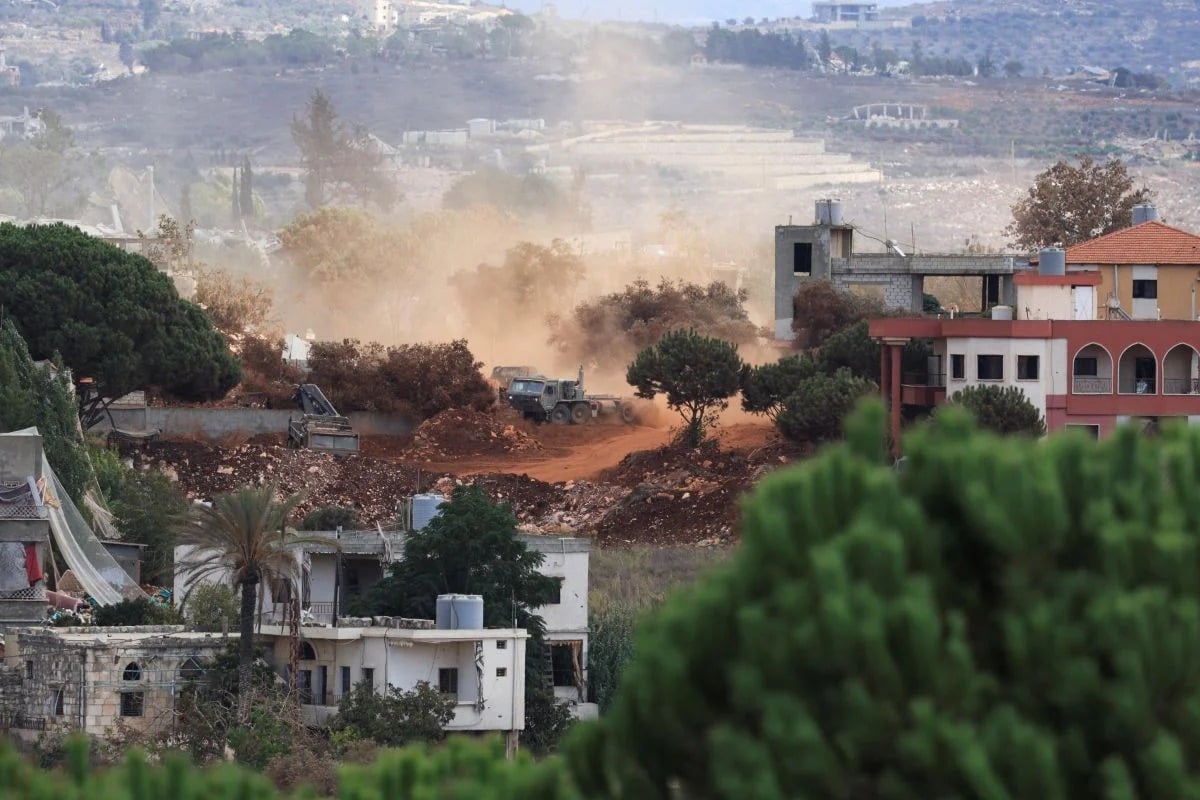
An Israeli army vehicle positioned in the occupied village of Zawtar Sharqieh, in southern Lebanon, on Oct. 1, 2026. (Credit: Mohammad Azakir/Reuters)






SOUTH LEBANON — The Israeli army prevented several farmers in Kfar Shuba, a village located on the edge of the Israeli-occupied zone in southern Lebanon, from reaching their olive groves on Thursday. The army said authorization was required before harvesting could begin, according to our correspondent in south Lebanon.
According to eyewitnesses, an Israeli unit intercepted a group of Kfar Shuba residents heading to nearby olive groves and told them they would have to wait for “authorization,” which could be issued on Sunday through the “Mechanism,” the body coordinating liaison between the Lebanese and Israeli armies. Israel regularly bars access to large areas of Lebanese territory, hindering agricultural work and emergency response efforts in particular.
The Union of Municipalities of Arkoub, in the eastern sector of the border area where Kfar Shuba is located, had called on farmers to gather in the morning and head to their lands together, accompanied by the Lebanese Army and the United Nations Interim Force in Lebanon (UNIFIL). However, neither the army nor the U.N. peacekeepers showed up that morning, according to the union.
Elsewhere, Israeli artillery fire continued on Thursday morning, particularly on the outskirts of Aita al-Jabal, in the Bint Jbeil district, which lies outside the boundaries of the occupied “buffer zone,” as well as in Beit Yahoun. A strike between Beit Yahoun and the neighboring village of Haddatha injured two people the previous day, according to our correspondent and the Health Ministry. Attacks have intensified in recent days around Haddatha and the neighboring villages of Haris and Beit Yahoun.
Since the morning, shells have also struck the Zibqine Valley, which is also located on the outskirts of the "buffer zone" in the Sour district, as well as Wadi Slouqi, between Houla and Shaqra, in the Marjayoun district.
Late Wednesday evening, Israeli occupation forces also set fire to the Kawthar school in Kfar Tibnit, in the Nabatieh district. The incident came amid a night of bombardments in several areas of south Lebanon and low-altitude overflights by fighter jets.
In Mansouri, Israeli aircraft carried out two strikes overnight. The village, in the Sour district, was also hit by artillery shells accompanied by machine-gun fire on Thursday morning, according to our correspondent.
Elsewhere, five shells landed on the outskirts of Mayfadoun in the Nabatieh district. At the same time, artillery fire targeted the outskirts of Haddatha, Haris and Srebbine, as well as Wadi Ghadir in the Bint Jbeil district. Strikes also hit Wadi Hujeir in the Marjayoun district and the outskirts of Dabshe and Dohat Kfar Roummane in the Nabatieh district.
Israeli attacks have continued daily in southern Lebanon despite a June "cease-fire" that followed months of war between Hezbollah and Israel. After Lebanon and Israel signed a framework agreement in June stipulating a gradual Israeli withdrawal from Lebanon in exchange the Lebanese Army disarming Hezbollah's, the process has stalled after the first three villages of the "pilot zones." The last negotiations took place more than two months ago.
Germany provides 5 million euros
In a separate development on Thursday concerning the Lebanese Army, the United Nations Development Programme (UNDP) said the German government was providing an additional 5 million euros to support stability and recovery in Lebanon through the Lebanese Army, bringing Germany’s total contribution to the programme to 10 million euros
"The new funding will provide equipment for rubble and explosive ordnance removal, alongside food, healthcare, education and housing support to bolster the dignity and well-being of Lebanese Army personnel and their families," the statement said.
The programme, implemented by UNDP under a Memorandum of Understanding with Lebanon's Ministry of Defense and the Office of the United Nations Special Coordinator for Lebanon, brings together contributions from Germany, the European Union, Spain, France, Norway, Denmark and Japan.
Additional reporting contributed by our correspondent in south Lebanon, Muntasser Abdallah.

 1 p.m. recap: Qatari PM expected in Beirut; missile intercepted in Medina; Hezbollah seeks to recover its explosives seized in Dahr al-Baidar