


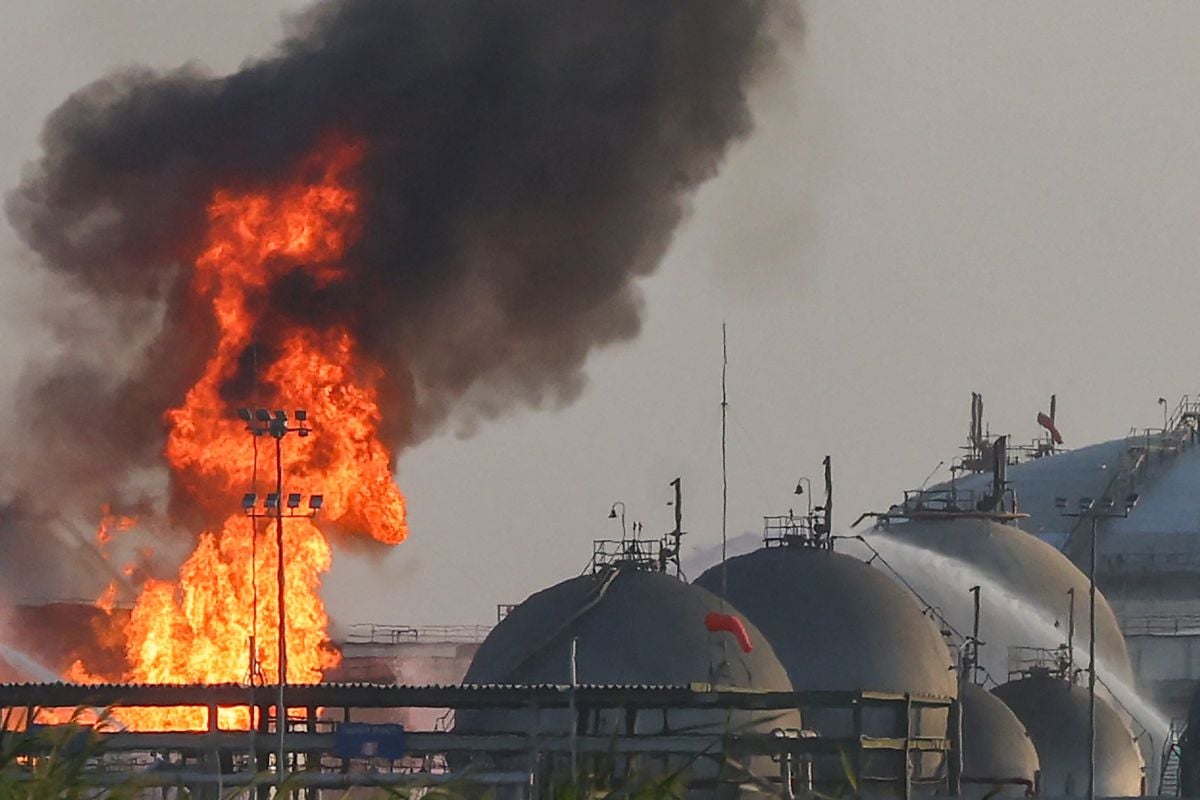
Flames at a facility belonging to Saudi oil giant Aramco south of Riyadh on Oct. 3, 2026. (Credit: AFP)






Top story
Yemen's internationally recognized government forces announced Monday that they had carried out over a thousand attacks against areas controlled by the Iran-backed Houthi rebels.
"Government forces have carried out 1,122 attacks" in the regions of Saada, the Houthis' stronghold, al-Jawf, Taiz, and the western coast, their spokesperson, Majid al-Nazili, told the official Saba news agency. "These operations have neutralized 1,747 members of the [Houthi] militias and destroyed or damaged 364 vehicles and pieces of military equipment," Nazili added.
Later Monday, Yemeni forces announced an offensive on the capital, Sanaa, involving "combat planes, drones, artillery fire, missiles, rocket launchers and snipers."
The Saudi-led military coalition announced that it would join the offensive launched the previous day by the Yemeni government against the Houthis, mobilizing 100 fighter jets to carry out strikes at dawn. "Twenty-four-hour air support will be provided to support Yemeni armed forces on the ground," coalition spokesperson Gen. Turki al-Maliki said on X.
Meanwhile, Saudi Arabia reported an interruption in oil transport through its East-West pipeline on Sunday in the eastern part of the kingdom in an attack claimed by the Houthis. "A pumping station east of Riyadh in Khurais. It wasn't targeted before. There was big damage, and the pipeline stopped again," a source, speaking on condition of anonymity, told AFP.
Why it matters
The offensive by Yemeni government forces against the Houthis, announced Sunday by Yemeni Presidential Council chief Rashad al-Alimi, aims to halt significant Houthi gains made since September, as the rebels advance toward areas bordering the Bab al-Mandeb Strait, from where they could target passing oil tankers.
After the relative closure of the Strait of Hormuz following the war between Iran and the United States, even a partial closure of another major strait could put further pressure on global oil traffic.
In addition, the Houthis have continued their offensive against the major Yemeni city of Taiz since Friday, surrounding and isolating it from Aden, where the Yemeni government is based.
For Saudi Arabia, the offensive is crucial because Houthi attacks have caused significant damage to the kingdom's oil infrastructure. On Sunday, the rebels announced that they had targeted oil giant Aramco, as well as the pipeline. This partly explains the direct involvement of the Saudi-led coalition in the offensive against the Houthis.
What to watch
In Lebanon, Prime Minister Nawaf Salam stressed during an interview Sunday night on NBN, the channel affiliated with Parliament Speaker Nabih Berri's Amal Movement, the importance of an Israeli withdrawal from south Lebanon. He later met with Berri and the Council for the South, the body mainly responsible for reconstruction, on Monday. Salam also toured Nabatieh last Friday.
In his interview, the prime minister said the framework agreement signed by Lebanon and Israel last June, which is now effectively frozen, needs a precise timeline for Israel's withdrawal from the South. He also stressed the state's intention to extend its sovereignty over its entire territory and reaffirmed the government's commitment to rebuilding.
In other news
- Netanyahu orders review of security measures on international flights to Israel
Israel's prime minister has ordered increased security measures on international flights to Israel following last Wednesday's attempted hijacking of a Dubai-Tel Aviv FlyDubai flight, with 166 Israelis on board. His move has drawn skepticism from political opponents, just weeks before Israel's election. Meanwhile, sources told Reuters that the Omani co-pilot was reportedly planning to crash the plane at Ben Gurion Airport in Tel Aviv and had planned the attack before he was hired by the company.
- Middle East oil exports surpass pre-war levels, says Kpler
Middle East oil exports, excluding Iran, surpassed the pre-war average of 18 million barrels per day last week, despite attacks in the Strait of Hormuz, according to data from the maritime tracking firm Kpler. Crude oil exports reached pre-war levels in September, with at least 16.5 million barrels leaving the region excluding Iran, Kpler said on Wednesday.
- Israeli soldiers in south Lebanon wounded over weekend in "improper handling of a grenade"
While the Israeli army announced that two of its soldiers were wounded in south Lebanon over the weekend, Israeli media outlet Ynet reported, citing security sources, that the two men were injured while improperly handling a grenade rather than during combat.