





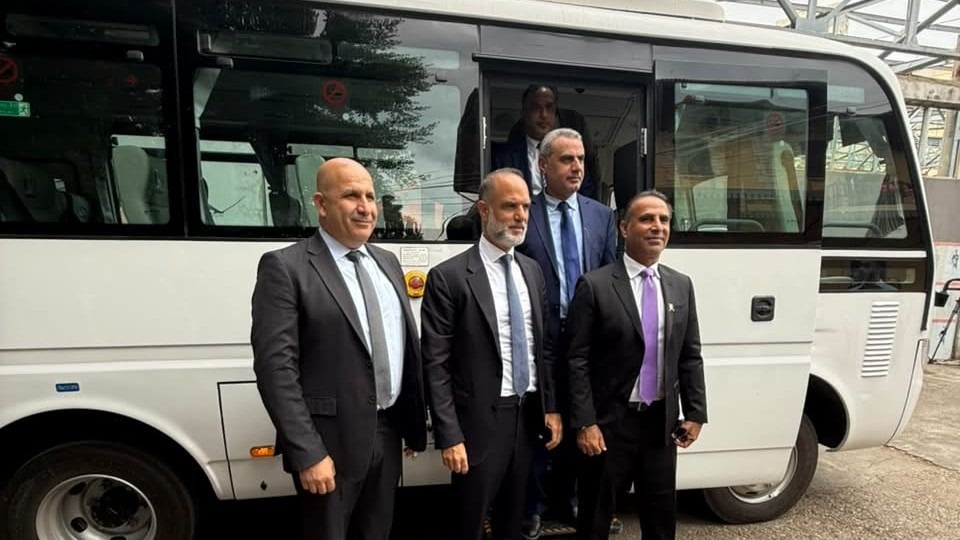
Transport Fayez Rasamny (second from the left), the Ambassador of Oman, and the Director General of OCFTC, Ziad Chayya, posing in front of one of the buses delivered on Monday, Sept. 28, 2026, by the Sultanate of Oman to Lebanon, during a ceremony held at the Mar Mikhael train station in Beirut. (Photo: NNA)






The Sultanate of Oman officially handed over 20 buses to Lebanon on Monday to be used in the public transport network, as part of a donation to the Lebanese state, during a ceremony organized by the Office of Railways and Public Transport (OCFTC) in the Mar Mikhael neighborhood of Beirut, attended by Minister of Public Works and Transport, Fayez Rasamny.
The ceremony was attended by Oman's ambassador to Lebanon, Ahmad bin Mohammad bin Saeed al-Saidi, OCFTC Director General Ziad Chayya, and Beirut Governor Marwan Abboud.
In his speech, Rasamny strongly emphasized the importance of developing the public transportation sector at a time when the economic situation of Lebanese people is so critical. "To change attitudes regarding public transport, we must provide an alternative," he said. Lebanon has been experiencing a severe financial and economic crisis since 2019, which was followed by a war with Israel since 2023, and then the impact of the U.S. war against Iran, which has caused global fuel prices to soar.
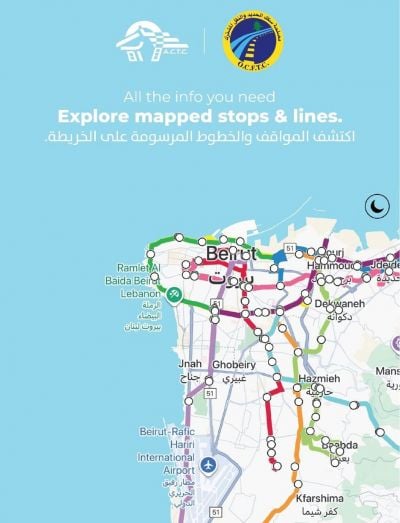
The minister clarified that public transport is currently operational on 11 routes, and the development of 5 others is underway. The OCFTC "can operate a larger fleet as soon as the necessary capacities and number of buses are available, up to 500 additional buses," he added.
Rasamny referred back to the experience of partnership with the private sector since the launch of the buses donated by France, which he described as "encouraging for the development of the sector." The private company Ahdab Commuting & Trading Company (ACTC) was assigned the management and maintenance of 93 state-owned buses, including 49 donated by France in May 2022.
For his part, Chayya thanked the Sultanate of Oman, stating that his institution had learned of this donation about a month ago, and praised the speed with which Oman implemented its action. "This donation comes at the right time to contribute to our efforts to develop the public transport sector," he added.
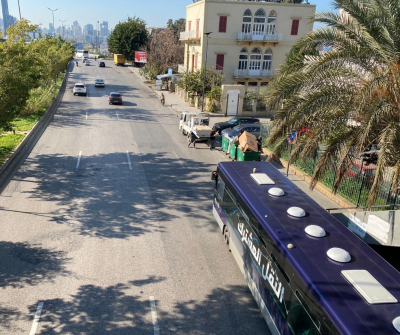
Meanwhile, Saidi stressed the importance for his country of contributing to the development of this sector, "which will help solve the traffic problem in Lebanese cities during rush hour." "One of the main challenges will be to encourage a public transport culture among Lebanese," added the ambassador of Oman.
The Lebanese government had approved in July a project to acquire one hundred buses for the OCFTC, funded by a donation from the government of the People's Republic of China, to strengthen the Lebanese network after the commissioning of other buses donated by France. In December 2025, Qatar had provided Lebanon, as part of a donation, with 30 buses to enrich its public transport system.
In a country where private interests often dominate decisions of the public authorities, and where the use of private cars remains largely favored, the advent of quality public transportation is a challenge. Largely absent from reconstruction projects after the civil war (1975–1990), public transportation had since remained confined to an informal network of minivans and private buses.
Only 35 aging buses belonging to the OCFTC, a state structure inherited from the French mandate, were still operating in 2019, running mainly in eastern Beirut, before being halted following the twin explosions at the port on Aug. 4, 2020.

 7 p.m. recap: Iran warns Egypt, Israeli soldiers vote in south Lebanon, Haret Hreik responds to Kataeb