






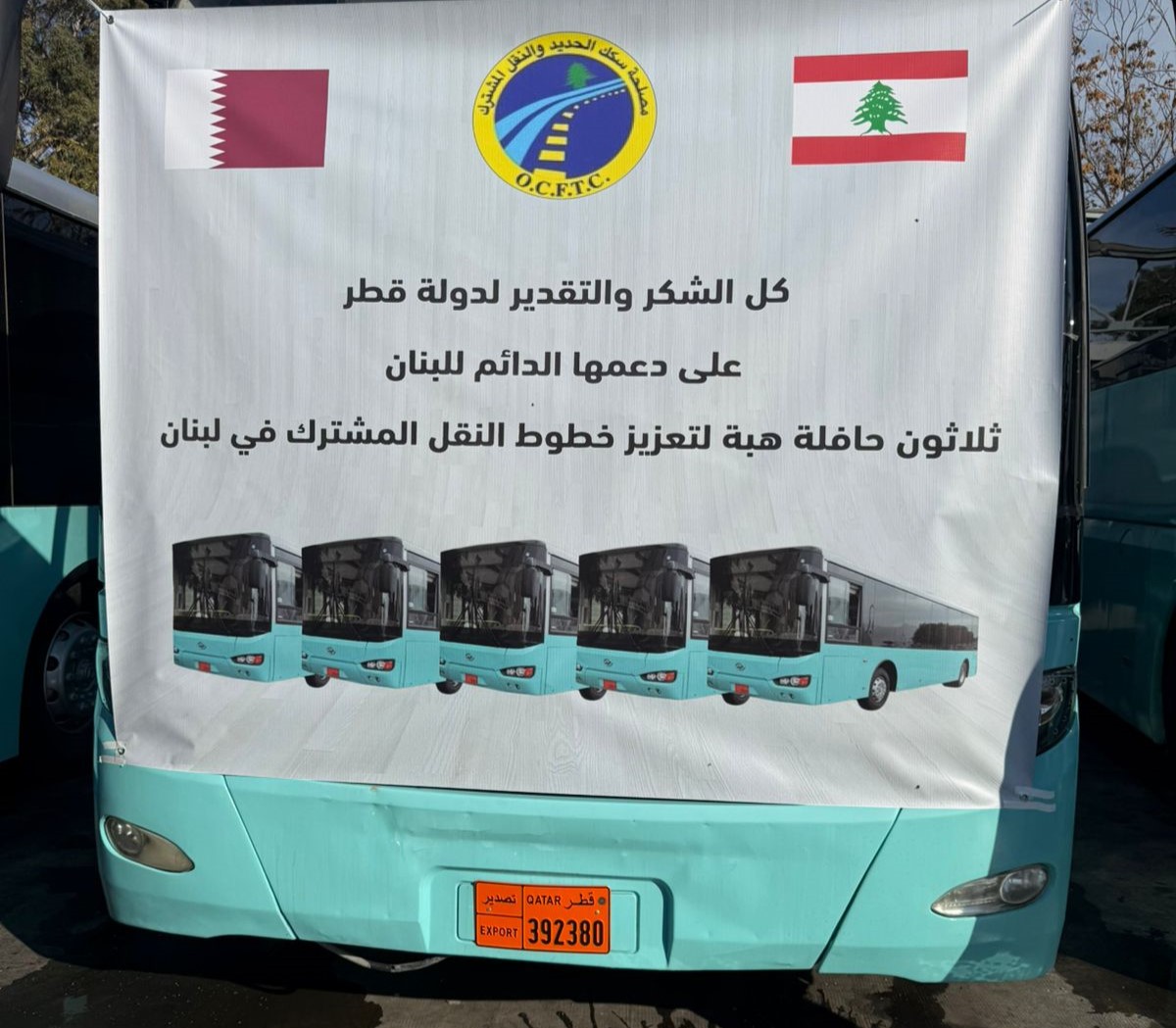
One of the 30 buses donated by Qatar to Lebanon, bearing a banner with a message of thanks addressed to the gas-rich emirate, in Mar Mikhael on Dec. 16, 2025. (Credit: The Public Works and Transport Ministry)






Qatar officially delivered 30 buses to Lebanon on Tuesday to be used in the nation’s public transport network, as part of a donation from the gas-rich emirate to the Lebanese state.
The handover ceremony took place in Beirut’s Mar Mikhael district, attended by Public Works and Transport Minister Fayez Rassamny and Qatar’s ambassador to Lebanon, Sheikh Saud bin Abdulrahman al-Thani.
Rassamny offered his heartfelt thanks to Qatar for “translating its good intentions toward Lebanon into concrete actions.”
He also noted that the idea of this donation had been circulating for some time and was finally put into action following discussions with Qatari Minister of Transport and Communications Sheikh Mohammed bin Abdullah al-Thani. Qatar supports Lebanon across several sectors and regularly assists the Lebanese Army.
'Reaching Lebanon’s most vulnerable areas'
The minister also explained that “this initiative is part of the government’s integrated vision to restore citizens’ confidence by providing essential public services,” delivering transportation that is “cheaper, more comfortable, and safer.”
The buses donated by Qatar will be operated by the Office of Railways and Public Transport (OCFTC), whose director, Ziad Shaaya, was also present. They are intended to “strengthen existing routes and reach the country’s most underserved areas.”
The OCFTC oversees a network of public bus lines that remains insufficient to adequately cover the country and faces competition from private drivers whose vehicles are often in poor condition and were grounded for four years following the explosions at the Beirut Port on Aug. 4, 2020.
These private drivers often operate dangerously and improvise most stops, especially on the coastal highway and main mountain roads.
'Vision to revive rail transport'
The public bus lines, launched in the 1990s without rehabilitation since, generally follow fixed routes and adhere more strictly to safety guidelines, particularly regarding speed.
The public bus fleet also consists of 49 buses donated by France in May 2022, which were distributed across a new set of routes and gradually put into service starting December 20, 2024, less than a month after the truce between Israel and Hezbollah.
According to Shaaya, as cited in the ministry’s statement, “public transportation is experiencing constant growth, with over 7,000 passengers per day,” without specifying a precise growth rate.
He also said the Office, under the minister’s oversight and with the support of Prime Minister Nawaf and President Joseph Aoun, is working on a vision to revive Lebanon’s long-dormant rail service, while several countries in the region — Iran and Turkey in November, Qatar and Saudi Arabia in December — have agreed to launch international railway lines.
