





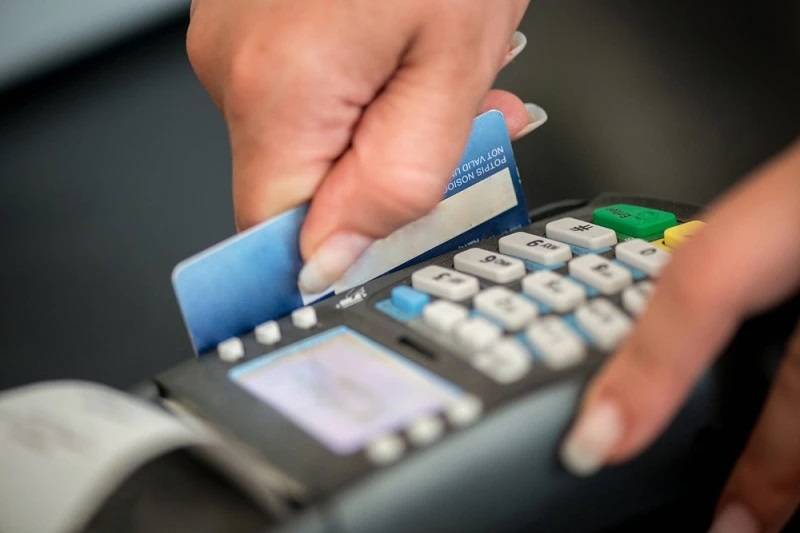
A payment made by card. (Credit: AFP)






BEIRUT — Payment-card transactions in Lebanon rose by 130% in the first eight months of 2026 compared with the same period last year, Banque du Liban (BDL) Vice-Governor Makram Bou Nassar announced Wednesday at a press conference covering the measures taken by the central bank to promote electronic payment methods, reduce the cash economy and strengthen compliance standards.
The value of these transactions also increased by more than 50%, with particularly strong growth among cards issued by Lebanese banks and financial institutions. Bou Nassar said the rise could have been greater had "the war and security situation not weighed on spending."
The speakers included Finance Ministry Director-General George Maarrawi, Economy and Trade Ministry Director-General Mohammad Abu Haidar, Mastercard regional director Cynthia El Khoury and Visa regional manager Mario Makary.
Lower commissions and tighter oversight
Bou Nassar reviewed several circulars already issued by BDL to encourage cashless payments and strengthen governance, transparency, and compliance, including measures governing payment-service providers, electronic-wallet operators, money-transfer companies, financial institutions and money changers.
BDL had previously capped card-payment commissions at 1.25% for gas stations, bakeries, supermarkets, hospitals, and pharmacies. Visa and Mastercard also reduced commissions on payments to the Finance Ministry to a ceiling of 0.9%, down from the usual 2% to 2.5%.
Fresh-lira checks increased by 142% in number and 105% in value, while fresh-dollar checks — involving dollar funds that have not been trapped in the banking system since the 2019 crisis rose by 124% and 108% in value, Bou Nassar further shared. The total value of fresh-dollar checks climbed from around $500 million in the first eight months of 2025 to more than $1 billion this year. Interbank transfers increased by about 60% in number, while the value of dollar transfers rose by 117%.
The share of payments made by card rose from 8 to 12% at gas stations, from 16 to 23% at pharmacies and from 15 to 35% at restaurants. At large supermarkets, it increased from 17 to 36%, while at medium-sized supermarkets it rose from 7.5 to 20%. Online debit-card payments exceeded 51%.
The Finance Ministry has installed around 38 of 52 planned POS terminals. More than 95% of major Treasury receipts, including customs revenue, VAT and large tax payments, are now collected by check or bank transfer, Maarrawi said.
Abu Haidar said some merchants continue to charge consumers an additional 2% to 3% when they pay by debit or credit card, stressing that such practices are prohibited. Consumers can report these charges through the ministry’s MoET Digital Services application and receive a reference number to track their complaint.
The push comes as Lebanon remains on the Financial Action Task Force’ (FATF)s grey list, to which it was added in October 2024 over strategic deficiencies in fighting money laundering and terrorist financing. Expanding traceable payments is part of efforts to curb the cash economy, which expanded significantly after the banking system collapsed in 2019 and confidence in banks evaporated.
Asked about restoring confidence in the banking sector, the erosion of which has contributed to the expansion of the cash economy, Bou Nassar said that "this is a long-term issue linked to the Financial Stabilization and Deposit Recovery Law, "adding that BDL was "making every effort, alongside the government and the IMF, to reach a solution."
$100,000 Mastercard collaboration
Mastercard announced a $100,000 collaboration with BDL to accelerate digital-payment adoption among small and medium-sized businesses and support women entrepreneurs across Lebanon.
The program will provide businesses with the tools and skills needed to participate in the digital economy and expand their customer bases, El Khoury said.
Mastercard is also working with its partners to develop card-payment solutions tailored to SMEs, allowing them to accept digital payments more easily, securely and efficiently.
Makary, meanwhile, said Visa plans to launch initiatives worth more than $400,000 in Lebanon in the near future. The funding will support the rollout of POS terminals and incentives encouraging consumers to use payment cards rather than cash.