





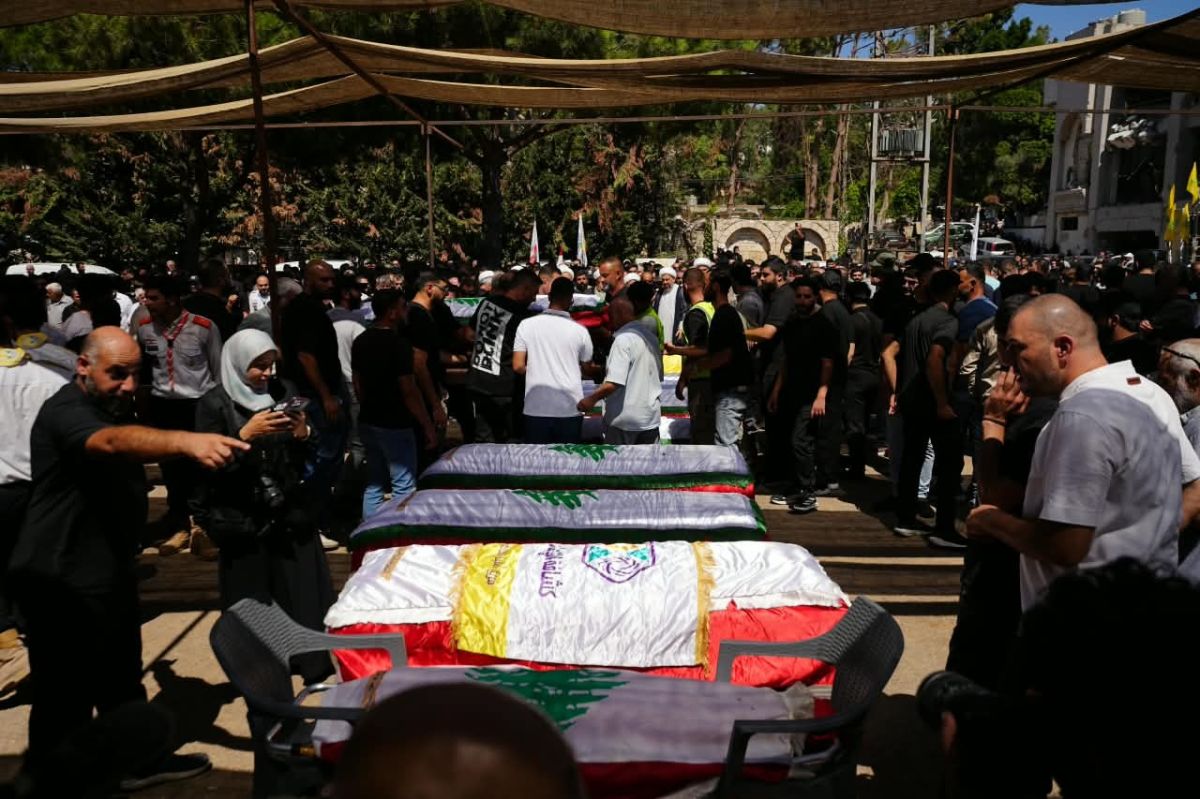
The coffins of victims of an Israeli strike that decimated a family, during funerals in Kfar Roummane, south Lebanon, on Sept. 9, 2026. (Credit: Mohammad Yassin / L'Orient-Le Jour)






U.N. Secretary-General António Guterres is"deeply concerned" by the worsening situation in southern Lebanon, his spokesperson Stéphane Dujarric said Tuesday at a press briefing. The U.N. warned of "intensifying Israeli military operations," particularly in "Nabatieh and its surroundings," and expressed concern over the deterioration of the security situation as hostilities continue despite the cease-fire reached in June under U.S. mediation.
Over the weekend, the Israeli army killed several dozen people, including women and children, in a series of airstrikes on Nabatieh and the surrounding area, following the announcement of its "operational control" of the Ali Taher hill. One of the strikes completely destroyed a hospital.
Following the attacks, which seem to have relatively subsided despite the continued demolitions in the occupied "buffer zone," Guterres condemned the "growing civilian casualties," including "women and children." He also expressed concern over displacement caused by evacuation orders and reports of "massive destruction and devastation."
'A deeply concerning situation'
In the statement read Tuesday by Dujarric, Guterres highlighted the scale of the humanitarian crisis and said he was "particularly alarmed" by the consequences of military operations on civilians and essential infrastructure. The U.N. pointed to strikes affecting "hospitals, health workers and public institutions." It also expressed concern over "restrictions on humanitarian access," which are making it harder to deliver aid to affected populations.
For the United Nations, these developments point to a dangerous dynamic. The U.N. called on the parties to refrain from actions that could further worsen the situation and reiterated that "civilians and civilian objects must be protected at all times." Guterres stressed that all parties must respect "their obligations under international law, including international humanitarian law,"particularly regarding the protection of civilians, medical infrastructure and humanitarian personnel.
Guterres also called for “an immediate cessation of hostilities” and urged Israel to “withdraw its forces from Lebanese territory.” He called on all parties to respect “the sovereignty and territorial integrity of Lebanon” and fulfill their obligations under Security Council Resolution 1701. Adopted in 2006, Resolution 1701 remains the main international framework governing the cessation of hostilities and security arrangements in southern Lebanon. It calls, among other things, for respect of the Blue Line, an end to offensive operations and the strengthening of Lebanese state authority in the South. By reaffirming this framework, the U.N. emphasizes that ongoing military operations cannot replace a political solution.
As Israeli strikes and attacks attributed to Hezbollah fuel a cycle of retaliation, the U.N. is calling on the parties to abide by international law and their international commitments. Guterres said the United Nations remains ready to support “efforts to end the violence,” protect civilians and achieve “a lasting solution.”
The urgency is now twofold: to end the hostilities and prevent southern Lebanon from from facing a prolonged humanitarian and security crisis.

 7 p.m. recap: Iran warns Egypt, Israeli soldiers vote in south Lebanon, Haret Hreik responds to Kataeb