





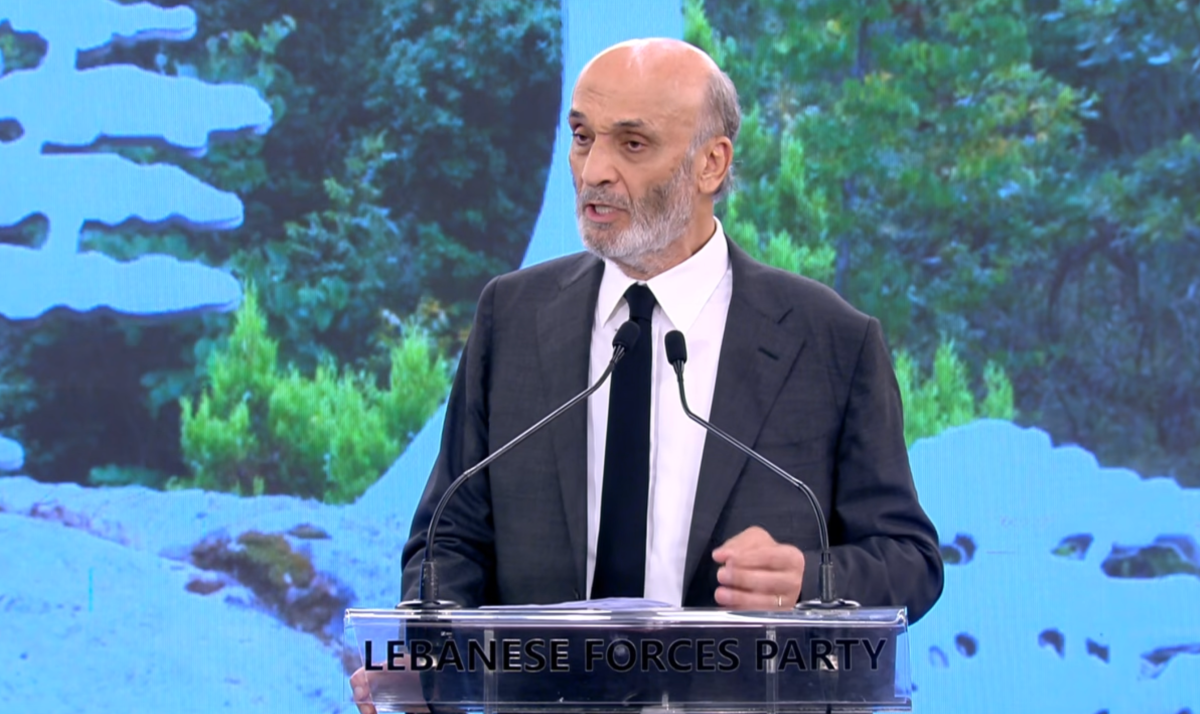
LF leader, Samir Geagea, during his speech on Sept. 6, 2026. (Credit: Screenshot)






BEIRUT — In a lengthy speech delivered at the annual mass for the party's “martyrs,” Lebanese Forces leader Samir Geagea positioned himself as a leading figure in the anti-Hezbollah camp. He praised the decisions taken by the current authorities regarding the state monopoly on weapons and negotiations with Israel, while criticizing the “slowness” of their implementation and once again denouncing the sidelining of Foreign Minister Joe Rajji, an ally of his party.
Samir Geagea said that “the dawn of sovereignty” would soon rise over Lebanon. He spent much of his speech reflecting on the ongoing war, which was sparked by Hezbollah against Israel on March 2. “What is most surprising is that some officials behave as Hezbollah does, directing their criticism solely at Israel,” he noted. “But we can insult Israel as much as we like; that won't rebuild a house in southern Lebanon or stop the conflict.”
The Lebanese Forces leader believes that the process of direct negotiations begun by President Joseph Aoun in April, which led to a framework agreement for the phased withdrawal of the Israeli army from occupied areas, is the only way out of the cycle of violence. “But let's not kid ourselves: this framework agreement can only deliver results if the Lebanese and Palestinian militias, led by Hezbollah, are disarmed,” he said.
The majority of Lebanese
He also argued that Hezbollah's disarmament is a demand of “the majority of Lebanese,” as well as the international community and the Arab world — not just Israel or the United States. “Hezbollah was waiting for Iran. Now, Iran itself is encircled,” he stated. “It must then dismantle its own armed branches, or else it is up to the Lebanese state to do so, one way or another.” Responding to threats from Naim Qassem, who had recently warned the government about the “anger” of Hezbollah's supporters, Geagea countered: “And what about the anger of the majority of Lebanese — what are we supposed to do with that?”
Taking a more critical tone toward the authorities, the Christian leader called on Lebanese leaders “not to lose any more time” in restoring state sovereignty. “It is time for action, not just words. The state must rise to the challenges in order to regain the trust of the Lebanese, and seize an opportunity that will not come again,” he asserted. While supporting the “sovereignist” decisions of President Aoun and Prime Minister Salam, Geagea criticized both men for what he called the excessively slow pace of reforms, particularly financial ones.
“We thought that with Joseph Aoun’s election to the presidency and Nawaf Salam’s appointment as prime minister, the time for the rule of law had arrived,” he continued. “But perhaps we were mistaken.” Samir Geagea first cited the Raouche incident last September, when Prime Minister Nawaf Salam refused to allow the portrait of former Hezbollah leader Hassan Nasrallah to be projected onto the Pigeon Rocks. Lacking the support of the president and the army chief, however, he was unable to enforce his decision. The Lebanese Forces chief also wondered how army commander General Rodolph Haykal could ignore “by all possible means” the Cabinet's decisions regarding the disarmament of Hezbollah.
Finally, he reproached both Aoun and Salam for sidelining Minister Joe Rajji. “Forget his name and his person. Joe Rajji represents an institution, that of the Ministry of Foreign Affairs,” he declared, saying his protégé is paying the price for his positions. “His only fault is adhering to the true policy of the state, where others have refrained from acting — from the inaugural speech, to the ministerial statement, to relevant government decisions,” he asserted.
Samir Geagea then returned to another incident: the decision by Bustros Palace to declare Iran’s ambassador Mohammad Reza Shibani persona non grata, while General Security nonetheless renewed his residency in August. “We support the mandate, but we believe that certain actions must be corrected,” he said.
Wishing to emphasize his national standing, Geagea said that the Lebanese Forces had “supported the Sunnis in the face of injustice by advocating for the adoption of the general amnesty.” As for the Shiites, he recalled having spent his childhood “among [them]” in Chiyah. “I am originally from Bsharri and Deir al-Ahmar — so the shoulder and heart of the Bekaa,” he added. Addressing the residents of the plain, he urged them not to believe rumors spread by the pro-Iranian axis, suggesting that the new Syrian authority (in place since December 2024, after the fall of Bashar al-Assad’s pro-Iranian regime) would intervene in Lebanon to fight Hezbollah. “The new state established in Syria has no such project at all,” he said. “But if, by some improbable turn, this does happen, the defense of the borders is the responsibility of the Lebanese army and security forces. And if duty requires it, we will not hesitate for a single instant to defend all of Lebanese territory.”

 Midday news recap: Hebron attack sparks Israeli crackdown, international meeting in Istanbul for regional 'de-escalation'