



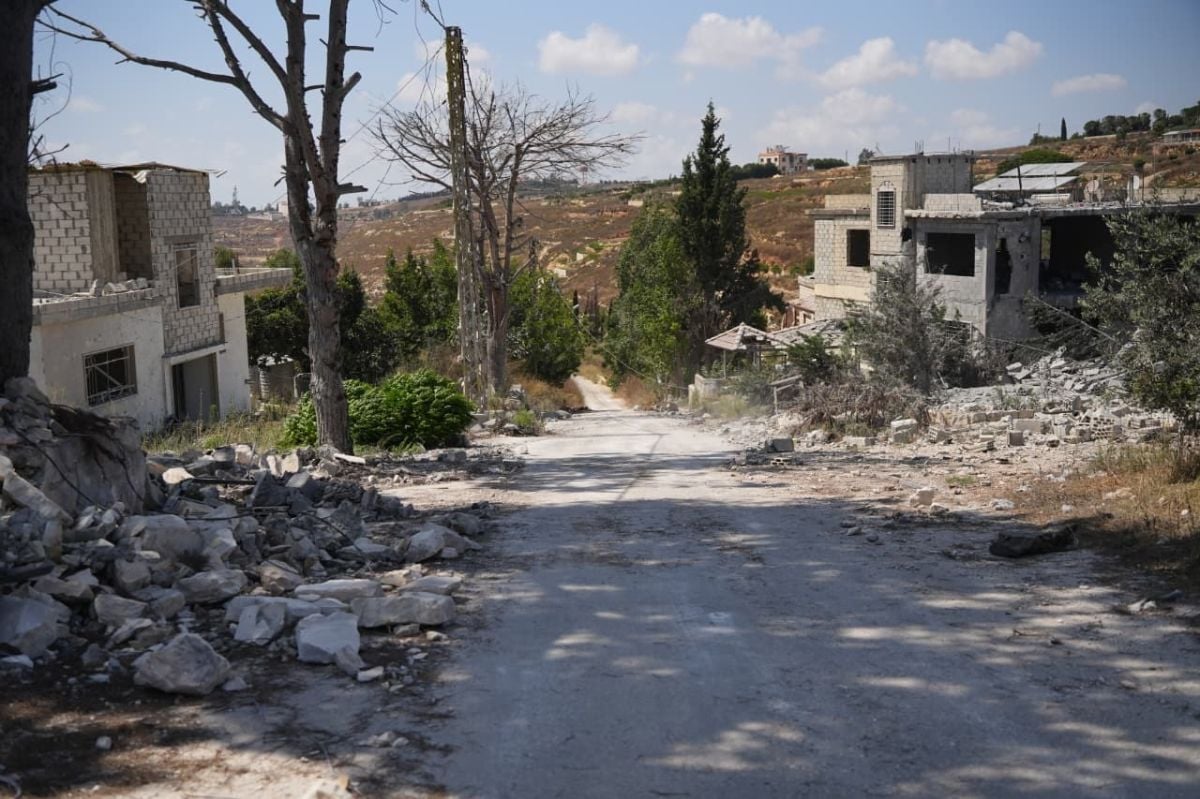
Debris along a road in Zawtar Gharbieh, in the Nabatieh district, on July 24, 2026. (Credit: Mohammad Yassine/L'Orient-Le Jour)






SOUTH LEBANON — The Nabatieh region remained under Israeli bombardment Tuesday, with three drone strikes hitting Nabatieh Fawqa without causing casualties, according to our correspondent in southern Lebanon.
The village has been repeatedly targeted despite the cease-fire that took effect in mid-June. The first two strikes hit the same location. Nabatieh Fawqa lies on the edge of the de facto “buffer zone” established in southern Lebanon and near the Ali Taher hills, where the Israeli army has accused Hezbollah of maintaining an underground command center.
Israeli forces also targeted the Ali Taher hills with aerially dropped explosives and artillery fire which triggered fires. The outskirts of Nabatieh Fawqa and the Ali Taher hills had already been shelled overnight. Explosions were also reported in Zawtar Sharqieh.
South of the Litani River, Israeli forces carried out two detonations in Adsheet al-Qusseir, in the Marjayoun district. The area had come under heavy artillery fire earlier in the day.
In the Sour district, Israeli drones dropped stun grenades on Mansouri and the neighboring village of Byout al-Siyad. Early Tuesday evening, Israeli forces carried out a major demolition operation between Majdal Zoun and Mansouri, followed by another large-scale explosion in Mansouri.
The affected villages are located inside or along the edge of the “buffer zone,” which covers around 620 square kilometers of Lebanese territory along the border, where Israeli forces continue to occupy dozens of villages.
On Monday evening, Israeli forces carried out several major demolitions, including in Tallousseh (Marjayoun), where an entire neighborhood was destroyed with explosives. Shelling and machine-gun fire also targeted the outskirts of Shebaa, in the Hasbaya district.
The escalation comes ahead of a new round of Lebanon-Israel talks in Rome on Aug. 4-6, confirmed Monday by Washington. A U.S. State Department official said the discussions would focus on implementing the framework agreement, expanding the "pilot zones," resolving remaining border disputes and advancing a broader peace and security agreement.
“The experience gained from the first zones will help us improve the implementation of the pilot zones so that these can be expanded gradually,” the official added.
Italian Foreign Minister Antonio Tajani had announced the talks several days earlier.
The agreement reached on June 26 calls for Israel to withdraw as the Lebanese Army in “pilot zones” deploy, and which remains conditional on Hezbollah’s disarmament.
According to Israeli Channel 11, the Lebanese Army discovered a “Hezbollah weapons cache” in one of these zones in south Lebanon. Citing unnamed sources, the channel said it was the first time infrastructure belonging to the Iran-backed group had been "neutralized" by the Lebanese Army since implementation of the framework agreement began, describing it as a positive sign of the army's commitment to addressing Hezbollah's weapons.
Channel 11 did not specify in which of the two pilot zones the cache was found. The zones are located south of the Litani River between Srifa and Froun in the Bint Jbeil district, and farther north around Zawtar Gharbieh.
In a statement issued Tuesday, UNIFIL said its explosive ordnance disposal (EOD) specialists discovered 385 containers containing around 4,000 kilograms of explosive material, mainly ammonium nitrate, on July 2 near Houla in the Marjayoun district. The material was later rendered inert.
The U.N. force also said it neutralized explosive components found in the wreckage of a drone discovered near one of its positions in south Lebanon on July 10.
