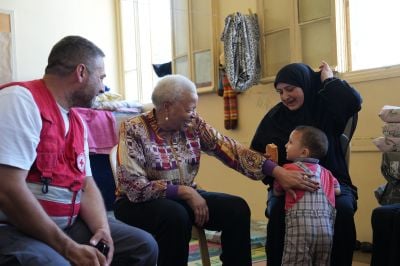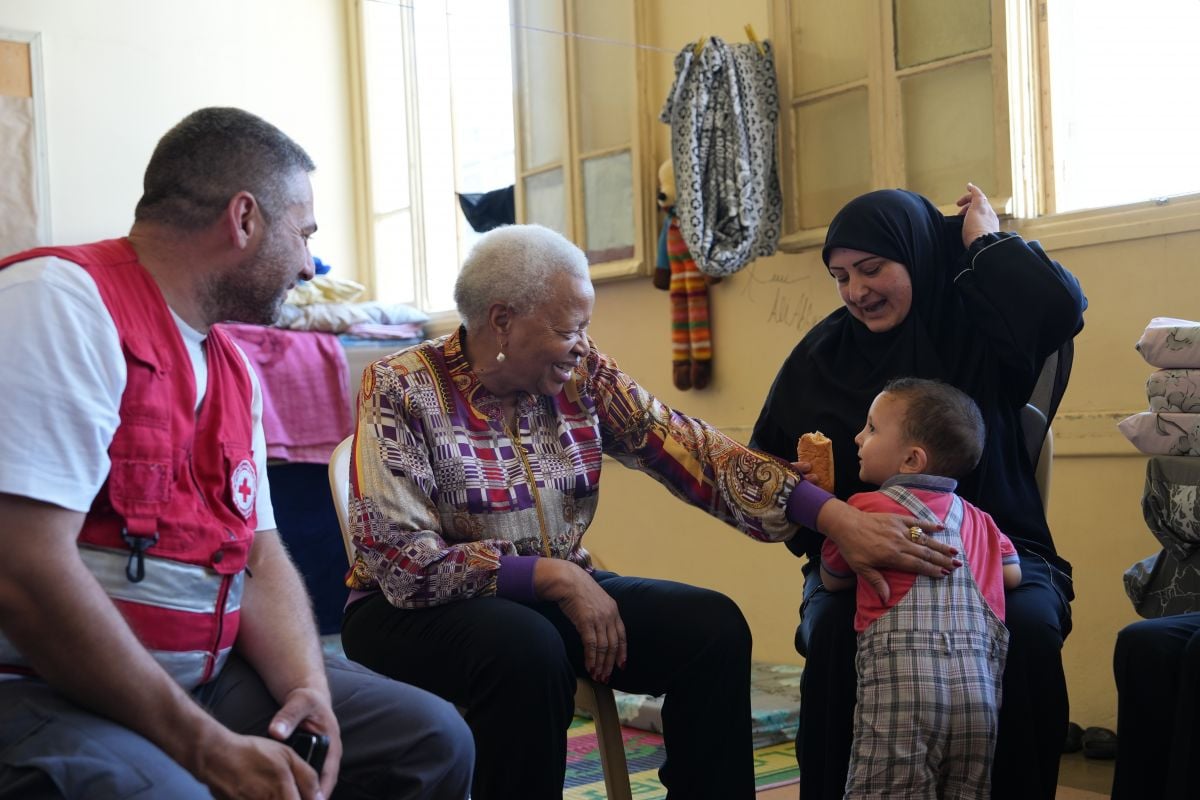
Graca Machel, former minister in Mozambique and widow of South African leader Nelson Mandela, talks with displaced people from South Lebanon in a center in Beirut on July 13, 2026, as part of a tour by members of the Elders organization in Lebanon. Photo Wael Kanj






Graca Machel, former Mozambican minister, Mary Robinson, former president of Ireland, and Helen Clark, former prime minister of New Zealand, shared with L’Orient-Le Jour their views on the conflicts across the region.
They are known as "The Elders." Founded in 2007 by Nelson Mandela, the organization brings together former heads of state, U.N. secretaries-general, and other respected figures who would use their experience and political independence to address the major challenges of our time, from human rights to the most complex conflicts, including climate change.

As part of this mission, Graca Machel, former Mozambican minister of culture and widow of Nelson Mandela; Mary Robinson, former president of Ireland and former U.N. High Commissioner for Human Rights; and Helen Clark, former prime minister of New Zealand, traveled to Lebanon this week before continuing their tour in Israel and the Palestinian territories.
We met and spoke with them.
International law violated
According to Graca Machel, the aggravating regional crisis prompted their visit. “We are concerned about the violence affecting the West Bank, with the apparent intention of occupying even more territory and leaving Palestinians with no space at all. The violence has reached unprecedented levels,” she said.
She also refers to “the bombings in Lebanon, where hundreds of thousands of families have been displaced from their villages and prevented from living with dignity.”

It was important for her to “see the situation firsthand” and to meet with “decision-makers, civil society actors, and displaced people.”
When the war resumed on March 2, more than one million people were forced to flee their homes in southern Lebanon, with Israel subsequently destroying dozens of villages in the region.
“We saw families living in a single room or under a tent in the middle of the city,” Helen Clark said. “Men have been deprived of work, while women have taken on the responsibility of caring for their families.”
She also recalled the accounts of people who had lost their homes, belongings, or livestock.
She said she is convinced that diplomacy is the only way to resolve the crisis. During their meeting with President Joseph Aoun, discussions focused on ongoing negotiations with Israel aimed at securing the withdrawal of Israeli troops and achieving a lasting peace.
“We found the president deeply committed to diplomatic solutions,” Helen Clark said, calling on all those with influence over the talks to use it “because families are suffering right now.”
The Elders also called for stronger support for the Lebanese Army, as well as continued backing for the government's reconstruction efforts and reform agenda.
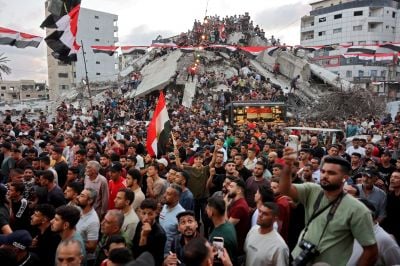
Mary Robinson, for her part, described Israel’s response as “disproportionate,” both to the “horrific Oct. 7 attacks,” referring to the Hamas operation prior to Israel's latest war on Gaza in 2023, and to the missiles fired by Hezbollah at Israel, particularly on March 2 following the assassination of Iran’s Supreme Leader, Ali Khamenei.
She said these conflicts have been marked by “killings and war crimes.” “We must uphold the rule of law because it is our strongest safeguard,” she said.
A message of ‘full solidarity’
After their visit to Israel, the three women will travel to Brussels to present their findings to European Union officials.
“We believe Europe can play a more active role in resolving these conflicts because of its ties with Israel,” Mary Robinson said.
“European countries import goods from the occupied territories, even though this goes against the human rights principles that the EU itself promotes. We hope to persuade them to use these trade interests as a means of putting pressure on Israel,” she added.
Their message to the people of the region remains a message of “full solidarity” with all victims, whether Lebanese, Palestinian, or even Israeli.
“Wars have never been a natural means of communication between states and peoples. They only bring suffering and death,” Graca Machel said. “Everything can be resolved peacefully through diplomacy.”
This article originally appeared in French on L'Orient-Le Jour.