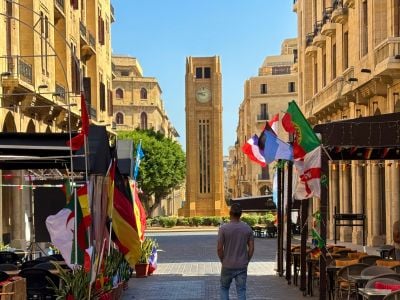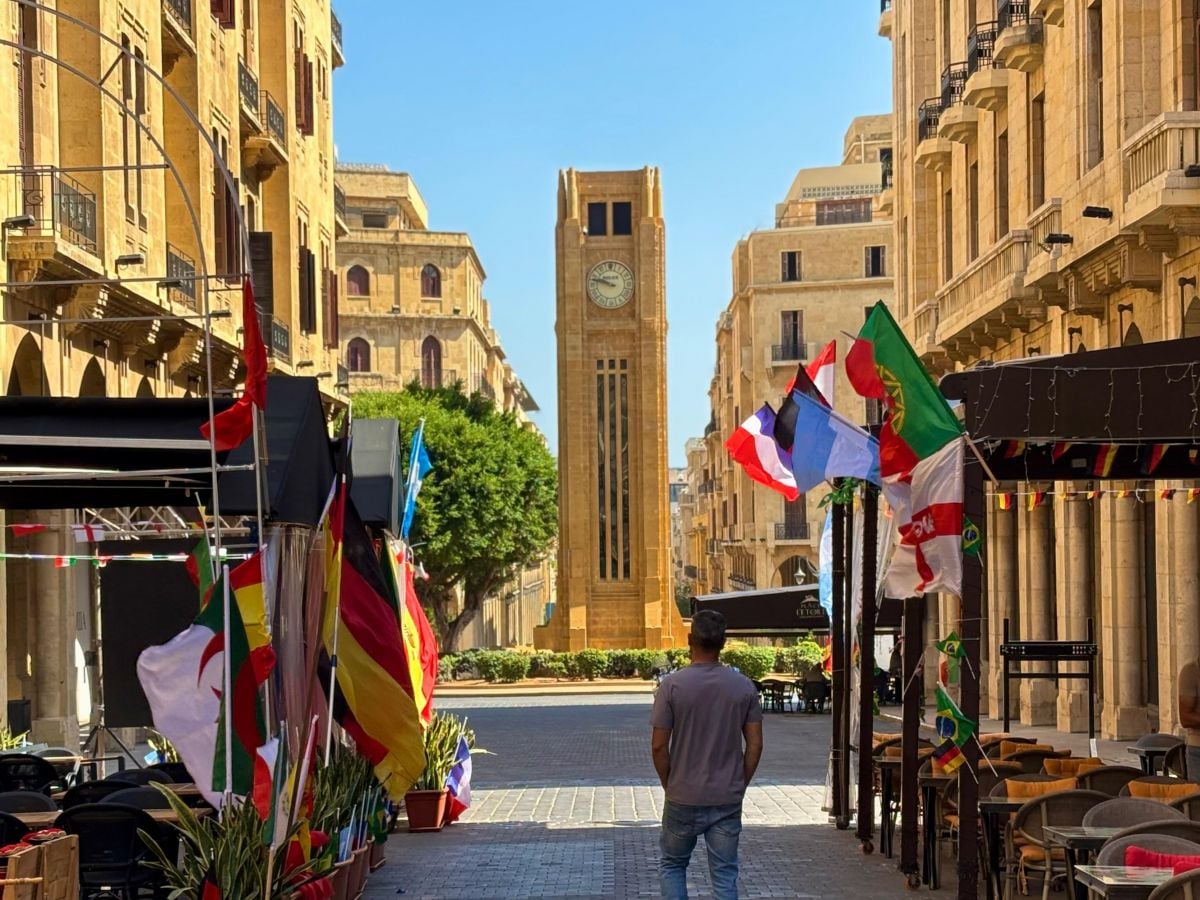
Place de l'Étoile, downtown Beirut, June 24, 2026. (Credit: Philippe Hage Boutros/L'Orient-Le Jour)






Eurobonds have not plummeted further since the re-escalation of the war between on March 2, as well as the broader regional war instigated by the U.S. against Iran on Feb. 28. This is evident from the curve of dollar-denominated debt securities issued by the Lebanese state and still in circulation since the March 2020 default.
After hovering around 30 cents on the dollar at the end of February, they are currently trading at around 25 cents on the secondary market (between holders, as the state is no longer issuing), as confirmed by Marwan Barakat, head of research at Bank Audi, who has just published his latest quarterly report on the Lebanese economy.
The report finds that the war has indeed reversed the "favorable" trend that was taking shape at the start of the year, and that "all indicators in the real sector have shifted from a phase of expansion to a phase of contraction, due to subdued demand for goods and services," in a context exacerbated by 'the sharp acceleration of inflation (+19% in May according to official figures, compared to 12.2% in December year-on-year), driven by rising oil prices."
As in April, the authors maintain a scenario forecasting a 5% contraction in GDP in 2026, if the current, albeit imperfect, cease-fire holds until the end of the year. They also foresee a state budget deficit in 2026, despite a budget that has once again pushed back investment expenditures in order to maintain a precarious equilibrium that the resumption of war has shattered, so far without affecting exchange rate stability.
They also note that Lebanon's balance of payments shifted from a real surplus of $0.3 billion in January-February 2026 to a deficit of $0.2 billion from March to May, due to declining capital inflows, particularly remittances, FDI, tourism revenues, and exports. The report also highlights a slowdown in foreign trade: "Despite the mechanical effect of higher prices related to inflation, imports declined by 5.8% year-on-year in March and April, after rising by 32.3% in the first two months of the year, while exports fell by 10.2% over the same period."
Optimism or illusion
If eurobond prices have still not fallen well below 20 cents despite these setbacks, it's because "investors are betting on the possibility of a breakthrough toward peace and a relaunch of the reform program, which would ultimately lead to a debt restructuring with potential recovery prices for eurobonds above 30 cents on the dollar," explains Barakat to L'Orient-Le Jour.
Lebanon, however, has not yet convinced the International Monetary Fund (IMF), which it approached after the default, to allow it to enter into a financial assistance program conditioned on reforms. Although the government of Nawaf Salam, formed at the beginning of 2025, tried to move the matter forward by adopting key pieces of legislation — bank secrecy, bank resolution, and the financial gap law — in line with IMF expectations, Parliament repeatedly introduced amendments before voting, which the institution deemed non-compliant with international standards. On the security front, the recent resumption of hostilities between Washington and Tehran is jeopardizing the stability of the entire region, including Lebanon, where Hezbollah rejects the direct negotiations taking place between Lebanon and Israel.
A banker, speaking on condition of anonymity, attributes the limited decline in eurobond prices to speculation linked to "numerous small individual investors or small trades that move the market, sometimes based on overly optimistic geopolitical expectations." "These are the usual Lebanese illusions that salvation is always within reach," he says.
Eurobond holders include Lebanese banks as well as investors represented by the Ad Hoc Group. Banque du Liban (BDL, central bank) also holds more than $5 billion in securities at nominal value, for instance, before any haircut, out of the approximately $30 billion still in circulation.
This article originally appeared in French on L'Orient-Le Jour.