


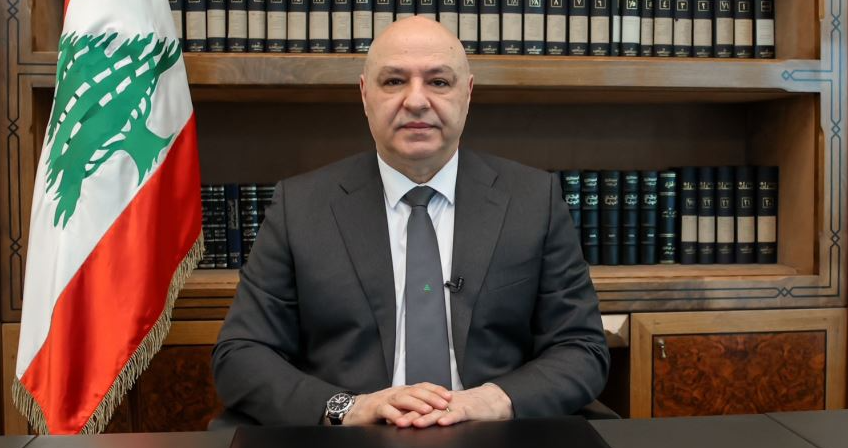
President Joseph Aoun. (Credit: Archive photo NNA)






BEIRUT — Ahead of a planned White House meeting later this month, President Joseph Aoun said he had a "good" 17-minute phone call with U.S. President Donald Trump on June 28, during which they agreed on several issues to discuss further in Washington.
In an interview with the Arabic-language daily an-Nahar, Aoun said his planned visit to Washington will help to consolidate the framework agreement with Israel and prepare for the launch of a "military project" in South Lebanon under the supervision and with the direct support of the United States.
This official visit will take place after a meeting between Trump and Israeli Prime Minister Benjamin Netanyahu, who is also expected in Washington in the coming days. Regarding reports of a possible meeting between Aoun and Netanyahu, the president assures that he "is not considering it" and will not accept it as long as Israeli attacks on Lebanese citizens and Israeli violations continue. He explained that he would immediately leave if he found himself in the same room as Netanyahu.
President Trump expressed understanding and voiced positive intentions, showing empathy toward Lebanon, it was learned.
Concluded at the end of June in Washington between Lebanon and Israel, the framework agreement aims to end the conflict between Hezbollah and Israel, and specifically provides for the withdrawal of Israeli forces from two "pilot zones" in occupied south Lebanon and their transfer to the Lebanese Army. However, it does not set a timetable for this withdrawal and makes it conditional on the verified disarmament of Hezbollah. The Shiite party has rejected this agreement.
Framework agreement ‘not ideal’
In his interview, Aoun once again acknowledges that the framework agreement is "not ideal," but justifies accepting it by pointing to a number of realities on the ground and the balance of power in the south, which currently favors Israel — though this should not prevent Lebanon from defending its rights and reclaiming occupied territories. "What alternative to this agreement is there?" the president asked.
Aoun also revealed that military communications have made significant progress and will be implemented on the ground starting with the first pilot zone in the villages of Zawtar Gharbieh and Zawtar Sharqieh in the Nabatieh district.
Aoun, however, voiced his fears of an Israeli attack on the strategic hill of Ali Taher (Nabatieh), which would radically alter the situation. Members of the Lebanese delegation in Washington contacted U.S. Secretary of State Marco Rubio about this, proposing that the hill be placed under the control of the Lebanese army. While Netanyahu accepted the proposal, Hezbollah rejected it, an-Nahar revealed.
The daily also reports that the "Mechanism" committee, which was tasked with monitoring the implementation of the November 2024 cease-fire, no longer exists in its previous form but has instead been transformed into a tripartite (U.S.-Lebanese-Israeli) committee operating under the name MCG4L. This committee will be led by U.S. General Joseph Clearfield, who maintains good relations with the commander of the Lebanese Army and will manage the committee from the U.S. Embassy in Awkar. No direct coordination between Lebanese and Israeli officers will take place, continued an-Nahar. France will not participate in this committee, although it continues preparations for a conference in support of the army, in cooperation with Saudi Arabia.
Full confidence in the Lebanese Army
At the same time, Aoun insists that any discussion about creating a special force or brigade within the Lebanese Army to carry out its mission in south Lebanon, or about the U.S. vetting the background of its officers, is unfounded. He asserts that this force will be composed of officers from any brigade operating in the south or elsewhere, with no distinction. "We have full confidence in our officers and soldiers who serve under the institution and its leadership, and who make great sacrifices," he said.
Will Lebanon be represented in discussions between Iran and the United States in Geneva? The head of state said he received two calls on this subject: one from Qatari Prime Minister Sheikh Mohammad bin Abdulrahman bin Jassim al-Thani and another from Marco Rubio, who proposed Lebanon's representation within the cell. According to him, the latter said he did not oppose Lebanon's participation in this cell, still in formation, which will be charged with monitoring the cease-fire alongside representatives from the United States, Iran, Qatar and Pakistan. The army is expected to be represented by an officer stationed in southern Lebanon, which should not be seen as contradicting the implementation of the Washington framework agreement, the head of state assured.
The president also indicated that he had previously met several times with Hezbollah MP Mohammad Raad, with whom he discussed the potential consequences of opening any support front in the country, as occurred on Oct. 8, 2023, when Hezbollah launched operations in South Lebanon in support of Hamas in Gaza.
Regarding his relationship with Parliament Speaker Nabih Berri, Aoun says there is "no discord." "We are united in our commitment to consolidate and rebuild the South, and to facilitate the return of its people to their occupied towns," he said.


