


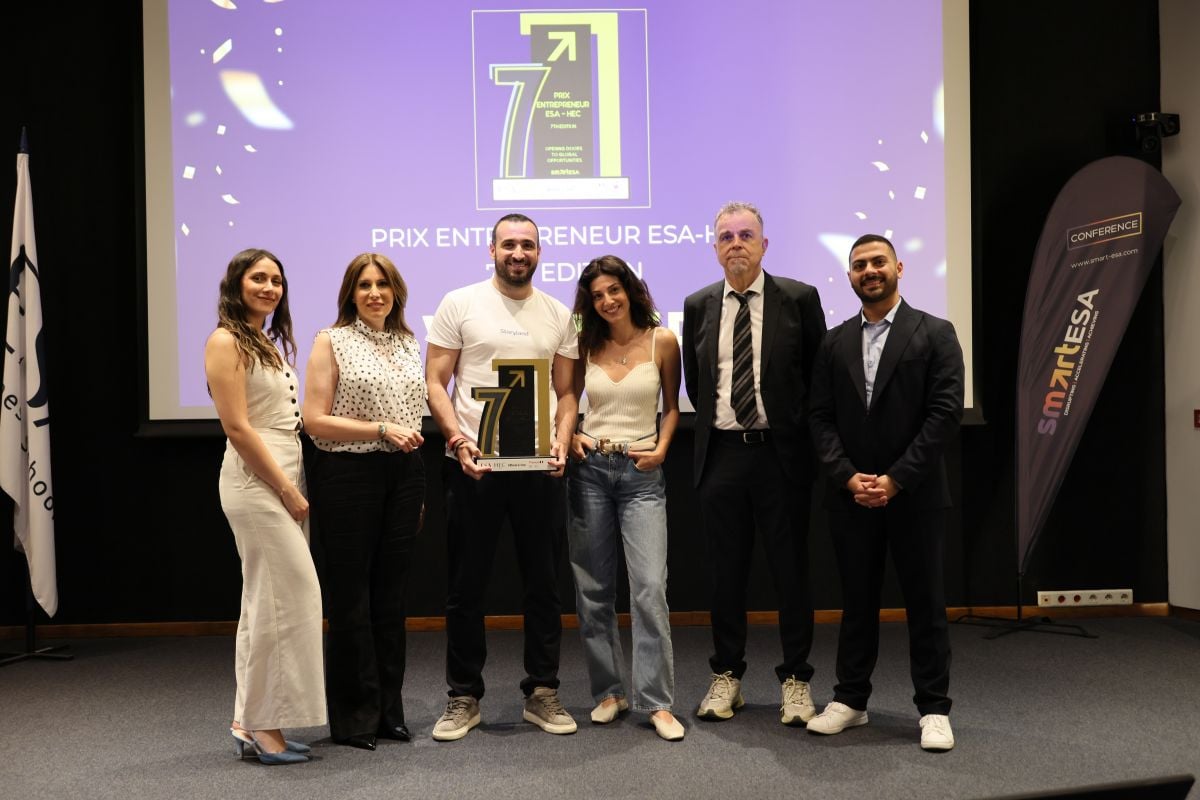
The winners of the ESA-HEC Entrepreneur Prize 2026, Lamice Joujou, Malek Fatte, and Razane Jammal, alongside Clara Maria Tadros, Head of Communications at Smart ESA, Karl Gedda, Director of Smart ESA, and Francesco Bakhos, Project Manager at Smart ESA, at the ESA Business School, on July 3, 2026. (Credit: ESA Business School)






The ESA-HEC Entrepreneur Prize 2026 was awarded on Friday to startup Storyland, selected from 12 finalists in the seventh edition of the competition launched last spring.
Organized by L'Orient-Le Jour and Smart ESA in partnership with the French Embassy, French Tech Beirut, HEC Paris Alumni Lebanon, Air France and Light FM, the award was presented at ESA Business School in Beirut following jury deliberations that included Smart ESA Director Karl Gedda.
Before the finalists delivered their pitches, L'Orient-Le Jour Executive Director Rima Abdul Malak highlighted that the competition had been maintained despite the country's difficult security situation over recent months amid the war between Israel and Hezbollah.
ESA Director General Maxence Duault also signed a memorandum of understanding with HEC Alumni Lebanon, chaired by Elsa Aoun, to strengthen mentoring initiatives.
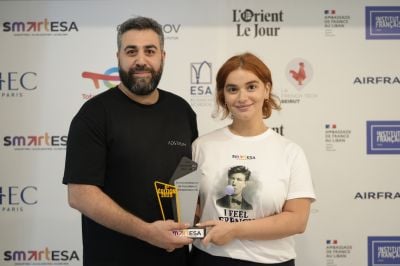
Storyland was founded by Malek Fatte with the support of Lebanese-British actress Razane Jammal, who serves as both an investor and the startup's brand ambassador. Another investor, Lamice Joujou, founder of the Lebanese daycare chain Dent de Lait, oversees the company's business-to-business distribution.
The startup developed an application that uses multiple artificial intelligence models to generate personalized illustrated stories combining narration and still images to strengthen bonds between children and their families.
One of the app's most distinctive features is its ability to clone a user's voice in seconds and use it to narrate stories.
According to Fatte, Storyland combines several AI models: ChatGPT, developed by OpenAI, for text generation; Google's Gemini Nano Banana model for illustrations; and the Chinese model MiniMax for voice cloning and audio narration. The app can also reproduce multiple Arabic dialects.
Targeting Lebanon's diaspora
The application, Storyland: Family Stories, is already available on iOS and Android. It can be downloaded free of charge, while a subscription unlocks premium features, including the creation of longer stories. L'Orient-Le Jour tested the app and confirmed that its voice-cloning feature is fully operational.
Storyland targets both families living in Lebanon and relatives abroad, reflecting the country's large diaspora. Children can listen to personalized illustrated stories narrated in the voice of a parent, grandparent, or another family member.
The prize awarded to Storyland — six months of fully funded incubation at the HEC Paris Incubator at Station F, the world's largest startup campus — will allow the company to expand into the childcare sector by developing products for nurseries, daycare centers and similar institutions.
The platform would enable parents to receive illustrated summaries of their children's day, highlighting activities, milestones and other key moments.
The incubation program is also expected to accelerate the startup's growth by giving it access to HEC Paris' entrepreneurial network and the broader French Tech ecosystem.
The 11 other finalists also showcased highly innovative projects, most centered on artificial intelligence and digital technologies. Two exceptions were VerdePlastix, which converts invasive algae into bioplastic, and Argentum, which has developed a process to recover silver from used X-ray films.
The Audience Choice Award went to United Network of Global Youth, which aims to build an international network enabling university students to design, implement, and validate social impact projects through a self-governance model. Instead of relying on institutional committees, participants receive verifiable certifications endorsed by thousands of their peers.
Among the other finalists, Bariq presented an AI-powered media monitoring platform designed for news organizations, think tanks, and universities. Al-Muwaten introduced a news platform focused on Lebanon's startup ecosystem to increase entrepreneurs' visibility and connect them with investors.
Hakkemni showcased an AI-powered platform connecting patients with doctors in Lebanon, while Rcover-ai presented an AI assistant that automates report writing for mental health professionals.
Coollab.ai demonstrated a platform that allows entrepreneurs to simulate running a business using an AI team assigned to different corporate roles before launching a company. Seyerne introduced a platform that transforms expert knowledge into interactive AI mentors, while Neuracare presented a real-time application for monitoring patients' responses to treatment.

 7 p.m. recap: Netanyahu seeks mastermind behind Flydubai incident; Washington sanctions 2 French nationals; Ben Gvir's 'I want to kill you' threat