



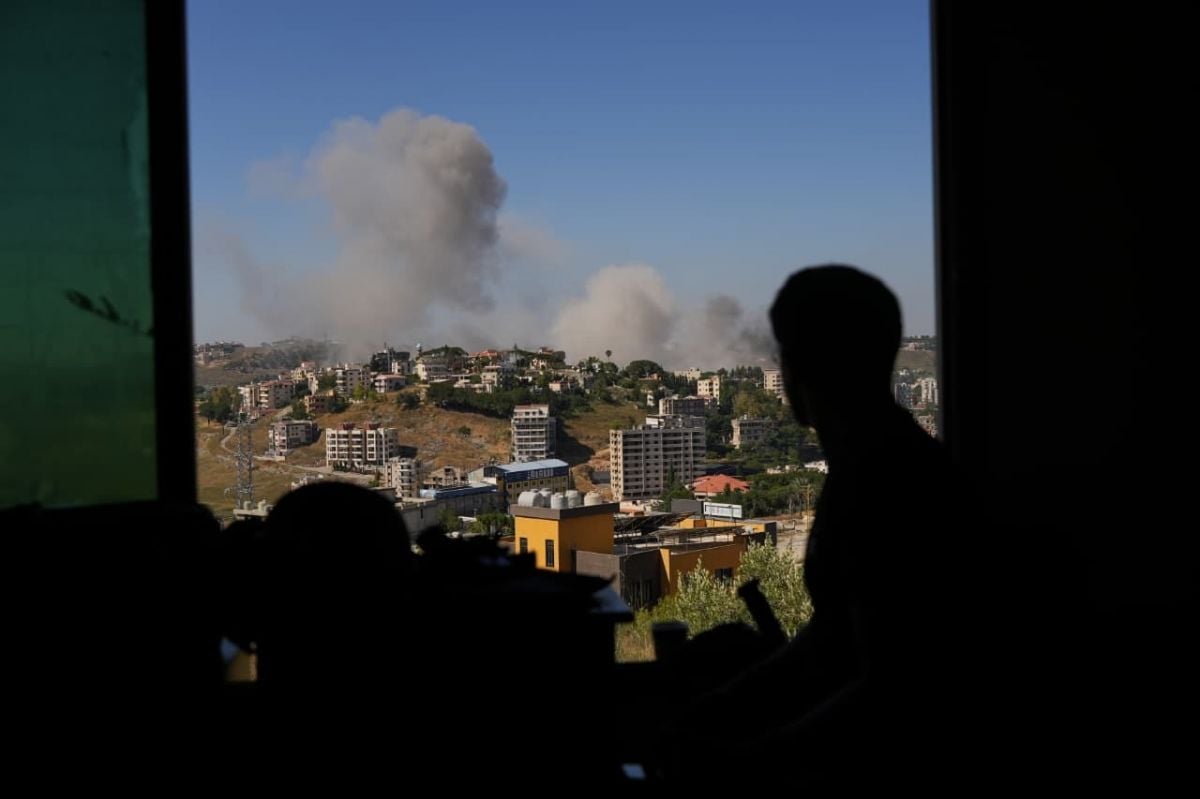
A man observes an Israeli strike on the Nabatieh region in southern Lebanon on June 20, 2026. (Credit: Mohammad Yassine/L'Orient-Le Jour)






BEIRUT — For the first time in nearly a week, daily Israeli drone strikes killed several people in southern Lebanon on Monday, while Israeli demolition operations continued in six occupied localities.
Against this tense backdrop, the heads of municipal councils in several Christian villages in the Marjayoun district said they received messages from the Israeli side on Monday afternoon warning them not to allow displaced residents to return to their villages, according to our correspondent in south Lebanon.
Hanna Daher, head of the municipal council of the Christian village of Qlayaa, told our correspondent that the warning may be linked to the return of some displaced people to Jdeidet Marjayoun who are considered to be originally from the neighboring Shiite villages of Dibbin and Blat. He said there are currently no displaced people in Qlayaa, adding that such messages keep residents in a constant state of anxiety and tension.
Meanwhile, Elie Sleiman, head of the municipal council of Burj al-Muluk, said he received the same message on his phone and likewise confirmed that there are no displaced people in the village. He added that the municipality had requested permission earlier in the day, through the "Mechanism," for 16 Christian families to return to the village, but the request was rejected.
Around 12:30 p.m., an Israeli drone carried out two successive strikes, one of which hit a car traveling in Nabatieh Fawqa. Sources connected to our correspondent in the South provided details on the identities of the three people killed in the drone strike on Nabatieh Fawqa.
They were four victims including three women one of which was Esperanza Fakhri Ghandour, principal of the Salman Chamoun Public Kindergarten in Nabatieh Fawqa. She was accompanied by her mother and her domestic worker. There were no men in the vehicle, contrary to earlier information that had also reported the death of her husband, our correspondent noted.
Reacting to the strike, the Israeli army said it had targeted four individuals "identified as approaching the 'security zone'" in the al-Aqida neighborhood of Nabatieh Fawqa, claiming they "posed a threat to its forces."
"Following the identification, the Air Force carried out a precision strike against the suspects in order to eliminate the threat," the Israeli military said in a statement.
The Israeli army uses the term "security zone" to refer to dozens of villages it has occupied in south Lebanon in recent months. It also said it had carried out a strike in the same area the previous day against what it described as a "Hezbollah-affiliated sabotage cell."
'Heinous attack contrary to all humanity'
The Association of Primary School Teachers in Lebanon paid tribute to the school principal in a statement, honoring the memory of a "dedicated and generous" colleague who was "devoted to her homeland and her students" and condemning a "heinous Israeli attack contrary to all humanity."
In addition to the deadly attack, the first since last Tuesday, when a young man from Touline (Bint Jbeil) was killed in Wadi Hujeir, another Israeli drone strike targeted Kfar Tibnit, also in the Nabatieh district, later in the afternoon. No casualties were reported.
Israeli artillery shelling also targeted the villages of Kounin (Bint Jbeil district), Qabrikha, Qantara, and the Wadi Slouki area (Marjayoun district). Israeli military vehicles were also seen near Beaufort Castle in the Nabatieh district.
Later in the afternoon, several Israeli attacks were concentrated in the Bint Jbeil area, according to our correspondent. A drone struck a house in Braasheet, which also came under artillery fire.
Machine-gun fire targeted Haddatha, where an Israeli force advanced to the outskirts of the village cemetery and opened fire again. In Kounin, the Israeli army demolished several buildings with explosives.
In its latest official count, published Sunday, the health ministry said at least 4,304 people have been killed and 12,196 others wounded in Lebanon by Israeli bombings since the resumption of Israel's attacks on March 2.
At the same time, the Israeli army stepped up demolitions in villages it continues to occupy within the so-called "buffer zone," which covers more than 600 square kilometers of Lebanese territory. Israeli troops blew up buildings in Kounin, Haddatha, Aitaroun and Bint Jbeil (Bint Jbeil district), as well as Houla (Marjayoun) and Kfar Tibnit (Nabatieh). A drone also dropped a stun grenade in Mansouri (Sour).
Meanwhile, Hezbollah held new funerals in Kafra (Bint Jbeil) for 19 fighters killed in battle.
On the Israeli side, Benjamin Netanyahu convened a security cabinet meeting Sunday to purportedly oversee preparations for the Israeli army's upcoming withdrawal from two "pilot zones" in southern Lebanon, as agreed under the framework agreement signed June 26 between Lebanon and Israel, Israeli media outlet Ynet reported.
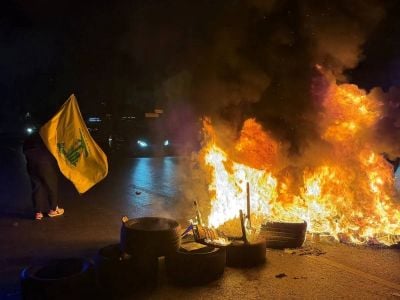
According to Ynet, Israel is waiting for the Lebanese Army to announce "its readiness to enter these zones" before proceeding, as well as for approval from U.S. Central Command, which is to serve as coordinator between the two sides. The gradual withdrawal of Israeli troops, for which no timetable has been set, is to be followed by the dismantling of Hezbollah infrastructure by the Lebanese Army in the returned villages.
For his part, President Joseph Aoun said the continued Israeli occupation "undermines the legitimacy of the state" and "prevents the deployment of the army" in southern Lebanon, according to the state-run National News Agency. He also said there is "no place for civil war in Lebanon," and that its return "is not on the agenda despite all attempts by some to fuel discord."
On the ground, the Israeli army continues to occupy a "buffer zone" of more than 600 square kilometers in southern Lebanon, extending up to 10 kilometers into Lebanese territory.
Reporting by our correspondent in the South, Muntasser Abdallah.