






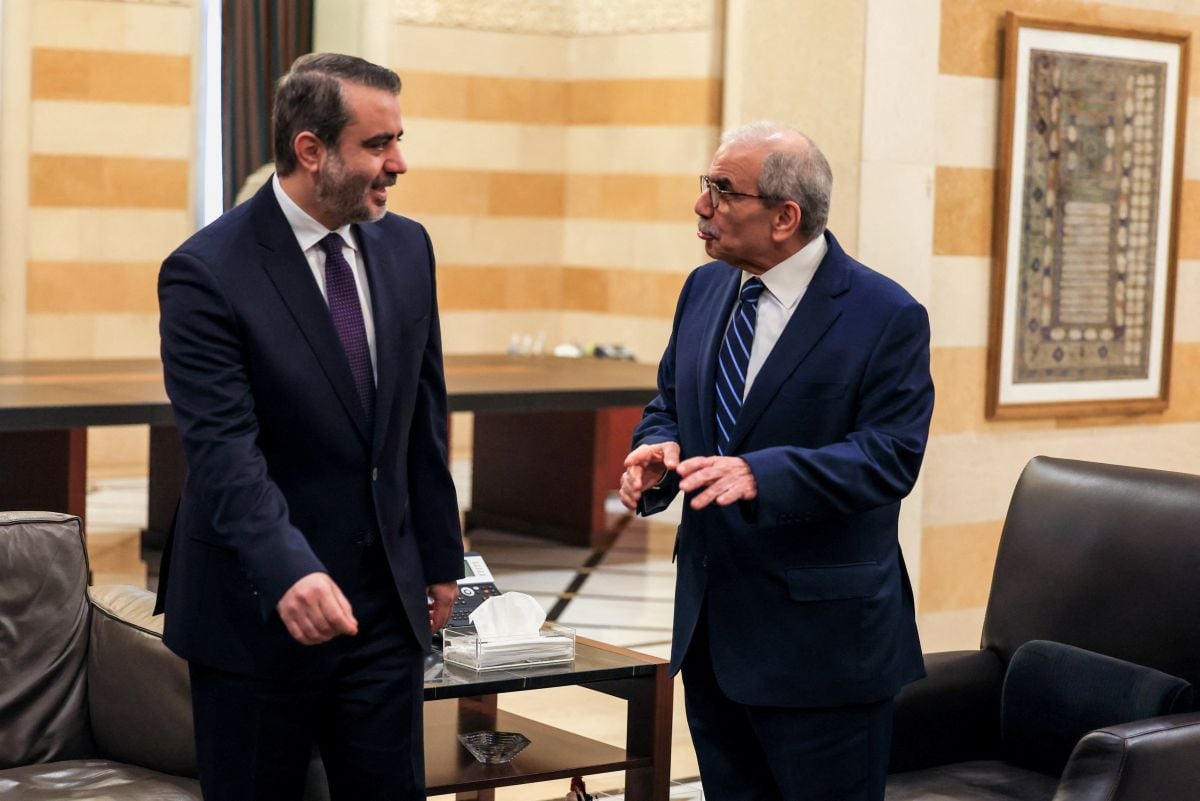
Lebanon's Prime Minister Nawaf Salam meets with Syrian Foreign Minister Asaad Al-Shaibani at the Government Palace, in Beirut, Lebanon, July 2, 2026. (Credit: Mohamed Azakir/ Reuters)






BEIRUT— The Cabinet approved on Thursday the establishment of a joint Lebanese-Syrian commission during a meeting held at the Grand Serail, a decision formalizing a new institutional framework for coordination between the two countries.
The body, officially named the Higher Joint Lebanese-Syrian Commission, will serve as the top-level mechanism for consultation, coordination and cooperation between Beirut and Damascus.
The agreement establishing the commission was signed earlier in the day by Prime Minister Nawaf Salam and visiting Syrian Foreign Minister Assaad al-Shaibani. It aims to “strengthen bilateral relations” and ensure “non-interference in internal affairs,” according to a copy of the text published on the Cabinet’s X account as the meeting began.
Information Minister Paul Morcos confirmed the Cabinet’s approval but did not provide details on implementation steps or the timeline for the commission’s first meeting.

The commission’s mandate covers political, diplomatic, financial, economic, commercial and investment cooperation, as well as legal and security coordination. It also includes transport, energy, infrastructure, education, culture and scientific research, along with health, social affairs, telecommunications and digital transformation.
Morcos added that the Cabinet also approved most other items on its agenda, including a project to purchase 100 buses for the Lebanese Railway and Public Transport Authority, funded by a grant from China, aimed at strengthening public transport after previous French-donated buses entered service.
Mitri visit to Geneva
Deputy Prime Minister Tarek Mitri, in his capacity as head of the National Commission for International Humanitarian Law, briefed the Cabinet on his visit to Geneva, where he presented a dossier documenting alleged violations and crimes committed during Israel’s military campaign in Lebanon.
According to Morcos, the file was submitted to the U.N. Human Rights Council, the Office of the High Commissioner for Human Rights and the International Committee of the Red Cross (ICRC). Mitri also said an independent mission is investigating alleged war crimes and violations of international law during the war between Hezbollah and Israel.
Technical education exams
Ministers were also expected to discuss year-end examinations for technical education. The Education Ministry had requested that these exams — including those for higher technical diplomas — be postponed rather than canceled, and that nursing exams, including technical baccalaureate tracks, be maintained.
No decision on the matter was announced at the end of the meeting.
Last week, the Cabinet canceled Lebanese baccalaureate exams scheduled for June 29, July 27 and September 7, 2026, amid uncertainty linked to the fragile cease-fire between Israel and Hezbollah in south Lebanon.
'Political, not legal commitments'
The June 26 Lebanon-Israel framework agreement — aimed at organizing Israel’s withdrawal and Hezbollah’s disarmament as part of a broader de-escalation process — also featured in discussions, despite the absence of several Shiite ministers.
According to the Information Minister, Prime Minister Salam opened the session by addressing the agreement, stressing that it constitutes a “political framework serving as a roadmap for negotiations” and entails “political, not legal, commitments.”
L’Orient Today learned that the discussion lasted around one hour and 15 minutes. Salam reiterated that the document is only a framework and that nothing has been finalized.
“Lebanon remains committed to the negotiation track and will continue moving forward with this process,” a ministerial source said.
Ministers from the Shiite alliance — Rakan Nasreddine, Mohammad Haidar and Tamara Zein — expressed “reservations” about the framework during the meeting.
“Everyone knows we are opposed to direct negotiations, and that is what we said in Cabinet,” Labor Minister Mohammad Haidar said. “We also object to the fact that the agreement was presented before being discussed by the government.”
“We are waiting for a written text in order to examine it,” he added.
