






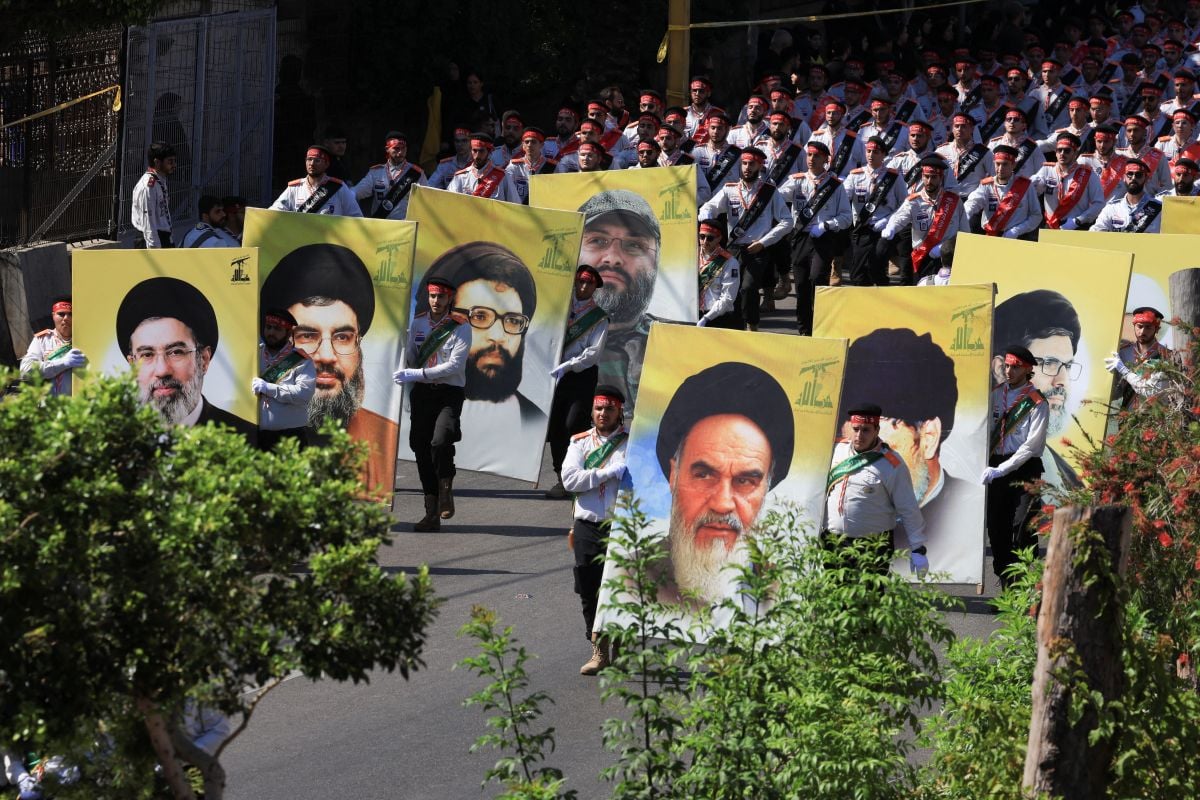
Shiite mourners hold placards bearing images of Iranian and Hezbollah figures during Ashura commemorations in Beirut's southern suburbs, Lebanon, June 26, 2026. (Credit: Mohamed Azakir/Reuters)






The member states of the Terrorist Financing Targeting Center (TFTC) announced Tuesday a series of sanctions targeting several "key infrastructures of Hezbollah."
Five entities and 16 individuals are involved, including Hezbollah’s main institutions, al-Qard al-Hassan (a microcredit organization) and Bayt al-Mal, which Washington considers the party’s "unofficial treasury," as well as their top leaders.
"The TFTC conducts joint actions, including sanctions designations, exchanges actionable information on terrorist financing networks, and enhances the capacity of its member states to combat terrorist networks that threaten security and stability. The networks targeted today by the center represent a threat to regional stability, international security, common interests, and global commerce," the released statement said.
"These coordinated measures underscore the TFTC members' shared commitment to disrupting Hezbollah’s ability to exploit the international financial system. All individuals and entities targeted today had already been designated by the United States," said the members of the center, founded in 2017 and bringing together the United States and the six countries of the Gulf Cooperation Council: Saudi Arabia, United Arab Emirates, Bahrain, Oman, Qatar, and Kuwait.
The TFTC notes that these targets had already been included on American sanctions lists, notably by the Office of Foreign Assets Control (OFAC), the U.S. Department of the Treasury agency that oversees financial sanctions. This does not automatically mean all member countries have individually adopted the same sanctions, but these designations are politically aligned and coordinated with U.S. sanctions.
This measure comes as Iran and the United States are on the verge of resuming talks in an attempt to turn the memorandum of understanding reached in mid-June into a formal and lasting agreement for an end to hostilities. Hezbollah, alongside its Shiite ally Amal, rejects the framework agreement signed last week between Israel and Lebanese authorities, which conditions Israel’s withdrawal from occupied territories in South Lebanon on the Lebanese state disarming the Shiite party.
List of targeted entities and individuals
In addition to al-Qard al-Hassan (sanctioned since July 24, 2007) and Bayt al-Mal (since Sept. 7, 2006), the list of entities includes:
- The Auditors for Accounting and Auditing, which provides financial services to Hezbollah’s central financial unit (sanctioned since Dec. 1, 2022);
- Tashilat SARL, which provided loans on behalf of Hezbollah and was a central element in the operations of al-Qard al-Hassan and Bayt al-Mal (since July 3, 2025);
- And finally al-Khobara for Accounting, Auditing, and Studies, owned, controlled and/or directed by Adel Mansour and located at the al-Qard al-Hassan premises, which provides “accounting services” (since Dec. 1, 2022).
The list of sanctioned individuals includes:
- Ibrahim Ali Daher, described as “head of Hezbollah’s central financial unit, supervising the group’s overall budget and expenditures,” has been sanctioned by OFAC since May 11, 2021. He also co-headed The Auditors for Accounting and Auditing.
- Adel Mohammad Mansour, “executive director of al-Qard al-Hassan,” has been sanctioned since December 1, 2022. The TFTC accuses him of “using his personal bank accounts to carry out transactions with various Hezbollah institutions.”
- Ahmad Mohammad Yazbeck, financial director of al-Qard al-Hassan, has been sanctioned by Washington since May 11, 2021.
- Samer Hassan Fawaz, head of the administrative division of al-Qard al-Hassan, has been under sanctions since July 3, 2025.
- Ali Mohamad Karnib, senior executive of al-Qard al-Hassan and head of the purchasing department, has been sanctioned since July 3, 2025. “In July 2024, he oversaw the purchase of more than 1,000 ounces of gold on behalf of al-Qard al-Hassan,” the TFTC noted.
- Abbas Hassan Gharib, IT manager of al-Qard al-Hassan, has been targeted by OFAC since May 11, 2021. He reportedly contributed, together with Ahmad Mohammad Yazbeck, Hassan Chehadeh Osman, Ezzat Youssef Akar, and Mustafa Habib Harb (all listed by OFAC since May 11, 2021), to “maintaining joint bank accounts in Lebanese banks, including Jammal Trust Bank (JTB),” sanctioned by the United States in 2019 and since closed, and to “transferring more than $500 million to the formal financial system over the past decade.”
- Nehmeh Ahmad Jamil, “senior official at al-Qard al-Hassan and head of the organization’s audit and affairs departments,” has been listed by OFAC since December 1, 2022.
- Issa Hussein Kassir, another “senior official” of the organization in charge of supervising the equipment procurement department and procurement and logistics activities, is accused of “opening bank accounts in the formal financial system for conducting commercial activities on behalf of AQAH.” He reportedly transferred nearly $1 million to Yazbeck, Gharib, and Osman between 2007 and 2019. He has been sanctioned by the United States since July 3, 2025.
- Ali Ahmad Krisht, former “manager of the al-Qard al-Hassan branch in Tyre,” is accused of “holding at least three bank accounts in the name of Hezbollah.” He has been sanctioned by Washington since July 3, 2025.
- Nasser Hassan Neser, who led Auditors for Accounting and Auditing alongside Ibrahim Daher, has been sanctioned by OFAC since December 1, 2022.
- Wahid Mahmoud Subayti is an official of al-Qard al-Hassan who is believed to be involved in transactions via “clandestine accounts” in the name of Hezbollah and in managing bank accounts opened in his name with other Bayt al-Mal officials. He has been sanctioned by OFAC since May 11, 2021.
- Imad Mohammad Bezz, head of the valuation and storage department of al-Qard al-Hassan, supervises gold-related operations. He has been under U.S. sanctions since July 3, 2025.
- Mohammed Suleiman Badr was deputy director of al-Qard al-Hassan under Wahid Mahmoud Subayti in the Nabatieh branch. He too was sanctioned on July 3, 2025, for acting, directly or indirectly, on behalf of AQAH.