


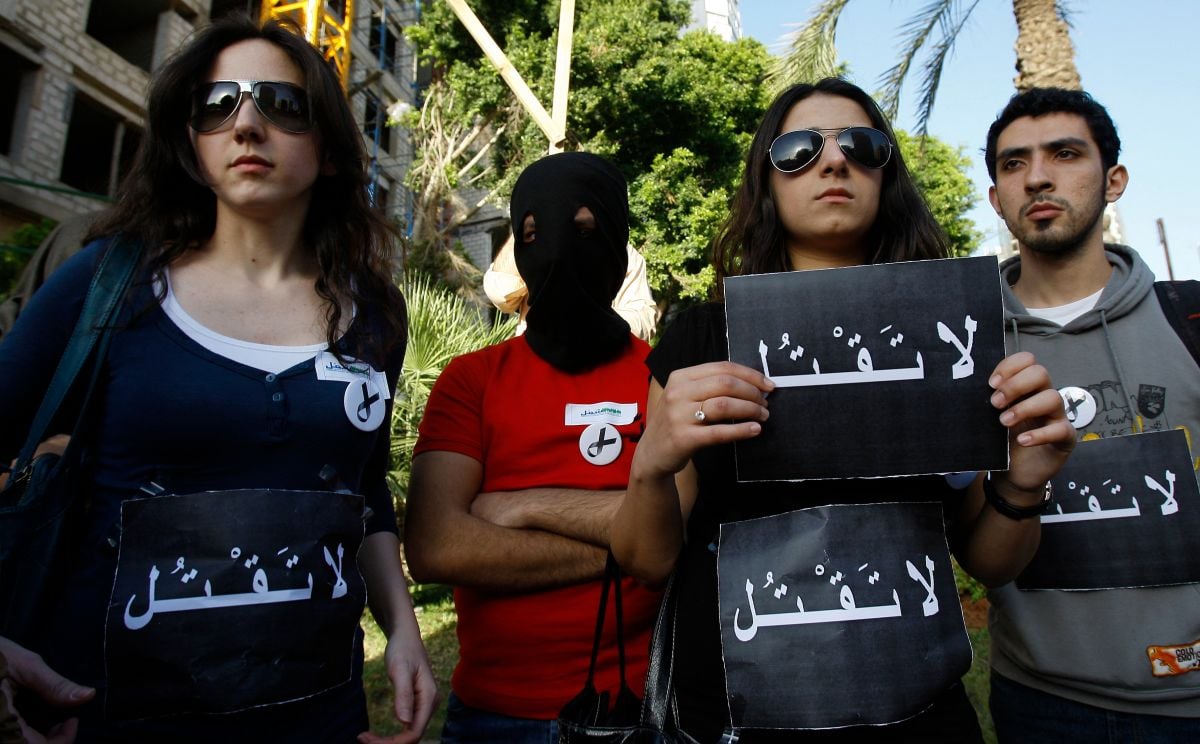
Lebanese human rights activists demonstrate in front of the Saudi Arabian embassy in Beirut on April 1, 2010, to oppose the death penalty, as the Lebanese ambassador to Riyadh stated he had not yet been informed of a Saudi decision to behead a former Lebanese television presenter, Ali Sabat, who was sentenced for witchcraft. (Credit: Anwar Amro/AFP)






BEIRUT — Political figures commented on the abolition of the death penalty in Lebanon, voted on Tuesday by Parliament, with many hailing it as a major step forward in the field of human rights. The death penalty, previously enshrined in law, was abolished after amendments that ended a de facto moratorium in force since January 2004.
From now on, Lebanese courts will no longer be able to issue death sentences. The text states that crimes committed before the entry into force of this law will be punishable by life imprisonment.
“Toward reformative justice, not punitive justice. Congratulations for the adoption yesterday of the abolition of the death penalty … and let’s hope the general amnesty law will be approved today,” Prime Minister Nawaf Salam wrote on X. Meeting on Wednesday to continue working through its agenda, Parliament is expected to vote on the controversial general amnesty law.
Foreign Minister Joe Rajji expressed his gratitude to “all his counterparts and friends from around the world who congratulated Lebanon for abolishing the death penalty.” “This historic decision confirms Lebanon’s history and the message our country has always carried: life prevails, dignity is inviolable, and freedom, pluralism and human rights are at the heart of our identity. It is also the reflection of the Lebanon that we are determined to rebuild: a strong state, based on rights, governed by the rule of law and worthy of its people,” the head of Lebanese diplomacy wrote on X.
Samy Gemayel, leader of the Kataeb party, welcomed Parliament’s decision to abolish the death penalty, calling it “an important step toward strengthening human rights, preserving human dignity and defending the right to life.”

Former Justice Minister Ibrahim Najjar welcomed the adoption of the law abolishing the death penalty, saying that “Lebanon is joining the global movement to abolish this penalty, in keeping with its commitment to human rights, and is taking a historic step by becoming the first country in the Arab world and the Middle East to abolish capital punishment.” Abolishing this penalty “is the culmination of many years of work and advocacy by prominent figures from various Lebanese communities,” he added.
Najjar recalled the bill he presented in 2008, when he was Justice Minister, proposing to abolish the death penalty and replace it with life imprisonment with hard labor. At that time, he refused to sign 19 execution orders.

In a statement, MP Melhem Khalaf called the abolition of the death penalty a “historic legislative milestone and a sign of hope amid the hardships faced by Lebanon and the Lebanese people.” “In a nation exhausted by crises, wars and divisions, this law affirms that Lebanon, despite its burdens and wounds, remains capable of expressing civilized and humane convictions,” he said.
“This is a historic step that confirms our society’s unwavering commitment to justice, dignity and human rights, and that Lebanon is capable, even in the darkest times, of sending a message of hope and defending life. Beirut, the city of law, reaffirms its adherence to its heritage and mission, and stands as a champion of justice, dignity and the human right to life,” added Khalaf, MP for Beirut and representative of the Protest movement.

 7 p.m. recap: 1 person killed near border with Lebanon; 200 kilos of explosives carried by mules; Riyadh shuts its airspace