







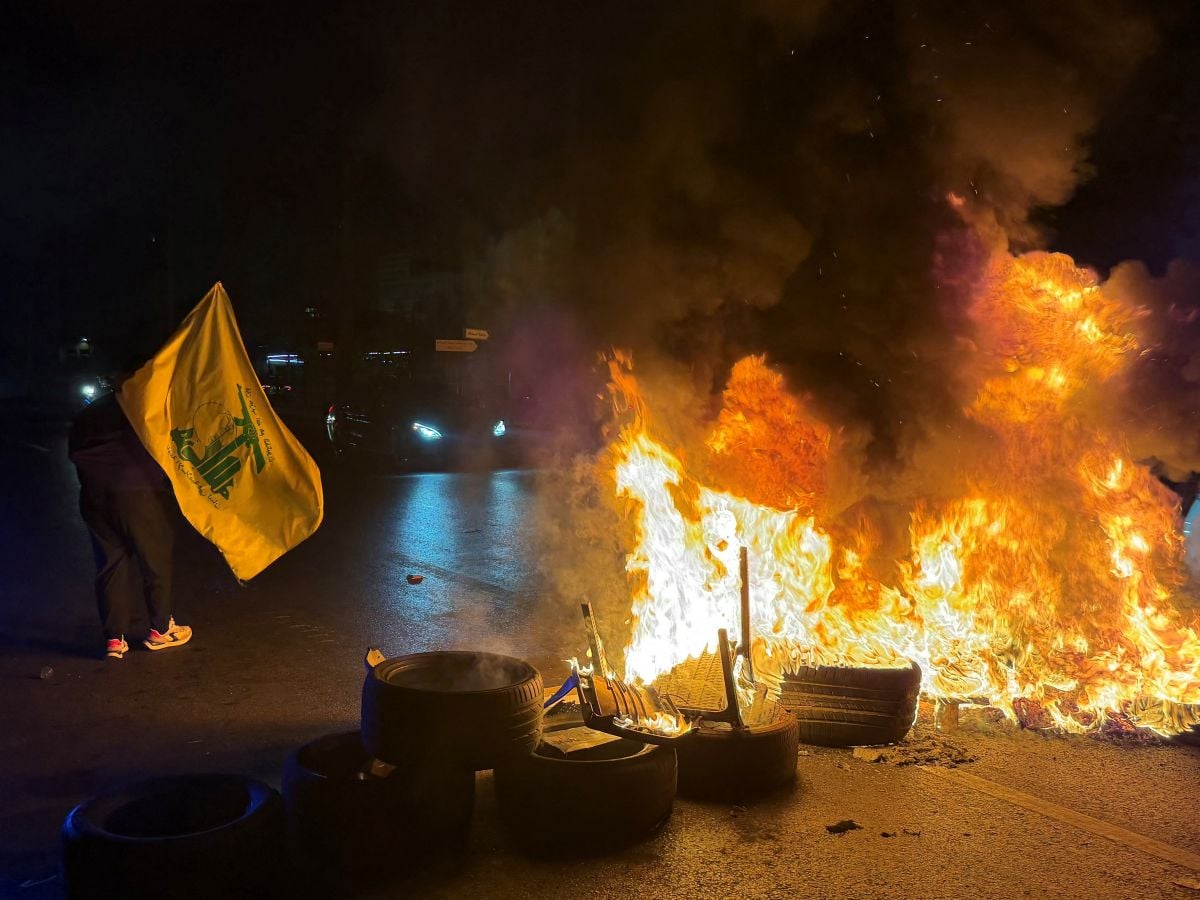
Hezbollah supporters blocking the old Beirut airport road with burning tires in the southern suburb on June 27, 2026. (Credit: Ibrahim Amro/AFP)






The vice president of Hezbollah’s political bureau, Mahmoud Qomati, on Monday described as “stillborn” the framework agreement reached Friday between Lebanon and Israel, arguing that it did “not deserve” for the party’s supporters to take to the streets to signal their rejection of the deal.
Following the categorical rejection of the framework agreement reached Friday between Lebanon and Israel, senior officials from the Amal-Hezbollah alliance have multiplied their public statements denouncing the deal and the direct negotiations that led to its adoption.
Protests were launched Friday night and Saturday in several areas across the country, notably in the Beirut's southern suburbs and near the Grand Serail, the seat of government. However, they remained limited and were quickly dispersed by the Lebanese Army.
According to the Hezbollah official, who has regularly launched scathing attacks and threats against the authorities in recent months, the movement does “not in any case wish to create problems inside Lebanon.”
In an interview with the pan-Arab media outlet The New Arab, Qomati further stated that the deal was “doomed to fail,” assuring that Hezbollah “will not allow its implementation.” He added that the party would oppose it “by all possible means and methods.” The Hezbollah official also indicated that the party does not intend, “in the near future,” for its two ministers in Nawaf Salam’s government to resign.
According to him, this decision is aimed at preserving “a thin thread” of communication and at showing that Hezbollah “does not want a break or total separation.”
“We are still giving them a chance and trying to make them correct their mistake. If necessary, it will be possible to adjust course and work together to protect the country. If they persist on this path, as seems to be the case, and if they want to lead the country toward discord, destruction, and instability, we know how to respond,” he said, without further details.
“We will not take any initiative that could jeopardize the stability of the country. The priority remains the Israeli enemy and the ongoing aggression against Lebanon,” he added. He accused some parties of seeking to “downplay the role of the resistance” and asserted that Hezbollah would not fall “into the trap” of being accused of using its weapons on the domestic scene.
Emphasizing the Iran-U.S. protocol of agreement, signed June 17 to end the war in the Middle East — including in Lebanon — Qomati also stated that Hezbollah continues to rely on it, adding that Tehran holds “leverage” over Washington, which could in turn put pressure on Israel to obtain its withdrawal from Lebanon.
Asked about the “pilot zones” project, under which the Israeli army would agree to withdraw permanently from certain sectors if it deemed that the Lebanese Army, rather than Hezbollah, had been effectively deployed there, the senior official of the pro-Iranian group insisted the Israeli withdrawal must be “total, with no conditions or coordination,” before the Lebanese Army enters — an army with which “Hezbollah continues to cooperate.”