


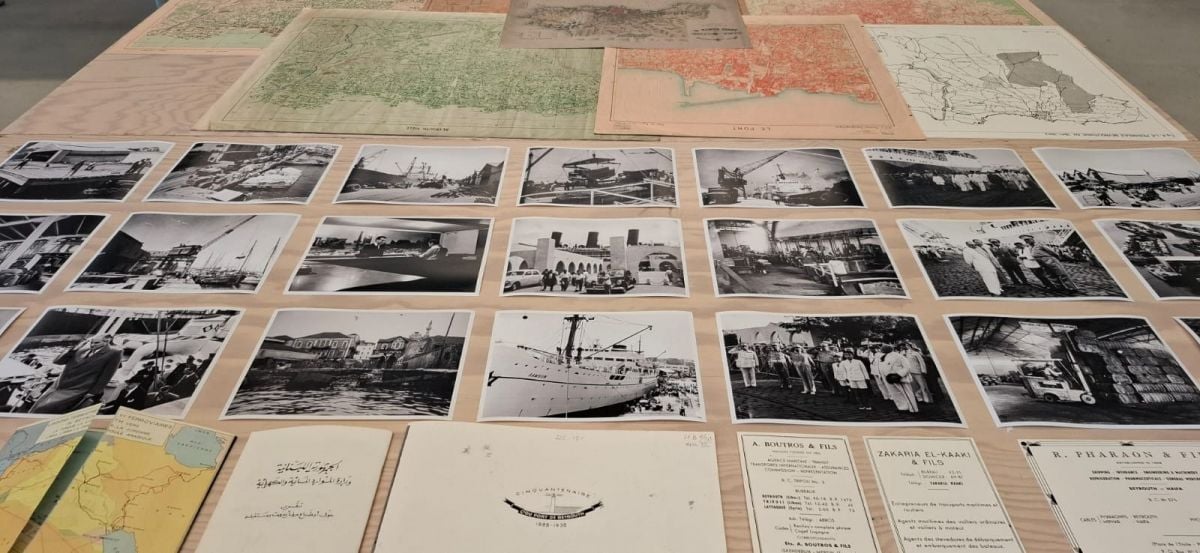
The exhibition "Beirut al-Marfa’" by the Urban Observatory of Beit Beirut and supported by IFPO, was presented in Marseille on June 24 and 25. (Credit: Emmanuel Khoury/L'Orient-Le Jour)






Despite the stifling heat of yet another French heatwave, on June 24 — the hottest day ever recorded in France — a small crowd gathered at the Mediterranean Institute of City and Territories (IMVT) in Marseille to discover the "Beirut al-Marfa" exhibition. Created at the Beit Beirut Urban Observatory in November 2025 and supported by the French Institute of the Near East (IFPO), the exhibition is part of the event "Inhabit, tell, share ... the Mediterranean," an initiative by the School for Advanced Studies in the Social Sciences (EHESS). It traces the port’s history from the creation of the Karantina district by Ibrahim Pasha in 1834 up to August 4, 2020, when 2,700 tons of ammonium nitrate — stored for seven years on one of the docks — exploded, causing one of the largest non-nuclear explosions in history with more...
Despite the stifling heat of yet another French heatwave, on June 24 — the hottest day ever recorded in France — a small crowd gathered at the Mediterranean Institute of City and Territories (IMVT) in Marseille to discover the "Beirut al-Marfa" exhibition. Created at the Beit Beirut Urban Observatory in November 2025 and supported by the French Institute of the Near East (IFPO), the exhibition is part of the event "Inhabit, tell, share ... the Mediterranean," an initiative by the School for Advanced Studies in the Social Sciences (EHESS). It traces the port’s history from the creation of the Karantina district by Ibrahim Pasha in 1834 up to August 4, 2020, when 2,700 tons of ammonium nitrate — stored for seven years on one of the docks — exploded, causing one of the largest non-nuclear explosions in history...
