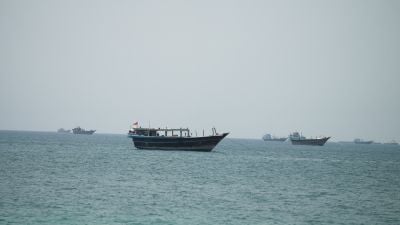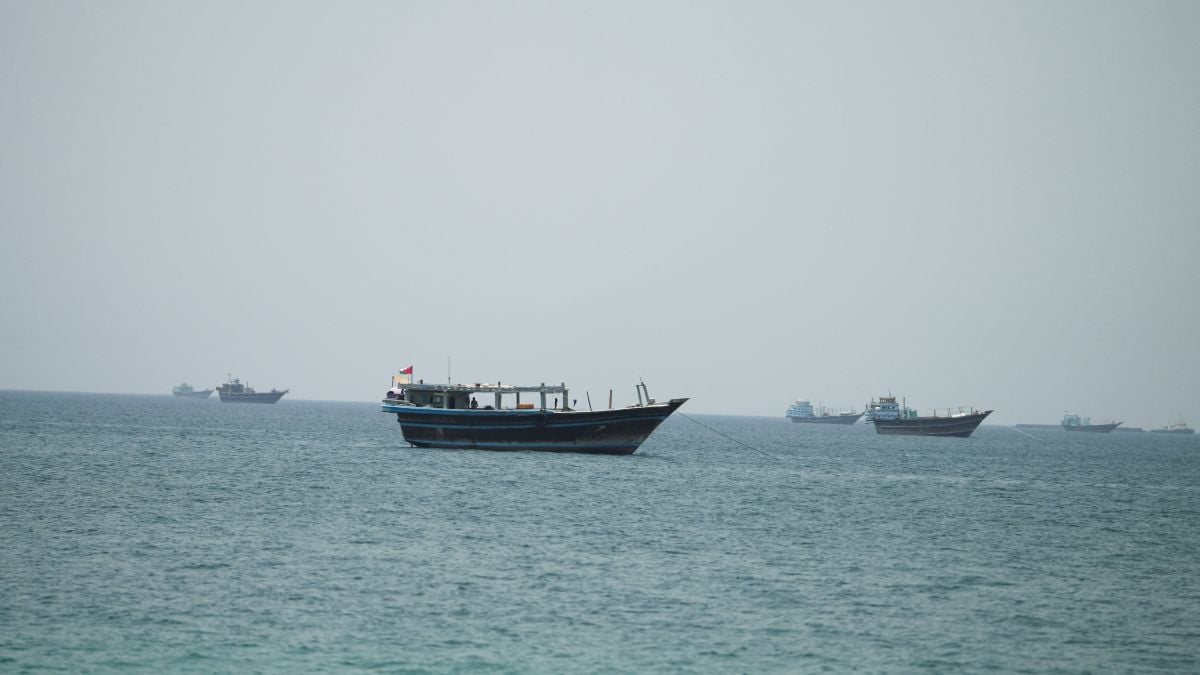
Vessels at the Strait of Hormuz, as seen from Musandam, Oman, June 22, 2026. (Credit: Reuters)




BEIRUT — Maritime traffic in the Strait of Hormuz reached a record high on Monday since the start of the war in the Middle East, according to maritime tracking platforms data cross-checked Tuesday by AFP.
A week after a memorandum of understanding was reached between the United States and Iran, the Kpler platform recorded 37 crossings by raw materials transport vessels on Monday, while navigation data provider AXSMarine detected 42, including container ships.
Both counts represent records, and these totals are likely to increase further, as platforms often detect additional crossings retrospectively, particularly through satellite imagery.
By cross-referencing these two lists, AFP counted 51 different ships that transited the strait on Monday.
This represents 42.5% of normal traffic in peacetime (about 120 per day) via this strategic route for global trade, through which a fifth of the world’s hydrocarbon exports and other essential raw materials ordinarily circulate.
During the war, from March 1 to June 14, fewer than 10 raw material ships on average crossed the strait each day, according to Kpler. Since June 15, the day after the agreement was announced, the average has risen to 21, and nearly 28 over the past five days.
But the path toward normalized traffic remains long, according to Deepak Maurya, analyst at HSBC, who listed “a lasting settlement” of the conflict, the “removal of mines” in the strait, and “a reduction in insurance costs” as necessary conditions.
Among the vessels that crossed the strait on Monday, according to Kpler, were five LNG tankers, whose owners had previously been very cautious. The presence of LNG carriers “could be one of the clearest signs yet of the beginning of traffic normalization,” Mihail Todorov of AXSMarine told AFP.
'Iran will administer' the strait
The Strait of Hormuz reopened last week, following an agreement between Iran and the United States meant to end the war in the Middle East, but Tehran announced Saturday the closure of the strait in response to Israeli attacks in Lebanon. Since then, Tehran and Washington have agreed on mechanisms to halt the fighting in Lebanon and to secure the Strait of Hormuz.
The administration of the strait “will never be what it was before the war,” Mohammad Bagher Ghalibaf, Iran’s representative in negotiations with the United States, assured Tuesday, according to remarks reported by official agency Irna. “Iran will administer” the strait, he insisted.
His negotiating team is currently in Oman, where the two countries will, according to a joint statement, discuss the “costs” of services associated with the future administration of the Strait of Hormuz, stressing “their sovereignty over their territorial waters” at this strategic passage.
Meanwhile, the Iranian fleet of so-called ghost oil tankers, under international sanctions and especially targeted by the U.S. Navy before the agreement, can once again sail freely, as Washington has authorized “until August 21 … all transactions” related to the production, sale, and transport of Iranian-origin hydrocarbons.
President Donald Trump, however, warned on his Truth Social network that the U.S. Navy remains stationed in the region “in case there is a need to reinstate a blockade,” though he said, “at this stage, that seems very unlikely.”