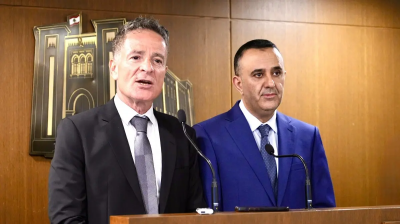


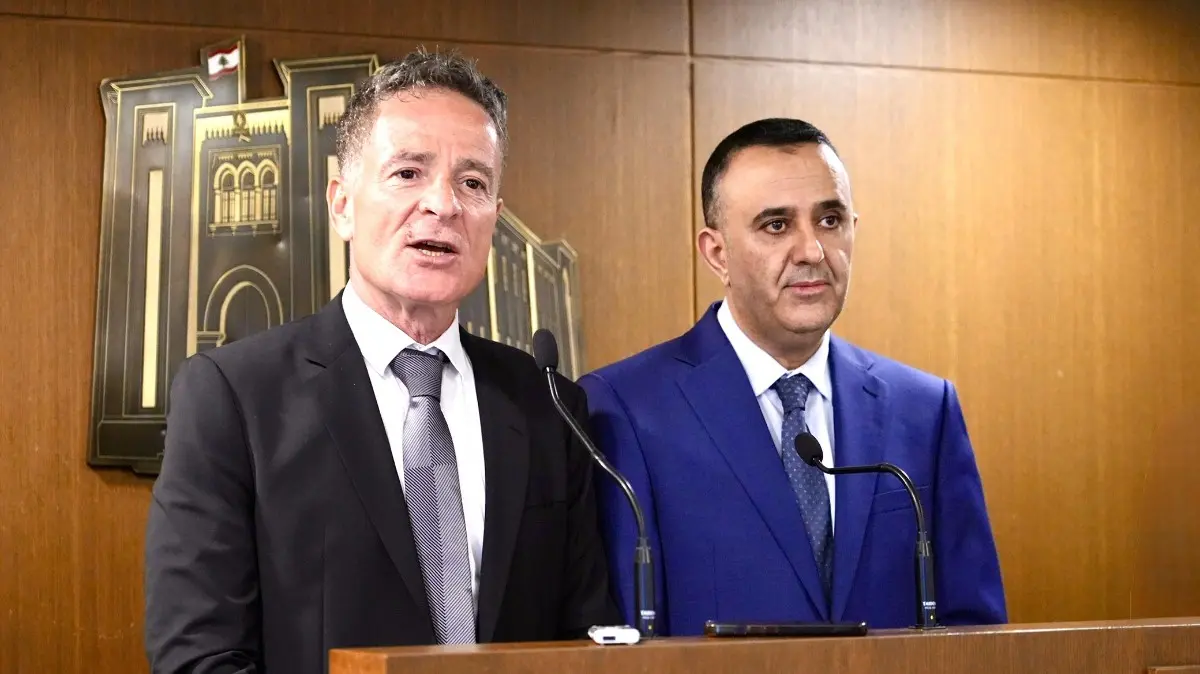
MP Elias Jradeh (L) and MP Ashraf Baydoun (R), during a press conference at Parliament, on June 23, 2026. (Photo: NNA)




BEIRUT — The "parliamentary commission for the protection of civilian property and the prevention of systematic destruction," comprised of MPs Fady Alameh, Ashraf Baydoun (Amal), and MP Elias Jradeh (opposition, who has recently become closer to Hezbollah), announced the creation of a U.N. team tasked with organizing meetings and field visits to document the "systematic destruction in South Lebanon since 2023."
The work of this team, formed on June 15 at the request of the United Nations High Commissioner for Human Rights, is expected to last four months, according to MP Baydoun, who spoke during a press conference held Tuesday in Parliament. The MPs had submitted a petition last week to the regional office of the UN Human Rights Office at ESCWA, before obtaining the creation of this team, Baydoun also revealed.
Jradeh, for his part, denounced the Israeli destruction carried out in Lebanon, "which are contrary to all norms, even the laws of war." "This is an attack on humanity, a systematic destruction, and an assault on all the foundations of humanity," he added. "Therefore, we have asked the Human Rights Commission and its president to establish a special and independent investigative commission in order to monitor these events and take all legal measures," the MP emphasized.
According to a new report published by the United Nations Development Program (UNDP), in coordination with the Lebanese National Council for Scientific Research (CNRS-L), Israel has completely destroyed more than 11,000 buildings in southern Lebanon since the start of the re-escalation of its war on Lebanon on March 2.
The report also estimates the value of direct damage to buildings in southern Lebanon at $1.38 billion, with a volume of rubble of approximately 3.1 million cubic meters, as of April 29, 2026.
This rapid assessment covers areas south of the Litani River, notably the districts of Bint Jbeil, Marjayoun, Nabatieh, Sour, and Saida, and follows on from a previous report on Beirut and Mount Lebanon, the UNDP states in its report.
A total of 11,095 buildings were completely destroyed, affecting 17,891 dwellings; 2,242 buildings sustained partial damage, affecting 5,219 dwellings; and 9,311 buildings sustained minor damage, affecting 18,282 dwellings.